In this comprehensive guide, we compare Chatling and SimplyRetrieve across various parameters including features, pricing, performance, and customer support to help you make the best decision for your business needs.
Overview
When choosing between Chatling and SimplyRetrieve, understanding their unique strengths and architectural differences is crucial for making an informed decision. Both platforms serve the RAG (Retrieval-Augmented Generation) space but cater to different use cases and organizational needs.
Quick Decision Guide
Choose Chatling if: you value broadest ai model selection (32 models) among no-code platforms - includes gpt-5, claude 4.5, gemini 2.5 with per-block flexibility
Choose SimplyRetrieve if: you value completely free and open source
About Chatling
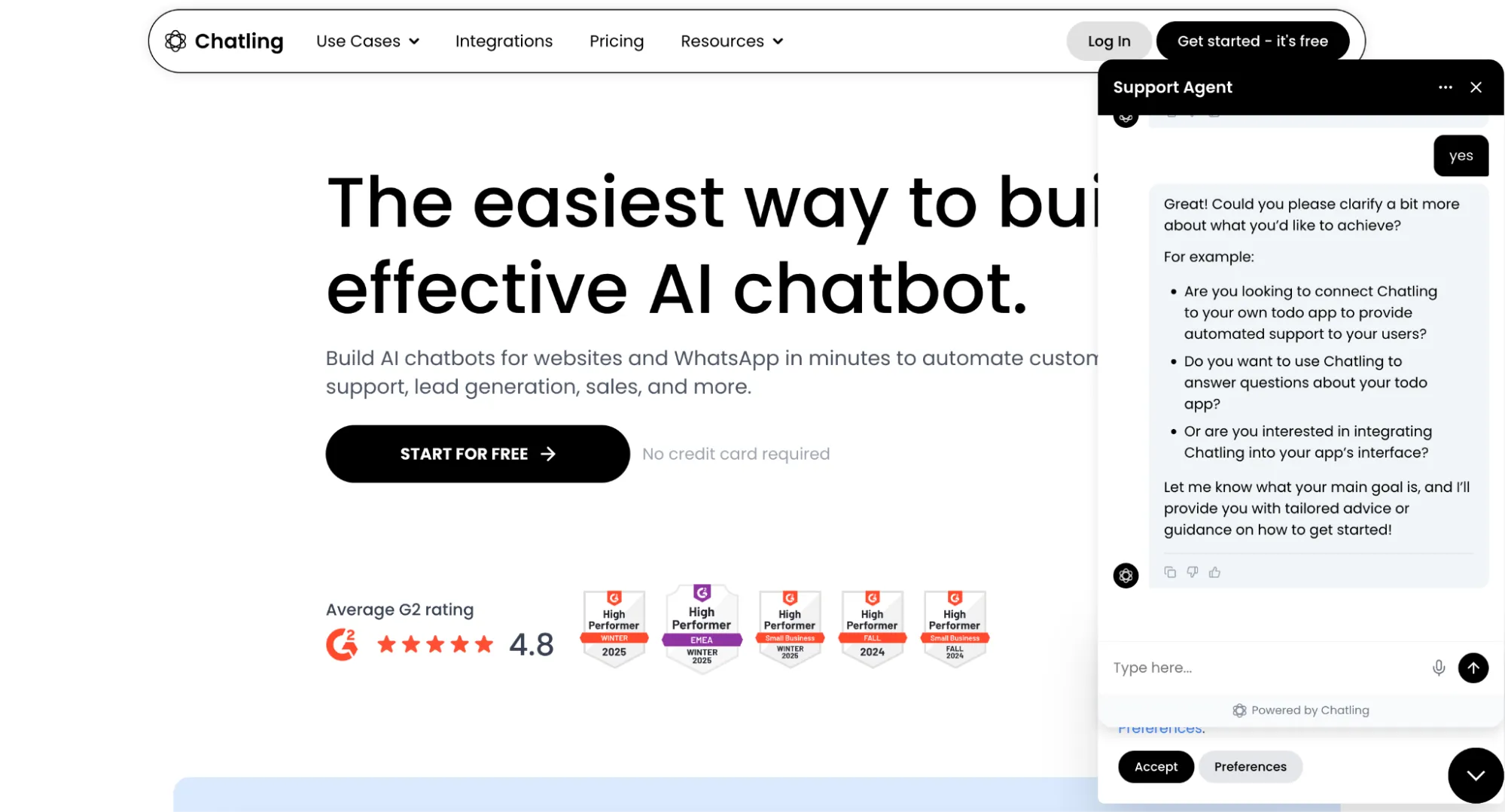
Chatling is no-code ai chatbot platform with 32-model llm selection. No-code AI chatbot platform with 32-model LLM selection and SMB-focused pricing starting at $25/month. Developed by Envision Labs Inc. (Ontario, Canada), Chatling balances visual builder simplicity with REST API v2 access and native WhatsApp integration. 4.8/5 G2 rating (53-63 reviews). Critical gaps: NO SOC 2/HIPAA certifications, NO native human handoff, NO official SDKs, NO source citations. Founded in Year not disclosed, headquartered in Ontario, Canada, the platform has established itself as a reliable solution in the RAG space.
Overall Rating
85/100
Starting Price
$25/mo
About SimplyRetrieve
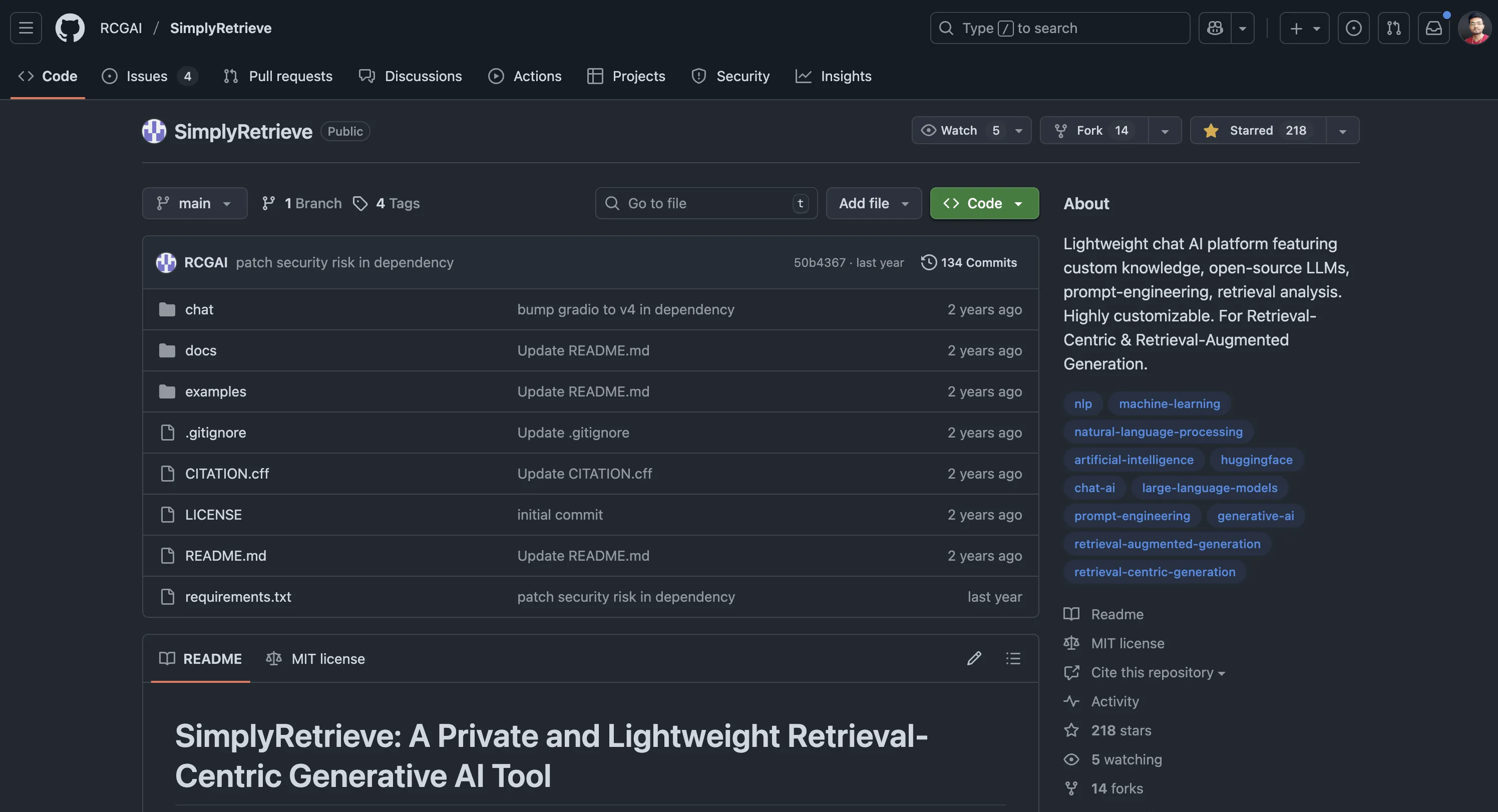
SimplyRetrieve is lightweight retrieval-centric generative ai platform. SimplyRetrieve is an open-source tool providing a fully localized, lightweight, and user-friendly GUI and API platform for Retrieval-Centric Generation (RCG). It emphasizes privacy and can run on a single GPU while maintaining clear separation between LLM context interpretation and knowledge memorization. Founded in 2019, headquartered in Tokyo, Japan, the platform has established itself as a reliable solution in the RAG space.
Overall Rating
82/100
Starting Price
Custom
Key Differences at a Glance
In terms of user ratings, both platforms score similarly in overall satisfaction. From a cost perspective, SimplyRetrieve offers more competitive entry pricing. The platforms also differ in their primary focus: Chatbot Platform versus RAG Platform. These differences make each platform better suited for specific use cases and organizational requirements.
⚠️ What This Comparison Covers
We'll analyze features, pricing, performance benchmarks, security compliance, integration capabilities, and real-world use cases to help you determine which platform best fits your organization's needs. All data is independently verified from official documentation and third-party review platforms.
Detailed Feature Comparison
Chatling
SimplyRetrieve
CustomGPTRECOMMENDED
Data Ingestion & Knowledge Sources
File Formats: PDF, DOCX, plain text ONLY
CRITICAL LIMITATION: NO CSV, Excel, or structured data format support
Website Crawler: Up to 1,000 pages per domain with automatic content extraction
Sitemap Ingestion: Required for sites larger than 1,000 pages
Help Desk Integration: Zendesk and Zoho for importing help articles
Manual Upload: Files, text snippets, FAQs via dashboard interface
NO Cloud Storage: Google Drive, Dropbox, Notion, OneDrive require manual downloads before upload - significant workflow friction
NO YouTube Transcripts: Video content ingestion not supported
Automatic Syncing: Daily, weekly, or monthly schedules on paid plans - NO real-time continuous sync
API Resync: /resync endpoint for programmatic knowledge base updates
Uses a hands-on, file-based flow: drop PDFs, text, DOCX, PPTX, HTML, etc. into a folder and run a script to embed them.
A new GUI Knowledge-Base editor lets you add docs on the fly, but there’s no web crawler or auto-refresh yet.
Lets you ingest more than 1,400 file formats—PDF, DOCX, TXT, Markdown, HTML, and many more—via simple drag-and-drop or API.
Crawls entire sites through sitemaps and URLs, automatically indexing public help-desk articles, FAQs, and docs.
Turns multimedia into text on the fly: YouTube videos, podcasts, and other media are auto-transcribed with built-in OCR and speech-to-text.
View Transcription Guide
Connects to Google Drive, SharePoint, Notion, Confluence, HubSpot, and more through API connectors or Zapier.
See Zapier Connectors
Supports both manual uploads and auto-sync retraining, so your knowledge base always stays up to date.
Integrations & Channels
WhatsApp Business API: Native robust integration with full chatbot functionality, media sharing, automated responses
Website Embedding: Floating chat bubble (bottom-left/right), inline iframe, full-page deployment with custom domain support
Zapier Integration: 7,000+ apps with triggers (new contacts/conversations) and actions (send messages)
AI Intents: Train on example phrases for intent recognition without exact keyword matching
Visual Flow Builder: No-code interface with drag-and-drop conversation design
HTTP Request Blocks: Real-time API integrations within chatbot flows (e.g., order confirmations, CRM lookups)
Lead Capture: Built-in system variables for name, email, phone collection with embedded forms
Multi-language Detection: 85+ languages with automatic browser-based preference detection
Satisfaction Surveys: Helpful/unhelpful tracking at conversation end with analytics integration
CRITICAL LIMITATION: NO native human handoff - fallback collects contact info for follow-up vs live agent transfer
Third-Party Escalation: Requires Zapier integration to Zendesk, Freshdesk, or similar platforms - adds complexity and latency
AI Agents (Beta): Task-oriented assistants with intent detection, decision-making, API execution beyond simple chatbots
Retrieval-Centric Generation (RCG): Research-backed approach separating LLM reasoning capabilities from knowledge memorization—more efficient than traditional RAG architectures
Retrieval Tuning Module: Developer-focused transparency layer showing which documents were retrieved, how queries were constructed, and how answers were generated
Knowledge Base Mixing (MoKB): Route queries across multiple selectable knowledge bases with intelligent source selection and weighting
Explicit Prompt Weighting (EPW): Fine-grained control over retrieved knowledge base influence in final answer generation
Single-Turn Q&A Focus: Primarily designed for single-turn question answering—limited multi-turn conversation and context memory
Analysis Tab Transparency: Visual debugging interface showing document retrieval process and query construction for answer inspection
Local Agent Execution: All agent processing happens on-premises with zero external API calls—complete control over agent behavior and data
LIMITATION - No Chatbot UI: Gradio interface for developers only—no polished conversational interface for end users or production deployment
LIMITATION - No Lead Capture: No built-in lead generation, email collection, or CRM integration capabilities—manual implementation required
LIMITATION - No Human Handoff: No escalation workflows, live agent transfer, or fallback mechanisms for complex queries—developer must build these features
LIMITATION - No Multi-Channel Support: No native integrations with Slack, Teams, WhatsApp, or website widgets—requires custom wrapper development
LIMITATION - No Session Management: Stateless interactions without conversation history tracking or multi-turn context retention
Custom AI Agents: Build autonomous agents powered by GPT-4 and Claude that can perform tasks independently and make real-time decisions based on business knowledge
Decision-Support Capabilities: AI agents analyze proprietary data to provide insights, recommendations, and actionable responses specific to your business domain
Multi-Agent Systems: Deploy multiple specialized AI agents that can collaborate and optimize workflows in areas like customer support, sales, and internal knowledge management
Memory & Context Management: Agents maintain conversation history and persistent context for coherent multi-turn interactions
View Agent Documentation
Tool Integration: Agents can trigger actions, integrate with external APIs via webhooks, and connect to 5,000+ apps through Zapier for automated workflows
Hyper-Accurate Responses: Leverages advanced RAG technology and retrieval mechanisms to deliver context-aware, citation-backed responses grounded in your knowledge base
Continuous Learning: Agents improve over time through automatic re-indexing of knowledge sources and integration of new data without manual retraining
Free Tier Access: 8 models available without payment (GPT-4.1, GPT-4o, GPT-4o Mini, Claude 4 Sonnet, etc.)
Hybrid Deployment Capability: Per-block model selection enables using GPT-4o for complex queries, GPT-4o Mini for simple FAQs within same chatbot
Cost Optimization: Model flexibility allows balancing quality vs credit consumption per conversation stage
Temperature & Token Control: Exposed at both global and per-block levels for fine-tuned model behavior
Competitive Advantage: Exceeds CustomGPT, Drift, Yellow.ai, Lindy.ai in sheer model variety and flexibility
Manual Selection Required: NO automatic routing based on query complexity - users must configure model per use case
Credit System Integration: Different models consume different credit amounts - documented per model for budgeting
N/A
N/A
Whats App Native Integration ( Differentiator)
WhatsApp Business API: Native robust integration vs third-party workarounds required by many competitors
Full Chatbot Functionality: All chatbot features work on WhatsApp including AI responses, knowledge base queries, lead capture
Media Sharing: Images, documents, voice messages supported in WhatsApp conversations
Automated Responses: 24/7 WhatsApp availability with AI-powered replies
Consumer-Facing Strength: Strong for e-commerce, SMBs, global markets where WhatsApp dominates customer communication
Competitive Gap: Progress, CustomGPT, many RAG platforms lack native WhatsApp - Chatling advantage for consumer use cases
B2B Messaging Gap: WhatsApp strength doesn't offset missing Slack/Teams integrations for enterprise internal use
N/A
N/A
Multi- Lingual Support
85+ Languages Supported: Broad coverage for global deployments
Automatic Browser-Based Detection: Chatbot detects user language preference from browser settings and responds accordingly
NO Manual Configuration Required: Language switching happens automatically without admin setup
Interface Language: Configurable for chatbot UI elements (buttons, prompts, system messages)
Multi-Language Model Support: All 32 AI models support multilingual conversations
Knowledge Base Processing: Supports multi-language content ingestion and retrieval
Global Customer Base: Valuable for international businesses serving diverse markets without language barriers
N/A
N/A
R A G-as-a- Service Assessment
Platform Type: NO-CODE CHATBOT PLATFORM with RAG capabilities - NOT pure RAG-as-a-Service like CustomGPT or Progress
RAG Implementation: Knowledge base grounding embedded within visual chatbot builder vs API-first RAG backend
Developer Access: REST API v2 provides programmatic knowledge base queries (/ai/kb/chat endpoint) but NO official SDKs
Transparency Limitation: NO source citations displayed to end users - responses don't show which documents informed answers
NO Confidence Scoring: Hallucination detection mechanisms not documented - only temperature control
Target Market: SMBs and non-technical teams prioritizing rapid chatbot deployment vs developers needing deep RAG customization
Comparison Validity: Architectural comparison to CustomGPT.ai is partially valid - both offer RAG but Chatling emphasizes no-code chatbot vs developer-first RAG API
Use Case Fit: Organizations prioritizing customer-facing chatbots with simple knowledge retrieval over complex RAG pipelines, embeddings control, or advanced retrieval strategies
Platform Type: NOT A RAG-AS-A-SERVICE PLATFORM - Open-source academic research project for local Retrieval-Centric Generation experimentation and learning
Core Mission: Provide localized, lightweight, user-friendly interface to Retrieval-Centric Generation (RCG) approach for machine learning community exploration and research
Academic Foundation: Published research tool from RCGAI with arXiv paper (2308.03983) explaining RCG methodology and architectural design decisions
Target Market: Researchers, developers, and organizations experimenting with RAG locally without cloud dependencies—NOT commercial service users
Self-Hosted Infrastructure: MIT-licensed tool requiring user-managed GPU hardware or cloud compute—no managed infrastructure, APIs, or service-level agreements
Developer-First Design: Python-based with Gradio GUI and script execution—intended for technical users comfortable with GPU infrastructure and model management
RAG Implementation: Retrieval-Centric Generation (RCG) philosophy emphasizing retrieval over memorization—FAISS vector search with open-source LLMs (WizardVicuna-13B default, any Hugging Face model supported)
API Availability: NO formal REST API or SDKs—interaction via Python scripts and local Gradio interface requiring subprocess calls or custom wrappers
Data Privacy Advantage: 100% local execution with zero external transmission—ideal for classified, PHI, PII, or confidential data requiring air-gapped processing
Pricing Model: Completely free (MIT license) with no subscription fees—only cost is GPU hardware or cloud compute infrastructure
Support Model: Community-driven GitHub Issues and lightweight documentation—no paid support, SLAs, or customer success teams
LIMITATION vs Managed Services: NO managed infrastructure, automatic scaling, production-grade monitoring, enterprise security controls, or commercial support—users responsible for all operational aspects
LIMITATION - No Service Features: NO authentication systems, multi-tenancy, user management, analytics dashboards, or SaaS conveniences—pure research/development tool
Comparison Validity: Architectural comparison to commercial RAG-as-a-Service platforms like CustomGPT.ai is MISLEADING—SimplyRetrieve is open-source research tool for on-premises experimentation, not production service
Use Case Fit: Perfect for offline/air-gapped RAG research, developers learning RAG internals with full transparency, organizations with strict data isolation requirements (defense, healthcare PHI compliance), and teams wanting zero cloud costs with existing GPU infrastructure
Core Architecture: Serverless RAG infrastructure with automatic embedding generation, vector search optimization, and LLM orchestration fully managed behind API endpoints
API-First Design: Comprehensive REST API with well-documented endpoints for creating agents, managing projects, ingesting data (1,400+ formats), and querying chat
API Documentation
Developer Experience: Open-source Python SDK (customgpt-client), Postman collections, OpenAI API endpoint compatibility, and extensive cookbooks for rapid integration
No-Code Alternative: Wizard-style web dashboard enables non-developers to upload content, brand widgets, and deploy chatbots without touching code
Hybrid Target Market: Serves both developer teams wanting robust APIs AND business users seeking no-code RAG deployment - unique positioning vs pure API platforms (Cohere) or pure no-code tools (Jotform)
RAG Technology Leadership: Industry-leading answer accuracy (median 5/5 benchmarked), 1,400+ file format support with auto-transcription, proprietary anti-hallucination mechanisms, and citation-backed responses
Benchmark Details
Deployment Flexibility: Cloud-hosted SaaS with auto-scaling, API integrations, embedded chat widgets, ChatGPT Plugin support, and hosted MCP Server for Claude/Cursor/ChatGPT
Enterprise Readiness: SOC 2 Type II + GDPR compliance, full white-labeling, domain allowlisting, RBAC with 2FA/SSO, and flat-rate pricing without per-query charges
Use Case Fit: Ideal for organizations needing both rapid no-code deployment AND robust API capabilities, teams handling diverse content types (1,400+ formats, multimedia transcription), and businesses requiring production-ready RAG without building ML infrastructure from scratch
Competitive Positioning: Bridges the gap between developer-first platforms (Cohere, Deepset) requiring heavy coding and no-code chatbot builders (Jotform, Kommunicate) lacking API depth - offers best of both worlds
Competitive Positioning
Market Position: SMB-focused no-code chatbot platform with strongest appeal to non-technical teams and budget-conscious startups
32-Model Differentiator: Broadest LLM selection among no-code platforms - exceeds competitors in model flexibility
Free Tier Generosity: 100 AI credits, 2 chatbots, 8 models without credit card - strongest trial experience for evaluation
WhatsApp Strength: Native integration vs third-party workarounds - competitive advantage for consumer-facing businesses
G2 Validation: 4.8/5 rating from 53-63 reviews with reliability praised ("chatbots have never gone down")
vs. CustomGPT: Chatling offers no-code simplicity + WhatsApp vs CustomGPT developer-first RAG with deeper API/SDK access
vs. Progress: Chatling $25/month + visual builder vs Progress $700/month + REMi quality monitoring + enterprise compliance
vs. Drift: Chatling customer support automation vs Drift B2B sales engagement - different use case focus
vs. Lindy.ai: Chatling has REST API v2 vs Lindy NO public API - developer accessibility advantage
Enterprise Gaps: NO SOC 2/HIPAA/ISO 27001, NO SSO, NO human handoff - disqualifies for regulated industries and large enterprises
B2B Messaging Gaps: NO native Slack/Teams/Telegram - limits enterprise internal use cases vs omnichannel competitors
Developer Limitations: NO official SDKs, NO source citations, NO confidence scoring - gaps vs developer-focused RAG platforms
Market Presence: Absent from Product Hunt, AppSumo vs competitors - limited growth marketing exposure
Market position: MIT-licensed open-source local RAG solution running entirely on-premises with open-source LLMs (no cloud dependency), designed for developers and tinkerers
Target customers: Developers experimenting with RAG locally, organizations with strict data isolation requirements (healthcare, government, defense), and teams wanting complete control without cloud costs or vendor dependencies
Key competitors: LangChain/LlamaIndex (frameworks), PrivateGPT, LocalGPT, and cloud RAG platforms for teams needing simplicity
Competitive advantages: Completely free and open-source (MIT license) with no fees or subscriptions, 100% local execution keeping all data on-premises, full control over model choice (any Hugging Face model), Python-based with full source code access for customization, "Retrieval Tuning Module" for transparency into answer generation, and zero external dependencies beyond local compute
Pricing advantage: Completely free with MIT license; only cost is GPU hardware or cloud compute; best value for teams with existing GPU infrastructure wanting to avoid subscription costs; requires technical expertise and hands-on maintenance
Use case fit: Ideal for offline/air-gapped environments requiring complete data isolation (defense, healthcare with strict PHI requirements), developers learning RAG internals and experimenting locally, and organizations with GPU infrastructure wanting zero cloud costs and complete control over LLM stack without vendor dependencies
Market position: Leading all-in-one RAG platform balancing enterprise-grade accuracy with developer-friendly APIs and no-code usability for rapid deployment
Target customers: Mid-market to enterprise organizations needing production-ready AI assistants, development teams wanting robust APIs without building RAG infrastructure, and businesses requiring 1,400+ file format support with auto-transcription (YouTube, podcasts)
Key competitors: OpenAI Assistants API, Botsonic, Chatbase.co, Azure AI, and custom RAG implementations using LangChain
Competitive advantages: Industry-leading answer accuracy (median 5/5 benchmarked), 1,400+ file format support with auto-transcription, SOC 2 Type II + GDPR compliance, full white-labeling included, OpenAI API endpoint compatibility, hosted MCP Server support (Claude, Cursor, ChatGPT), generous data limits (60M words Standard, 300M Premium), and flat monthly pricing without per-query charges
Pricing advantage: Transparent flat-rate pricing at $99/month (Standard) and $449/month (Premium) with generous included limits; no hidden costs for API access, branding removal, or basic features; best value for teams needing both no-code dashboard and developer APIs in one platform
Use case fit: Ideal for businesses needing both rapid no-code deployment and robust API capabilities, organizations handling diverse content types (1,400+ formats, multimedia transcription), teams requiring white-label chatbots with source citations for customer-facing or internal knowledge projects, and companies wanting all-in-one RAG without managing ML infrastructure
Deployment & Infrastructure
Cloud-Only SaaS: NO on-premise or hybrid deployment options - cloud-only hosted on DigitalOcean
Data Center: Amsterdam (DigitalOcean) for GDPR compliance with EU data residency
Website Embedding: Three modes - floating chat bubble (customizable position), inline iframe for page sections, full-page deployment
Custom Domain Support: Branded chatbot URLs available for white-labeled deployments
Domain Whitelisting: Security control limiting widget embedding to authorized domains
Mobile Deployment: NO native SDKs - app integration requires webview embedding
NO Multi-Region: Single data center (Amsterdam) - no US, Asia-Pacific, or other regional options documented
NO On-Premise: Cannot deploy on private infrastructure or air-gapped environments
N/A
N/A
Customer Feedback & Case Studies
G2 Rating: 4.8/5 from 53-63 reviews with strong reliability scores
Trustpilot Rating: 4.3/5 from 8 reviews
Support Quality (G2): 9.2/10 despite email-only channel and response time concerns
Setup Time Praise: "5-minute setup" consistently highlighted by users as genuine rapid deployment
Reliability Testimonial: "Chatbots have never gone down" - uptime performance praised
Support Deflection: One user reported 45% of support questions resolved, reducing email inquiries from 1,500+ monthly
Large-Scale Deployment: User uploaded 4,000+ website URLs with "reliable answers in real time"
Fine-Tuning from Traffic: "Game changer" - ability to improve from live conversation data
Recurring Criticism: Single flow architecture unwieldy for complex bots, NO import/export flows, NO screen reader accessibility, email support can be slow
NO Named Enterprise Customers: Public case studies limited to G2/Trustpilot testimonials vs named Fortune 500 deployments
N/A
N/A
A I Models
Free Tier (8 Models): GPT-4.1, GPT-4o, GPT-4o Mini, GPT-4, Claude 4 Sonnet, Claude 3.5 Haiku without payment
Paid Tiers (32 Total): GPT-5, GPT-5 Mini, GPT-5 Nano, GPT-4.5, o4 Mini, o3 Mini, Claude 4.5 Sonnet, Claude 4.5 Haiku, Claude 4 Opus, Claude 3.7 Sonnet, Gemini 2.5 Flash, Gemini 2.5 Pro, Gemini 2.0 Flash - broadest selection among no-code platforms
Model Flexibility: Configure globally per chatbot OR per individual AI response block for hybrid deployments optimizing cost-quality balance
Temperature & Max Tokens: Exposed at both global and per-block levels for fine-tuned control over creativity and verbosity
Manual Selection Only: No query complexity-based automatic model routing - users manually configure model per use case
Credit Consumption: 1 credit per AI response on GPT-4o, consumption varies by model with monthly reset (no carryover)
Competitive Advantage: 32-model roster exceeds most no-code platforms (Botsonic, Chatbase, SiteGPT) in LLM flexibility
Hugging Face Compatibility: Swap in any Hugging Face model with sufficient GPU resources (Llama 2, Falcon, Mistral, etc.)
Full Local Control: Models run entirely on-premises with no external API calls or cloud dependencies
Embedding Model: Default multilingual-e5-base for retrieval with option to swap for other embedding models
Model Customization: Fine-tune or quantize models for specific use cases and hardware constraints
No Vendor Lock-In: Complete flexibility to use any open-source LLM without subscription fees or API limits
GPU Requirements: Smaller models may not match GPT-4 depth but enable complete data isolation and zero operational costs
Primary models: GPT-4, GPT-3.5 Turbo from OpenAI, and Anthropic's Claude for enterprise needs
Automatic model selection: Balances cost and performance by automatically selecting the appropriate model for each request
Model Selection Details
Proprietary optimizations: Custom prompt engineering and retrieval enhancements for high-quality, citation-backed answers
Managed infrastructure: All model management handled behind the scenes - no API keys or fine-tuning required from users
Anti-hallucination technology: Advanced mechanisms ensure chatbot only answers based on provided content, improving trust and factual accuracy
R A G Capabilities
Knowledge Base Training: Upload documents (PDF, DOCX, TXT, CSV) and website URLs to train chatbot on custom content
Retrieval-Augmented Responses: Grounds answers in uploaded knowledge base for factual accuracy and reduced hallucinations compared to pure LLM responses
Auto-Retraining: Daily, weekly, or monthly schedules on paid plans - NO real-time continuous sync with cloud storage
Simple RAG Workflow: No advanced features like semantic chunking controls, confidence scoring, or source citations - basic upload-and-query model
Manual Updates: Knowledge base updates require manual re-upload or retraining via dashboard or API /resync endpoint
NO Source Citations: Responses don't show which specific documents or URLs informed each answer - reduces transparency vs competitors (CustomGPT, Progress)
NO Confidence Scoring: No hallucination detection mechanisms documented - only indirect temperature control
Best for Simple Bots: Works well for small to medium-sized knowledge bases (500K-90M characters) - not designed for massive enterprise deployments
Performance Claims: 45% support question resolution, 4,000+ URLs processed with "reliable answers in real time" per user testimonials
Retrieval-Centric Generation (RCG): Research-backed approach explicitly separating LLM roles from knowledge memorization for more efficient implementation
Retrieval Tuning Module: Transparency into answer generation showing which documents were retrieved and how queries were built
Mixtures-of-Knowledge-Bases (MoKB): Multiple selectable knowledge bases with intelligent routing between knowledge sources
Explicit Prompt-Weighting (EPW): Control over retrieved knowledge base weighting in final answer generation
FAISS Vector Search: Fast approximate nearest neighbor search using Facebook's FAISS library for efficient retrieval
On-the-Fly Knowledge Base Creation: Drag-and-drop documents in GUI to create knowledge bases without manual preprocessing
Analysis Tab: Visual debugging showing document retrieval process and query construction for transparency
Multiple Document Support: Handles PDFs, text files, DOCX, PPTX, HTML, and other common formats
Core architecture: GPT-4 combined with Retrieval-Augmented Generation (RAG) technology, outperforming OpenAI in RAG benchmarks
RAG Performance
Anti-hallucination technology: Advanced mechanisms reduce hallucinations and ensure responses are grounded in provided content
Benchmark Details
Automatic citations: Each response includes clickable citations pointing to original source documents for transparency and verification
Optimized pipeline: Efficient vector search, smart chunking, and caching for sub-second reply times
Scalability: Maintains speed and accuracy for massive knowledge bases with tens of millions of words
Context-aware conversations: Multi-turn conversations with persistent history and comprehensive conversation management
Source verification: Always cites sources so users can verify facts on the spot
Use Cases
Website Chatbots: Quick embedding on websites for customer support and lead generation with simple JavaScript widget
WhatsApp Business: Native WhatsApp integration for conversational commerce and customer engagement on mobile-first platforms
Customer Support Automation: FAQ automation and basic support ticket routing reducing email inquiries by 45% (user testimonial: 1,500+ monthly inquiries)
Lead Generation: Built-in lead capture with system variables (name, email, phone) and qualification flows for sales pipeline building
Multi-Language Support: Automatic browser-based language detection across 85+ languages for global SMB audiences
Zapier Workflows: Connect to 7,000+ apps through Zapier for sales/marketing automation without coding
HTTP Request Actions: Custom API calls within visual builder for order lookups, CRM updates, external automations
E-commerce Support: Product information, order status, customer inquiry automation for online stores
SMB-Focused: Designed for small to mid-size businesses with straightforward chatbot needs and limited technical resources (5-minute setup time)
Air-Gapped Environments: Defense, classified research, and secure facilities requiring complete offline operation without external connectivity
Healthcare PHI Compliance: HIPAA-regulated organizations needing 100% data isolation for protected health information
RAG Research & Education: Developers learning RAG internals with full visibility into retrieval and generation processes
Local Experimentation: Prototype RAG applications locally before committing to cloud infrastructure and subscription costs
Data Sovereignty: Organizations with strict data residency requirements preventing cloud storage or processing
Zero-Cost RAG: Teams with existing GPU infrastructure wanting to avoid subscription fees for RAG capabilities
Custom Model Development: Research teams fine-tuning and testing custom LLMs and embedding models for specific domains
Customer support automation: AI assistants handling common queries, reducing support ticket volume, providing 24/7 instant responses with source citations
Internal knowledge management: Employee self-service for HR policies, technical documentation, onboarding materials, company procedures across 1,400+ file formats
Sales enablement: Product information chatbots, lead qualification, customer education with white-labeled widgets on websites and apps
Documentation assistance: Technical docs, help centers, FAQs with automatic website crawling and sitemap indexing
Educational platforms: Course materials, research assistance, student support with multimedia content (YouTube transcriptions, podcasts)
Healthcare information: Patient education, medical knowledge bases (SOC 2 Type II compliant for sensitive data)
Unlimited Non-AI Chats: All tiers include unlimited non-AI conversations - only AI-powered responses consume credits
14-Day Money-Back Guarantee: Applies to initial purchases for risk-free testing
Add-Ons Available: Extra credits, characters, seats, and chatbots purchasable separately when plan limits exceeded
Credit System: Monthly reset with no carryover - usage planning required to avoid service interruption at 100% consumption
Competitive SMB Positioning: $25/month entry vs $700/month (Progress), $30K+/year (Drift, Yellow.ai) - 10-100x cheaper for small businesses
Transparent Pricing: No hidden fees, confusing tier jumps, or expensive add-on stacking costs
Completely Free: MIT open-source license with no subscription fees, API charges, or usage limits
Infrastructure Costs Only: GPU hardware or cloud compute (AWS/GCP/Azure GPU instances) are the only expenses
No Per-Query Charges: Unlimited queries without per-request pricing or rate limits
No Vendor Fees: Zero payments to SaaS providers or LLM API vendors (OpenAI, Anthropic, etc.)
GPU Requirements: Single GPU sufficient for development; scale hardware based on throughput needs
Open-Source Ecosystem: Leverage free Hugging Face models, FAISS library, and PyTorch without licensing costs
Best Value For: Teams with existing GPU infrastructure or ability to provision cloud GPU instances economically
Standard Plan: $99/month or $89/month annual - 10 custom chatbots, 5,000 items per chatbot, 60 million words per bot, basic helpdesk support, standard security
View Pricing
Premium Plan: $499/month or $449/month annual - 100 custom chatbots, 20,000 items per chatbot, 300 million words per bot, advanced support, enhanced security, additional customization
Enterprise Plan: Custom pricing - Comprehensive AI solutions, highest security and compliance, dedicated account managers, custom SSO, token authentication, priority support with faster SLAs
Enterprise Solutions
7-Day Free Trial: Full access to Standard features without charges - available to all users
Annual billing discount: Save 10% by paying upfront annually ($89/mo Standard, $449/mo Premium)
Flat monthly rates: No per-query charges, no hidden costs for API access or white-labeling (included in all plans)
Managed infrastructure: Auto-scaling cloud infrastructure included - no additional hosting or scaling fees
Support & Documentation
Email-Only Support: support@chatling.ai - NO live chat, phone support, or published SLAs (email support can be slow per reviews)
G2 Support Rating: 9.2/10 quality despite email-only channel and response time concerns
Comprehensive Documentation: docs.chatling.ai with getting started guides, API reference, integration tutorials, flow builder instructions
Video Tutorials: Supplement written documentation for visual learners
Action Tutorial Library: Practical HTTP request examples for common integrations (e.g., "Fetch and Email Order Confirmation")
Trust Center: trust.chatling.ai for security documentation and compliance details
REST API v2: https://api.chatling.ai/v2/ with Bearer token authentication and 300 requests/minute rate limit
MISSING ECOSYSTEM: NO community forum, Discord, Slack workspace, or public status page for peer support
NO Public Roadmap: Feature development transparency limited compared to competitors
Enterprise Support: Requires contacting sales - no dedicated support tiers publicly documented
GitHub Repository: Open-source at github.com/RCGAI/SimplyRetrieve with code, documentation, and examples
Research Paper: Academic publication on arXiv (2308.03983) explaining RCG approach and architecture
Community Support: GitHub Issues for bug reports, feature requests, and community troubleshooting
Lightweight Documentation: README and docs directory with setup instructions and usage examples
No Paid Support: Community-driven support only; no SLAs or enterprise help desk available
Code Examples: Example scripts and Jupyter notebooks demonstrating core functionality
Academic Background: Built on established libraries (Hugging Face, Gradio, PyTorch, FAISS) with extensive external documentation
Documentation hub: Rich docs, tutorials, cookbooks, FAQs, API references for rapid onboarding
Developer Docs
Email and in-app support: Quick support via email and in-app chat for all users
Premium support: Premium and Enterprise plans include dedicated account managers and faster SLAs
Code samples: Cookbooks, step-by-step guides, and examples for every skill level
API Documentation
Active community: User community plus 5,000+ app integrations through Zapier ecosystem
Regular updates: Platform stays current with ongoing GPT and retrieval improvements automatically
Limitations & Considerations
Single Flow Management: Larger bots get unwieldy because everything lives inside single flow - no folder organization like ManyChat for complex conversation trees
NO Live Chat Support: Doesn't include live chat feature - blended human-AI support approach unavailable without Zapier workarounds
Separate Bots Per Channel: Need to build separate chatbot for website vs WhatsApp - no unified multi-channel bot creation
Limited Advanced Features: Once you need fallback behavior, confidence scoring, or content indexing control, limitations appear
Barebones Analytics: Analytics pretty barebones compared to enterprise platforms with detailed conversation intelligence and custom report builders
Knowledge Base Management Challenges: For e-shop or site with lots of pages, nightmare to sort which pages to add - no Excel import for bulk management
Data Quality Dependency: If data isn't clean, bot might pull irrelevant answers - heavily dependent on training data quality and curation
NO Flow Import/Export: Cannot import or export flows, no option to copy or duplicate full group of blocks for version control
Screen Reader Accessibility: Does not support accessibility for blind users using screen readers - inclusivity limitation cited in reviews
Setup Time Investment: Configuring chatbot tone takes manual effort, assembling strong knowledge base not plug-and-play despite 5-minute claims
Learning Curve: Takes while to learn how to use builder and tools despite drag-and-drop interface and visual design
Integration Gaps: Heavy reliance on Zapier might limit functionality if service experiences downtime - not all third-party platforms supported natively
Interface Overwhelm: Drag-and-drop can be overwhelming for new users unfamiliar with chatbot design principles and flow logic
Best for Small-to-Medium Bots: Works best for small to medium-sized bots rather than massive enterprise-level projects with complex requirements
B2B Messaging Gaps: NO native Slack, Microsoft Teams, or Telegram integrations - limits enterprise internal use cases
NO Official SDKs: Must build own HTTP clients or rely on community implementations - no official JavaScript or Python SDKs
Enterprise Compliance Gaps: NO SOC 2, HIPAA, ISO 27001 certifications disqualifies platform for regulated industries (healthcare, finance, government)
Developer-Only Tool: Requires Python expertise, GPU knowledge, and technical setup—not suitable for non-technical users
GPU Infrastructure Required: Needs dedicated GPU hardware or cloud GPU instances with associated costs and management overhead
Basic UI: Gradio interface is functional but not polished—requires custom front-end development for production use
Limited Scalability: Scaling requires manual infrastructure management and load balancing vs auto-scaling cloud platforms
No Enterprise Features: Missing multi-tenancy, user management, advanced analytics, and production-grade monitoring
Slower Inference: Open-source models on single GPU (few to 10+ seconds per reply) vs sub-second cloud API responses
Manual Knowledge Base Updates: No automatic web crawling, syncing, or scheduled reindexing capabilities
No Pre-Built Integrations: Requires custom development to integrate with Slack, websites, or support platforms
Limited Context Memory: Primarily single-turn Q&A with minimal conversation history retention
Maintenance Burden: User responsible for updates, model management, troubleshooting, and infrastructure maintenance
Managed service approach: Less control over underlying RAG pipeline configuration compared to build-your-own solutions like LangChain
Vendor lock-in: Proprietary platform - migration to alternative RAG solutions requires rebuilding knowledge bases
Model selection: Limited to OpenAI (GPT-4, GPT-3.5) and Anthropic (Claude) - no support for other LLM providers (Cohere, AI21, open-source models)
Pricing at scale: Flat-rate pricing may become expensive for very high-volume use cases (millions of queries/month) compared to pay-per-use models
Customization limits: While highly configurable, some advanced RAG techniques (custom reranking, hybrid search strategies) may not be exposed
Language support: Supports 90+ languages but performance may vary for less common languages or specialized domains
Real-time data: Knowledge bases require re-indexing for updates - not ideal for real-time data requirements (stock prices, live inventory)
Enterprise features: Some advanced features (custom SSO, token authentication) only available on Enterprise plan with custom pricing
Additional Considerations
Simplicity as Strength: Platform strongest feature is simplicity designed so anyone regardless of technical background can build powerful GPT-enabled chatbot quickly
No-Code Accessibility: Drag-and-drop interface makes creating AI chatbots accessible to non-technical users with minimal learning curve
Multilingual Versatility: Supports over 85 languages ensuring chatbot can communicate with diverse linguistic backgrounds automatically
Integration Flexibility: Seamless integration with HubSpot, Zendesk, Zoho, Google Sheets, Cal.com, and Zapier for workflow automation
Cost-Effective Free Plan: Unique free plan doesn't cap conversations - if you don't need AI-powered replies, stay free forever making it most cost-effective for SMBs
Latest AI Models: Powered by latest large language models including GPT, Gemini, and Claude ensuring cutting-edge performance
WhatsApp Native Integration: Works seamlessly on websites and WhatsApp providing mobile-first customer engagement capabilities
Proven Reliability: G2 reviews praise "chatbots have never gone down" with 4.8/5 rating from 53-63 reviews demonstrating strong uptime
Support Deflection Success: User reported 45% of support questions resolved reducing email inquiries from 1,500+ monthly for efficiency gains
Security & Privacy: Industry-standard security with data encryption in transit and at rest, GDPR compliant with regular security audits
Training Flexibility: Upload documents, add websites, connect data sources to train AI chatbot automatically on custom content
Trade-Off: Simplicity vs Advanced Features: Exceptional usability and ease comes at cost of advanced features like custom flows, live chat, enterprise compliance
Best Fit: Small to mid-size businesses prioritizing rapid deployment, simplicity, and cost-effectiveness over enterprise-grade features and compliance
Great for offline / on-prem labs where data never leaves the server—perfect for tinkering.
Takes more hands-on upkeep and won’t match proprietary giants in sheer capability out of the box.
Slashes engineering overhead with an all-in-one RAG platform—no in-house ML team required.
Gets you to value quickly: launch a functional AI assistant in minutes.
Stays current with ongoing GPT and retrieval improvements, so you’re always on the latest tech.
Balances top-tier accuracy with ease of use, perfect for customer-facing or internal knowledge projects.
Core Chatbot Features
AI-Powered Responses: Accurate, round-the-clock customer support trained on business data from URLs, FAQs, knowledge bases, documents, text inputs
No-Code Visual Builder: Intuitive drag-and-drop builder requiring no coding expertise - heart of Chatling 2.0 update and game-changer for non-technical users
Multi-Turn Conversations: Maintains conversation history and context for natural, flowing dialogues rather than treating each query independently
Multi-Language Support: 85+ languages with automatic browser-based language detection - bot responds in user's detected language without manual configuration
24/7 Availability: Operates around the clock ensuring customers receive feedback when needed without human intervention
Lead Capture Forms: Built-in form builder for embedding within conversation flows to collect customer information seamlessly
Analytics & Insights: Tracks customer conversations to identify gaps in support resources with visual metrics, heatmaps, and trend graphs
Customization Options: Tailor every aspect from chat interface to conversational logic matching brand tone and style with color picker, icon uploader, settings toggles
Integration Capabilities: Easily integrates with websites (WordPress, Squarespace, Shopify) and platforms like HubSpot, Zendesk, Zoho, Zapier
Multiple Chatbots: Create multiple chatbots per account (1 on Free, 2 on Pro, 5 on Pro, 35 on Ultimate) for different use cases
Conversation Management: Real-time monitoring, message history viewing, popular question identification for knowledge base optimization
45% Resolution Rate: User testimonial reports 45% of support questions successfully resolved with email reduction from 1,500+ monthly inquiries
Runs a retrieval-augmented chatbot on open-source LLMs, streaming tokens live in the Gradio UI.
Primarily single-turn Q&A; long-term memory is limited in this release.
Includes a “Retrieval Tuning Module” so you can see—and tweak—how answers are built from the data.
Reduces hallucinations by grounding replies in your data and adding source citations for transparency.
Benchmark Details
Handles multi-turn, context-aware chats with persistent history and solid conversation management.
Speaks 90+ languages, making global rollouts straightforward.
Includes extras like lead capture (email collection) and smooth handoff to a human when needed.
After analyzing features, pricing, performance, and user feedback, both Chatling and SimplyRetrieve are capable platforms that serve different market segments and use cases effectively.
When to Choose Chatling
You value broadest ai model selection (32 models) among no-code platforms - includes gpt-5, claude 4.5, gemini 2.5 with per-block flexibility
Generous free tier: 100 AI credits, 2 chatbots, 8 models, 500K characters - meaningful testing capacity without credit card
Unlimited non-AI chats across all tiers reduces usage anxiety and cost unpredictability
Best For: Broadest AI model selection (32 models) among no-code platforms - includes GPT-5, Claude 4.5, Gemini 2.5 with per-block flexibility
When to Choose SimplyRetrieve
You value completely free and open source
Strong privacy focus - fully localized
Lightweight - runs on single GPU
Best For: Completely free and open source
Migration & Switching Considerations
Switching between Chatling and SimplyRetrieve requires careful planning. Consider data export capabilities, API compatibility, and integration complexity. Both platforms offer migration support, but expect 2-4 weeks for complete transition including testing and team training.
Pricing Comparison Summary
Chatling starts at $25/month, while SimplyRetrieve begins at custom pricing. Total cost of ownership should factor in implementation time, training requirements, API usage fees, and ongoing support. Enterprise deployments typically see annual costs ranging from $10,000 to $500,000+ depending on scale and requirements.
Our Recommendation Process
Start with a free trial - Both platforms offer trial periods to test with your actual data
Define success metrics - Response accuracy, latency, user satisfaction, cost per query
Test with real use cases - Don't rely on generic demos; use your production data
Evaluate total cost - Factor in implementation time, training, and ongoing maintenance
Check vendor stability - Review roadmap transparency, update frequency, and support quality
For most organizations, the decision between Chatling and SimplyRetrieve comes down to specific requirements rather than overall superiority. Evaluate both platforms with your actual data during trial periods, focusing on accuracy, latency, ease of integration, and total cost of ownership.
📚 Next Steps
Ready to make your decision? We recommend starting with a hands-on evaluation of both platforms using your specific use case and data.
• Review: Check the detailed feature comparison table above
• Test: Sign up for free trials and test with real queries
• Calculate: Estimate your monthly costs based on expected usage
• Decide: Choose the platform that best aligns with your requirements
Last updated: December 6, 2025 | This comparison is regularly reviewed and updated to reflect the latest platform capabilities, pricing, and user feedback.
The most accurate RAG-as-a-Service API. Deliver production-ready reliable RAG applications faster. Benchmarked #1 in accuracy and hallucinations for fully managed RAG-as-a-Service API.
DevRel at CustomGPT.ai. Passionate about AI and its applications. Here to help you navigate the world of AI tools and make informed decisions for your business.
People Also Compare
Explore more AI tool comparisons to find the perfect solution for your needs

Join the Discussion
Loading comments...