In this comprehensive guide, we compare Botpress and Vectara across various parameters including features, pricing, performance, and customer support to help you make the best decision for your business needs.
Overview
When choosing between Botpress and Vectara, understanding their unique strengths and architectural differences is crucial for making an informed decision. Both platforms serve the RAG (Retrieval-Augmented Generation) space but cater to different use cases and organizational needs.
Quick Decision Guide
Choose Botpress if: you value visual drag-and-drop builder with extensive code extensibility via execute code cards
Choose Vectara if: you value industry-leading accuracy with minimal hallucinations
About Botpress
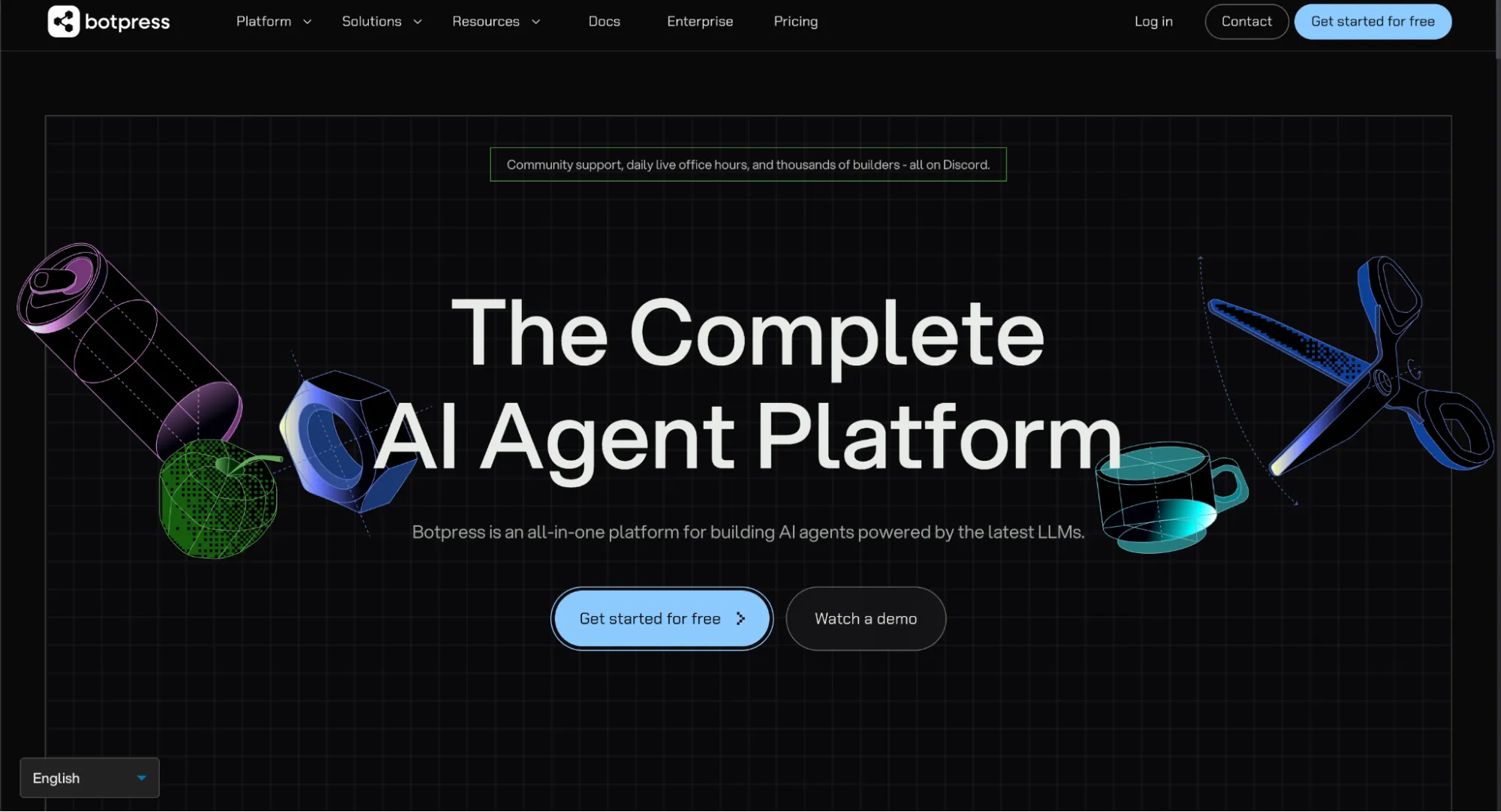
Botpress is enterprise ai agent platform with visual bot building and omnichannel deployment. Enterprise AI agent platform with visual bot building, omnichannel deployment, and RAG capabilities. 750,000+ active bots processing 1 billion+ messages with extensive channel support and no-code/low-code development. Founded in 2016, headquartered in Montreal, Quebec, Canada, the platform has established itself as a reliable solution in the RAG space.
Overall Rating
85/100
Starting Price
Custom
About Vectara
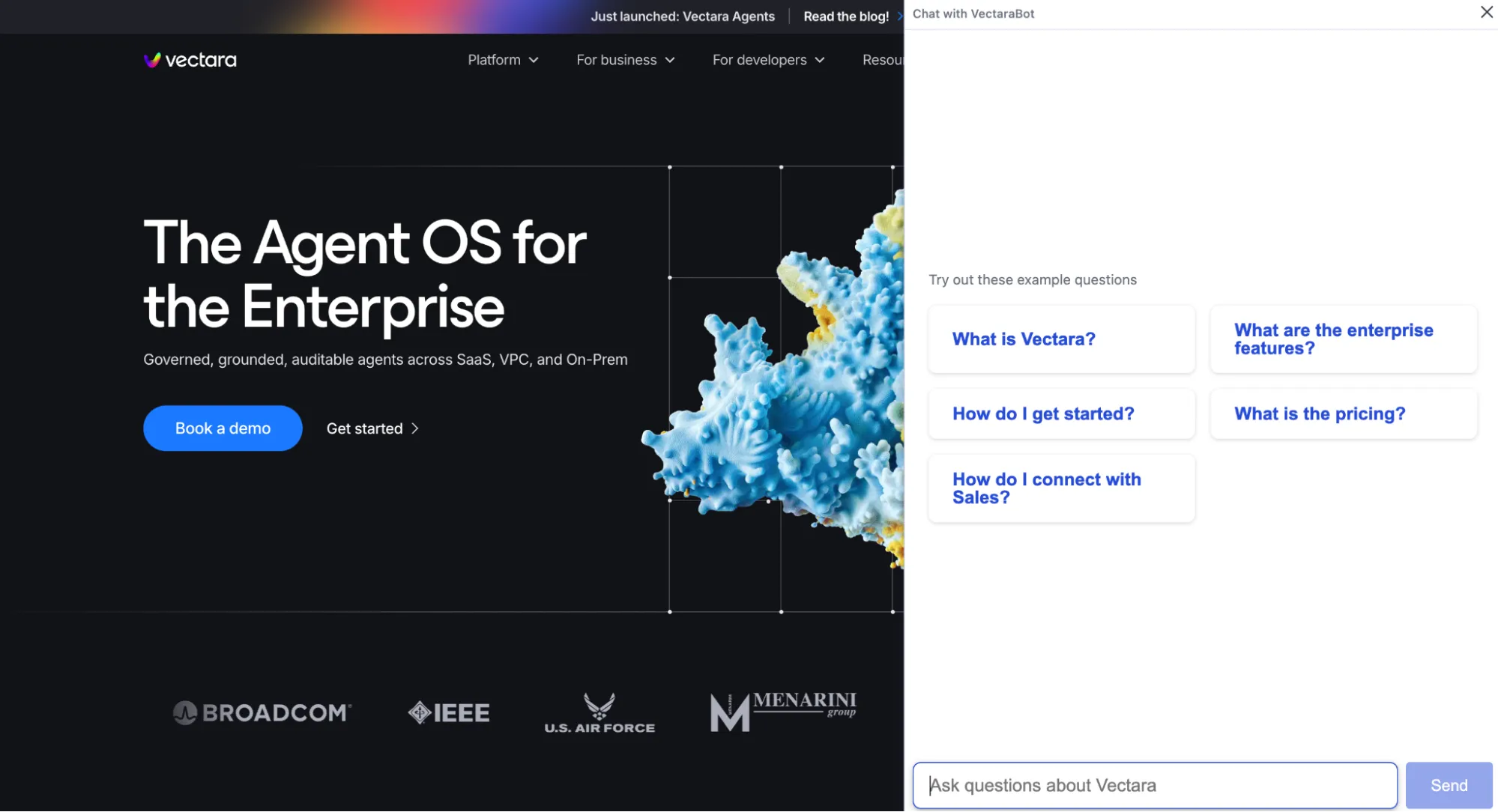
Vectara is the trusted platform for rag-as-a-service. Vectara is an enterprise-ready RAG platform that provides best-in-class retrieval accuracy with minimal hallucinations. It offers a serverless API solution for embedding powerful generative AI functionality into applications with semantic search, grounded generation, and secure access control. Founded in 2020, headquartered in Palo Alto, CA, the platform has established itself as a reliable solution in the RAG space.
Overall Rating
90/100
Starting Price
Custom
Key Differences at a Glance
In terms of user ratings, both platforms score similarly in overall satisfaction. From a cost perspective, pricing is comparable. The platforms also differ in their primary focus: Chatbot Platform versus RAG Platform. These differences make each platform better suited for specific use cases and organizational requirements.
⚠️ What This Comparison Covers
We'll analyze features, pricing, performance benchmarks, security compliance, integration capabilities, and real-world use cases to help you determine which platform best fits your organization's needs. All data is independently verified from official documentation and third-party review platforms.
Detailed Feature Comparison
Botpress
Vectara
CustomGPTRECOMMENDED
Data Ingestion & Knowledge Sources
Supported Formats: PDF, Word (DOC/DOCX), HTML, TXT, Markdown files via Studio UI and Files API
Website Crawling: Firecrawl integration for HTML-to-Markdown conversion with automatic sitemap detection
Real-Time Search: "Search The Web" feature using Bing API for queries when sitemaps unavailable
Cloud Integrations: Google Drive (OAuth sync with file upload/download triggers), Notion (database queries, page management)
Missing Integrations: No native Dropbox or Salesforce document ingestion
YouTube Limitation: No transcript ingestion support - requires manual transcription and text upload (Apify workaround exists but manual)
Automatic Retraining: Website sources sync regularly, file uploads managed dynamically through Files API
File Management: Replacing files automatically removes old content and indexes new content without downtime
Pulls in just about any document type—PDF, DOCX, HTML, and more—for a thorough index of your content (Vectara Platform).
Packed with connectors for cloud storage and enterprise systems, so your data stays synced automatically.
Processes everything behind the scenes and turns it into embeddings for fast semantic search.
Lets you ingest more than 1,400 file formats—PDF, DOCX, TXT, Markdown, HTML, and many more—via simple drag-and-drop or API.
Crawls entire sites through sitemaps and URLs, automatically indexing public help-desk articles, FAQs, and docs.
Turns multimedia into text on the fly: YouTube videos, podcasts, and other media are auto-transcribed with built-in OCR and speech-to-text.
View Transcription Guide
Connects to Google Drive, SharePoint, Notion, Confluence, HubSpot, and more through API connectors or Zapier.
See Zapier Connectors
Supports both manual uploads and auto-sync retraining, so your knowledge base always stays up to date.
Integrations & Channels
Native Channels: WhatsApp (Meta Business API), Slack (OAuth + Bot Framework), Microsoft Teams (Azure portal), Telegram (BotFather), Messenger, Instagram
SMS Support: Twilio and Vonage integrations for text messaging
Web Widget: JavaScript widget (recommended), DOM element mounting, full React component library for SPAs
Mobile Integration: React Native SDK (BpWidget, BpIncomingMessagesListener) for iOS/Android cross-platform support
Webhook Support: Unique webhook URL per bot with optional x-bp-secret header authentication and CORS configuration
Automation Platforms: Zapier integration (partially in beta - some features require manual activation)
Conversational AI: Multi-turn dialogue with context retention across conversation sessions
Multi-Lingual: 100+ languages supported via Translator Agent with automatic translation
Knowledge Base Integration: RAG-powered answers grounded in uploaded documents and websites
Policy Agent: Customizable guardrails filtering outputs against defined policies for brand safety
Knowledge Agent: Structured retrieval before generation to reduce hallucinations
HITL Agent: Human-in-the-loop takeover when bot cannot answer (requires Team plan $495/month)
Personality Agent: Rewrites all bot messages to match defined persona (friendly, professional, casual, custom)
Autonomous Nodes: LLM decides which actions to execute based on conversation context
Performance Claims: "Zero hallucinations in 100,000 conversations" for health coaching client, 65% ticket deflection (no RAGAS scores or latency benchmarks published)
Agentic RAG Framework: Vectara-agentic Python library enables AI assistants and autonomous agents going beyond Q&A to act on users' behalf (sending emails, booking flights, system integration)
Agent APIs (Tech Preview): Comprehensive framework enabling intelligent autonomous AI agents with customizable reasoning models, behavioral instructions, and tool access controls
Configurable Digital Workers: Create agents capable of complex reasoning, multi-step workflows, and enterprise system integration with fine-grained access controls
LlamaIndex Agent Framework: Built on LlamaIndex with helper functions for rapid tool creation connecting to Vectara corpora—single-line code for tool generation
Multiple Agent Types: Support for ReAct agents, Function Calling agents, and custom agent architectures for different reasoning patterns
Pre-Built Domain Tools: Finance and legal industry-specific tools with specialized retrieval and analysis capabilities for regulated sectors
Multi-LLM Agent Support: Agents integrate with OpenAI, Anthropic, Gemini, GROQ, Together.AI, Cohere, and AWS Bedrock for flexible model selection
Structured Output Extraction: Extract specific information from documents for deterministic data extraction and autonomous agent decision-making
Step-Level Audit Trails: Every agent action logged with source citations, reasoning steps, and decision paths for governance and compliance
Real-Time Policy Enforcement: Fine-grained access controls, factual-consistency checks, and policy guardrails enforced during agent execution
Multi-Turn Agent Conversations: Conversation history retention across dialogue turns for coherent long-running agent interactions
Grounded Agent Actions: All agent decisions grounded in retrieved documents with source citations and hallucination detection (0.9% rate with Mockingbird-2-Echo)
LIMITATION - Developer Platform: Agent APIs require programming expertise—not suitable for non-technical teams without developer support
LIMITATION - No Built-In Chatbot UI: Developer-focused platform without polished chat widgets or turnkey conversational interfaces for end users
LIMITATION - No Lead Capture Features: No built-in lead generation, email collection, or CRM integration workflows—application layer responsibility
LIMITATION - Tech Preview Status: Agent APIs in tech preview (2024)—features subject to change before general availability release
Custom AI Agents: Build autonomous agents powered by GPT-4 and Claude that can perform tasks independently and make real-time decisions based on business knowledge
Decision-Support Capabilities: AI agents analyze proprietary data to provide insights, recommendations, and actionable responses specific to your business domain
Multi-Agent Systems: Deploy multiple specialized AI agents that can collaborate and optimize workflows in areas like customer support, sales, and internal knowledge management
Memory & Context Management: Agents maintain conversation history and persistent context for coherent multi-turn interactions
View Agent Documentation
Tool Integration: Agents can trigger actions, integrate with external APIs via webhooks, and connect to 5,000+ apps through Zapier for automated workflows
Hyper-Accurate Responses: Leverages advanced RAG technology and retrieval mechanisms to deliver context-aware, citation-backed responses grounded in your knowledge base
Continuous Learning: Agents improve over time through automatic re-indexing of knowledge sources and integration of new data without manual retraining
Customization & Branding
Webchat Customization: Full CSS override via external stylesheet URL, custom colors/fonts/button styles/chat bubbles
Branding Control: Custom bot name and avatar, proactive greeting messages via JavaScript, configurable placement and sizing
White-Labeling: Remove "Powered by Botpress" watermark (requires Plus plan $89/month minimum)
Personality Configuration: Personality Agent defines bot persona with variable expressions for dynamic context
Persona Disable: Can be disabled at node level for specific interactions requiring different tone
Backend Branding: Admin dashboard remains Botpress-branded (no full white-label backend)
Multi-Tenant Limitation: No agency dashboard for managing multiple client bots under one interface
Real-Time Updates: Knowledge sources update via Files API without bot republishing for Table-based sources
Versioning Gap: No native versioning system - file replacement is manual with external version control required for rollback
Full control over look and feel—swap themes, logos, CSS, you name it—for a true white-label vibe.
Restrict the bot to specific domains and tweak branding straight from the config.
Even the search UI and result cards can be styled to match your company identity.
Fully white-labels the widget—colors, logos, icons, CSS, everything can match your brand.
White-label Options
Provides a no-code dashboard to set welcome messages, bot names, and visual themes.
Lets you shape the AI’s persona and tone using pre-prompts and system instructions.
Uses domain allowlisting to ensure the chatbot appears only on approved sites.
No Python SDK: Significant limitation for data science teams - other languages must use direct REST API access
Authentication: Three token types - Personal Access Token (PAT) for full access, Bot Access Key (BAK) for runtime, Integration Access Key (IAK) for integration-specific actions
Rate Limits: Exist but specifics not publicly documented - Studio limits lower than production bot limits (acknowledged by staff)
Documentation: Well-organized at botpress.com/docs with API references, video tutorials, "Ask AI" feature
Training Resources: Botpress Academy offers free courses
RAG Focus: RAG is one feature within comprehensive conversational AI platform, not standalone RAG API
Platform Type: TRUE ENTERPRISE RAG-AS-A-SERVICE PLATFORM - Agent Operating System for trusted enterprise AI with unified Agentic RAG and production-grade infrastructure
Core Mission: Enable enterprises to deploy AI assistants and autonomous agents with grounded answers, safe actions, and always-on governance for mission-critical applications
Target Market: Enterprise organizations requiring production-ready RAG with factual consistency scoring, development teams needing white-label search/chat APIs, companies with dedicated VPC or on-prem deployment requirements
RAG Implementation: Proprietary Mockingbird LLM outperforming GPT-4 on BERT F1 scores (26% better) with 0.9% hallucination rate, hybrid search (semantic + BM25), advanced multi-stage reranking pipeline
Managed Service: Usage-based SaaS with generous free tier, then scalable bundles—plus dedicated VPC or on-premise deployment options for enterprise data sovereignty
Pricing Model: Free trial (30-day access to enterprise features), usage-based pricing for query volume and data size, custom pricing for dedicated VPC and on-premise installations
Data Sources: Connectors for cloud storage and enterprise systems with automatic syncing, comprehensive document type support (PDF, DOCX, HTML), all processed into embeddings for semantic search
Model Ecosystem: Proprietary Mockingbird/Mockingbird-2 optimized for RAG, GPT-4/GPT-3.5 fallback via Azure OpenAI, Hughes HHEM for hallucination detection, Hallucination Correction Model (HCM)
Security & Compliance: SOC 2 Type 2, ISO 27001, GDPR, HIPAA ready with BAAs, encryption (TLS 1.3 in-transit, AES-256 at-rest), customer-managed keys (BYOK), private VPC/on-prem deployments
Support Model: Enterprise support with dedicated channels and SLAs, Microsoft support network backing, comprehensive API documentation, active community forums
Funding & Stability: $53.5M total raised ($25M Series A July 2024 from FPV Ventures and Race Capital) demonstrating strong investor confidence and long-term viability
LIMITATION - Enterprise Complexity: Advanced capabilities require developer expertise—complex indexing, parameter tuning, agent configuration not suitable for non-technical teams
LIMITATION - No No-Code Builder: Azure portal UI for management but no drag-and-drop chatbot builder—requires development resources for deployment
LIMITATION - Ecosystem Lock-In: Strongest with Azure services—less seamless for AWS/GCP-native organizations requiring cross-cloud flexibility
Comparison Validity: Architectural comparison to simpler chatbot platforms like CustomGPT.ai requires context—Vectara targets enterprise RAG infrastructure vs no-code chatbot deployment
Use Case Fit: Perfect for enterprises requiring mission-critical RAG with factual consistency scoring, regulated industries (health, legal, finance) needing SOC 2/HIPAA compliance, organizations building white-label search APIs for customer-facing applications, and companies needing dedicated VPC/on-prem deployments for data sovereignty
Core Architecture: Serverless RAG infrastructure with automatic embedding generation, vector search optimization, and LLM orchestration fully managed behind API endpoints
API-First Design: Comprehensive REST API with well-documented endpoints for creating agents, managing projects, ingesting data (1,400+ formats), and querying chat
API Documentation
Developer Experience: Open-source Python SDK (customgpt-client), Postman collections, OpenAI API endpoint compatibility, and extensive cookbooks for rapid integration
No-Code Alternative: Wizard-style web dashboard enables non-developers to upload content, brand widgets, and deploy chatbots without touching code
Hybrid Target Market: Serves both developer teams wanting robust APIs AND business users seeking no-code RAG deployment - unique positioning vs pure API platforms (Cohere) or pure no-code tools (Jotform)
RAG Technology Leadership: Industry-leading answer accuracy (median 5/5 benchmarked), 1,400+ file format support with auto-transcription, proprietary anti-hallucination mechanisms, and citation-backed responses
Benchmark Details
Deployment Flexibility: Cloud-hosted SaaS with auto-scaling, API integrations, embedded chat widgets, ChatGPT Plugin support, and hosted MCP Server for Claude/Cursor/ChatGPT
Enterprise Readiness: SOC 2 Type II + GDPR compliance, full white-labeling, domain allowlisting, RBAC with 2FA/SSO, and flat-rate pricing without per-query charges
Use Case Fit: Ideal for organizations needing both rapid no-code deployment AND robust API capabilities, teams handling diverse content types (1,400+ formats, multimedia transcription), and businesses requiring production-ready RAG without building ML infrastructure from scratch
Competitive Positioning: Bridges the gap between developer-first platforms (Cohere, Deepset) requiring heavy coding and no-code chatbot builders (Jotform, Kommunicate) lacking API depth - offers best of both worlds
Competitive Positioning
Primary Advantage: Visual bot building with code extensibility - accessible to non-developers, powerful for developers
Scale Validation: 750,000+ active bots and 1 billion+ messages processed prove production reliability at massive scale
Omnichannel Strength: Comprehensive native support for WhatsApp, Slack, Teams, Telegram, Messenger, SMS, web, mobile
Community Power: 31,000+ Discord members provide peer support, troubleshooting, best practices, feature validation
Primary Challenge: SOC 2 not certified, no EU data residency - critical gaps for enterprise buyers with compliance needs
Security Gap: Not HIPAA compliant, no ISO 27001 - blocks regulated industry adoption (healthcare, finance)
Cost Trade-Off: Free tier available but AI Spend unpredictability + feature paywalls (RBAC at $495/month) add complexity
Market Position: Conversational AI platform competing with Dialogflow, Rasa, Microsoft Bot Framework vs. pure RAG services
Use Case Fit: Ideal for teams needing visual bot building + multi-channel deployment vs. pure RAG API integrations
Platform vs. API: Full development environment with Studio, not lightweight RAG API - different target audience than CustomGPT
Market position: Enterprise RAG platform with proprietary Mockingbird LLM and hybrid search capabilities, positioned between Azure AI Search and specialized chatbot builders
Target customers: Enterprise organizations requiring production-ready RAG with factual consistency scoring, development teams needing white-label search/chat APIs, and companies wanting Azure integration with dedicated VPC or on-prem deployment options
Key competitors: Azure AI Search, Coveo, OpenAI Enterprise, Pinecone Assistant, and enterprise RAG platforms
Competitive advantages: Proprietary Mockingbird LLM optimized for RAG with GPT-4/GPT-3.5 fallback options, hybrid search blending semantic and keyword matching, factual-consistency scoring with hallucination detection, comprehensive SDKs (C#, Python, Java, JavaScript), SOC 2/ISO/GDPR/HIPAA compliance with customer-managed keys, Azure ecosystem integration (Logic Apps, Power BI), and millisecond response times at enterprise scale
Pricing advantage: Usage-based with generous free tier, then scalable bundles; competitive for high-volume enterprise queries; dedicated VPC or on-prem for cost control at massive scale; best value for organizations needing enterprise-grade search + RAG + hallucination detection without building infrastructure
Use case fit: Ideal for enterprises requiring mission-critical RAG with factual consistency scoring, organizations needing white-label search APIs for customer-facing applications, and companies wanting Azure ecosystem integration with hybrid search capabilities and advanced reranking for high-accuracy requirements
Market position: Leading all-in-one RAG platform balancing enterprise-grade accuracy with developer-friendly APIs and no-code usability for rapid deployment
Target customers: Mid-market to enterprise organizations needing production-ready AI assistants, development teams wanting robust APIs without building RAG infrastructure, and businesses requiring 1,400+ file format support with auto-transcription (YouTube, podcasts)
Key competitors: OpenAI Assistants API, Botsonic, Chatbase.co, Azure AI, and custom RAG implementations using LangChain
Competitive advantages: Industry-leading answer accuracy (median 5/5 benchmarked), 1,400+ file format support with auto-transcription, SOC 2 Type II + GDPR compliance, full white-labeling included, OpenAI API endpoint compatibility, hosted MCP Server support (Claude, Cursor, ChatGPT), generous data limits (60M words Standard, 300M Premium), and flat monthly pricing without per-query charges
Pricing advantage: Transparent flat-rate pricing at $99/month (Standard) and $449/month (Premium) with generous included limits; no hidden costs for API access, branding removal, or basic features; best value for teams needing both no-code dashboard and developer APIs in one platform
Use case fit: Ideal for businesses needing both rapid no-code deployment and robust API capabilities, organizations handling diverse content types (1,400+ formats, multimedia transcription), teams requiring white-label chatbots with source citations for customer-facing or internal knowledge projects, and companies wanting all-in-one RAG without managing ML infrastructure
A I Models
Native OpenAI Support: GPT-4o, GPT-4o mini, GPT-4 Turbo with in-Studio presets ("Best Model" and "Fast Model" for quick selection)
Claude Models: Claude 4 Sonnet, Claude 3.5 Sonnet, Claude 3.7 Sonnet, Claude 4.5 Sonnet accessible via custom integrations or Execute Code cards
Google Gemini: Gemini Pro, Gemini 2.5 Flash available through external API calls in custom integrations
Open Source Options: LLaMA, DeepSeek accessible via Execute Code cards with external API integration
Model Access within Days: Platform provides access to latest LLMs within days of release for every chatbot built on Botpress
No Automatic Routing: Deliberately avoided for "concerns about unpredictability and latency" - users manually select models per task
LLMz Engine: Proprietary inference layer with claimed improvements - better tool calling, token efficiency, TypeScript type definitions, V8 isolate execution
AI Spend Pricing: Charged at-cost with no Botpress markup on OpenAI tokens; option to use Botpress-managed credits or BYOK (bring your own key)
No Fine-Tuning: RAG recommended as primary approach, supplemented by "learnings" system providing relevant examples at prompt-time
Proprietary Mockingbird LLM: RAG-specific fine-tuned model achieving 26% better performance than GPT-4 on BERT F1 scores with 0.9% hallucination rate
Mockingbird 2: Latest evolution with advanced cross-lingual capabilities (English, Spanish, French, Arabic, Chinese, Japanese, Korean) and under 10B parameters
GPT-4/GPT-3.5 fallback: Azure OpenAI integration for customers preferring OpenAI models over Mockingbird
Model selection: Choose between Mockingbird (optimized for RAG), GPT-4 (general intelligence), or GPT-3.5 (cost-effective) based on use case requirements
Hughes Hallucination Evaluation Model (HHEM): Integrated hallucination detection scoring every response for factual consistency
Hallucination Correction Model (HCM): Mockingbird-2-Echo (MB2-Echo) combines Mockingbird 2 with HHEM and HCM for 0.9% hallucination rate
No model training on customer data: Vectara guarantees your data never used to train or improve models, ensuring compliance with strictest security standards
Customizable prompt templates: Configure tone, format, and citation rules through prompt engineering for domain-specific responses
Primary models: GPT-5.1 and 4 series from OpenAI, and Anthropic's Claude 4.5 (opus and sonnet) for enterprise needs
Automatic model selection: Balances cost and performance by automatically selecting the appropriate model for each request
Model Selection Details
Proprietary optimizations: Custom prompt engineering and retrieval enhancements for high-quality, citation-backed answers
Managed infrastructure: All model management handled behind the scenes - no API keys or fine-tuning required from users
Anti-hallucination technology: Advanced mechanisms ensure chatbot only answers based on provided content, improving trust and factual accuracy
Use Cases
Customer Support: Most popular use case with 98% of chats resolved without human intervention (Ruby Labs: 4 million support chats monthly)
Sales Automation: Majority of deployed bots part of sales process - appointment scheduling, lead nurturing, product suggestions, competitive comparisons, automated follow-ups
Sales Impact: Businesses report average 67% sales increase using chatbots, projected $112 billion in retail sales for 2024
Enterprise Internal Use: HR chatbots for vacation requests, IT chatbots for employee tech troubleshooting, repetitive high-volume task automation
Lead Generation: AI lead generation qualifies leads through conversational engagement, needs assessment, information gathering, automated follow-up
Cost Savings: One bank saved €530,000 by deploying chatbot, demonstrating measurable enterprise ROI
Multi-Channel Engagement: WhatsApp Business API, Slack, Microsoft Teams, Telegram, Messenger, Instagram, SMS (Twilio/Vonage) for comprehensive reach
Scale Validation: 750,000+ active bots, 1 billion+ messages processed provide real-world production reliability proof
Regulated industry RAG: Perfect for health, legal, finance, manufacturing where accuracy, security, and explainability critical (SOC 2 Type 2 compliance)
Enterprise knowledge bases: Summarize search results for research/analysis, build Q&A systems providing quick precise answers from large document repositories
Autonomous agents: Structured outputs provide significant advantage for AI agents requiring deterministic data extraction and decision-making
Customer-facing search APIs: White-label search/chat APIs for customer applications with millisecond response times at enterprise scale
Cross-lingual knowledge retrieval: Organizations requiring multilingual support (7 languages) with single knowledge base serving multiple locales
High-accuracy requirements: Use cases demanding citation precision, factual consistency scoring, and hallucination detection (0.9% rate with Mockingbird-2-Echo)
Azure ecosystem integration: Companies using Azure Logic Apps, Power BI, and GCP services wanting seamless RAG integration
Customer support automation: AI assistants handling common queries, reducing support ticket volume, providing 24/7 instant responses with source citations
Internal knowledge management: Employee self-service for HR policies, technical documentation, onboarding materials, company procedures across 1,400+ file formats
Sales enablement: Product information chatbots, lead qualification, customer education with white-labeled widgets on websites and apps
Documentation assistance: Technical docs, help centers, FAQs with automatic website crawling and sitemap indexing
Educational platforms: Course materials, research assistance, student support with multimedia content (YouTube transcriptions, podcasts)
Healthcare information: Patient education, medical knowledge bases (SOC 2 Type II compliant for sensitive data)
No hidden fees: Transparent pricing with no per-seat charges, no storage surprises, no model switching fees
Competitive for enterprise: Best value for organizations needing enterprise-grade RAG + hybrid search + hallucination detection without building infrastructure
Funding: $53.5M total raised ($25M Series A in July 2024 from FPV Ventures and Race Capital) demonstrating strong investor confidence
Standard Plan: $99/month or $89/month annual - 10 custom chatbots, 5,000 items per chatbot, 60 million words per bot, basic helpdesk support, standard security
View Pricing
Premium Plan: $499/month or $449/month annual - 100 custom chatbots, 20,000 items per chatbot, 300 million words per bot, advanced support, enhanced security, additional customization
Enterprise Plan: Custom pricing - Comprehensive AI solutions, highest security and compliance, dedicated account managers, custom SSO, token authentication, priority support with faster SLAs
Enterprise Solutions
7-Day Free Trial: Full access to Standard features without charges - available to all users
Annual billing discount: Save 10% by paying upfront annually ($89/mo Standard, $449/mo Premium)
Flat monthly rates: No per-query charges, no hidden costs for API access or white-labeling (included in all plans)
Managed infrastructure: Auto-scaling cloud infrastructure included - no additional hosting or scaling fees
Support & Documentation
Free Plan Support: Community only - Discord (31,000+ members), documentation, forums - no direct support
Plus Plan Support: Live chat with Botpress engineers ($89/month) for direct technical assistance
Team Plan Support: Advanced support + solution engineering ($495/month) for complex implementations
Enterprise Support: Named support manager, SLA-backed response times (2 hours to 2 business days), ~$2,000+/month
Discord Community: 31,000+ highly active members with daily discussions, feature requests, troubleshooting - praised as "best Discord experience"
Documentation: Comprehensive docs at botpress.com/docs with API references, video tutorials, "Ask AI" feature for guided help
Botpress Academy: Free training courses covering bot development, best practices, advanced features
Response Time SLAs: 2 business days (standard Level 1) to 2 hours (premium Level 1) for Enterprise customers
Service Credits: 99.8% uptime SLA with credits for downtime, includes OpenAI unavailability (notable external dependency caveat)
Support Limitation: Non-Enterprise users lack formal ticketing system, may experience wait times for complex issues
Enterprise support: Dedicated support channels and SLA-backed help for Enterprise plan customers
Microsoft support network: Backed by Microsoft's extensive support infrastructure, documentation, forums, and technical guides
Comprehensive documentation: Detailed API references, integration guides, SDK documentation, and best practices at docs.vectara.com
Azure partner ecosystem: Benefit from broad Azure partner network and vibrant developer community
Sample code and notebooks: Pre-built examples, Jupyter notebooks, and quick-start guides for rapid integration
Community forums: Active developer community for peer support, knowledge sharing, and best practice discussions
Regular updates: Constant stream of new features and integrations keeps platform fresh with R&D investment
API/SDK support: C#, Python, Java, JavaScript SDKs with comprehensive documentation and code samples
Documentation hub: Rich docs, tutorials, cookbooks, FAQs, API references for rapid onboarding
Developer Docs
Email and in-app support: Quick support via email and in-app chat for all users
Premium support: Premium and Enterprise plans include dedicated account managers and faster SLAs
Code samples: Cookbooks, step-by-step guides, and examples for every skill level
API Documentation
Active community: User community plus 5,000+ app integrations through Zapier ecosystem
Regular updates: Platform stays current with ongoing GPT and retrieval improvements automatically
Additional Considerations
High learning curve: Platform highly flexible but non-technical users struggle with advanced flow builder and developer-oriented features
Developer dependency: No quick copy-and-paste solution for real enterprise - company needs long-term employees ready to see it through with recommended 1-2 developers and 1-2 business-side employees per project
Performance under load: Live users report latency and webhook timeout issues under spiky high-concurrency loads - high-traffic teams should stress-test with projected peak traffic
Self-hosting complexity: For enterprise deployments with large numbers of bots or conversations self-hosting might be required shifting maintenance and scaling challenges to your team
Technical requirements: Configuring Docker, Kubernetes, databases, and certificates can become roadblock - requires skills in JavaScript, API integration, NLP, state management
DevOps investment needed: Teams should be prepared for additional DevOps investment for autoscaling, database sharding, and backup strategies
Unpredictable AI usage costs: Every message, retrieval, or workflow call consumes tokens making monthly bills swing dramatically depending on traffic and complexity
Hidden expenses: Third-party services like WhatsApp, SMS, voice integrations billed separately - advanced use cases often require engineering hours, enterprise deployments may require onboarding packages, compliance audits, or custom module builds costing thousands
Scaling costs: Growing from 5,000 to 20,000 MAUs means moving from $495/month to much higher custom enterprise price - multiple bots, custom integrations, or premium add-ons can push monthly spend well past initial plan quote
Resource-heavy features: Botpress LLM features can be resource-heavy requiring wise CPU/memory allocation planning
Commercial license threshold: Planning more than 150K interactions per month requires commercial license
Ongoing maintenance: Deployment is just start - bots must be continuously monitored, tested, and iterated to stay effective and aligned with evolving business goals
Hybrid search + reranking gives each answer a unique factual-consistency score.
Deploy in public cloud, VPC, or on-prem to suit your compliance needs.
Constant stream of new features and integrations keeps the platform fresh.
Slashes engineering overhead with an all-in-one RAG platform—no in-house ML team required.
Gets you to value quickly: launch a functional AI assistant in minutes.
Stays current with ongoing GPT and retrieval improvements, so you’re always on the latest tech.
Balances top-tier accuracy with ease of use, perfect for customer-facing or internal knowledge projects.
Core Chatbot Features
Advanced AI capabilities: Extremely advanced AI with multiple sophisticated AI agents - automatic translation, conversation summarization, Vision Agent for image understanding
LLMz custom inference engine: Core of every Botpress agent with proprietary engine for enhanced performance
Conversational memory: Rich conversational memory maintaining context across long interactions, understanding complex multi-turn queries, and generating human-like responses
User memory across sessions: Agent remembers conversation history of specific users across different times - recalls user preferences, where they left off, and preferred tone of voice
Visual flow builder: Drag-and-drop interface for designing complex conversational flows without coding
Built-in AI features: Intent recognition, entity extraction, knowledge base integration, and AI agents
Custom data training: Train chatbot on custom data like website and documents
Multi-channel deployment: Create and launch chatbots on many channels including website, Facebook, WhatsApp, Slack, Instagram and more platforms
API integrations: Integrates with APIs, CRMs, databases, and other business applications
Automatic translation: Over 100 languages for global reach
AI Swarms/Teams (2025): Platform transformed into mature "AI workforce deployment and management center" with AI team collaboration capabilities
Live Database Connectors: Breakthrough feature allowing direct secure connection to SQL or NoSQL database in addition to traditional API connections
Open-source flexibility: Users have access to application source code and can contribute to development - skilled developers can push envelope to tailor to unique needs
Combines smart vector search with a generative LLM to give context-aware answers.
Uses its own Mockingbird LLM to serve answers and cite sources.
Keeps track of conversation history and supports multi-turn chats for smooth back-and-forth.
Reduces hallucinations by grounding replies in your data and adding source citations for transparency.
Benchmark Details
Handles multi-turn, context-aware chats with persistent history and solid conversation management.
Speaks 90+ languages, making global rollouts straightforward.
Includes extras like lead capture (email collection) and smooth handoff to a human when needed.
Knowledge Bases: Upload in variety of formats ranging from website or document to custom text file or Table
Knowledge Base scoping: Scope which Knowledge Bases Autonomous Node searches by organizing documents into folders limiting availability to certain workflows
Search field configuration: Configure search fields such as name, description, power, price to refine bot responses
Dynamic management: Programmatically manage Knowledge Base files with Botpress API to dynamically add, update, or remove content in real time keeping AI agent knowledge current
Behavior customization: Define specific behaviors in instructions to avoid unintended outputs - specify prices are final and include all discounts to prevent bot from fabricating discounts
Custom responses: Program custom response by adding Transition Card in Autonomous Node and handle transition however wanted with custom error messages
Bot templates: Pre-configured projects containing predefined conversational flows, Knowledge Bases, and responses serving as starting point - easily customized and extended to meet specific requirements with full developer control
Visual customization: Give bot name, store avatar URL for custom icon, provide general description, formulate placeholder text displayed before user enters first text
ChatGPT consultation: Customize bot behavior deciding when to consult ChatGPT based on knowledge base responses
Highly customizable workflows: Unlimited variables and open-source flexibility for advanced customization
Fine-grain control over indexing—set chunk sizes, metadata tags, and more.
Tune how much weight semantic vs. lexical search gets for each query.
Adjust prompt templates and relevance thresholds to fit domain-specific needs.
Lets you add, remove, or tweak content on the fly—automatic re-indexing keeps everything current.
Shapes agent behavior through system prompts and sample Q&A, ensuring a consistent voice and focus.
Learn How to Update Sources
Supports multiple agents per account, so different teams can have their own bots.
Balances hands-on control with smart defaults—no deep ML expertise required to get tailored behavior.
Limitations & Considerations
Steep Learning Curve: Platform highly flexible but non-technical users struggle with advanced flow builder and developer-oriented features
Developer Dependency: Requires developer involvement making it less suitable for small businesses needing quick setup
Bug Disruptions: Various bugs may disrupt workflows and cause functionality problems requiring troubleshooting
Missing Features: White-labeling, global compliance, seamless live support require heavy effort or unavailable, slowing adoption
Data Visibility Gap: Cannot see user variables (name, email, custom fields) in chatbot conversations - limits analytics capabilities
Cost for SMBs: Enterprise-level security, compliance, dedicated support cost prohibitive for smaller teams ($495-$2,000+/month)
Resource Requirements: Self-hosted deployment requires IT resources for deployment and ongoing management
Complex Setup: Publishing on Facebook/Instagram technically complex, live chat only available on higher-priced plans
Limited Analytics: Standard plans offer limited analytical capabilities - advanced analytics require Team plan ($495/month)
LLM Provider Dependency: Reliance on third-party LLM providers (primarily OpenAI) impacts operational costs, scalability, and control
Complex Issue Handling: Chatbots may struggle with handling complex, nuanced customer issues requiring human judgment
Multi-Instance Challenges: Setting up multiple instances from one installation proven difficult for some enterprise users
Compliance Gaps: SOC 2 incomplete, no HIPAA, no ISO 27001, US-only data residency blocks regulated industries and EU enterprises
Azure/Microsoft ecosystem focus: Strongest integration with Azure services - less seamless for AWS/GCP-native organizations
Complex indexing requires technical skills: Advanced indexing tweaks and parameter tuning need developer expertise vs turnkey no-code tools
No drag-and-drop GUI: Azure portal UI for management, but no full no-code chatbot builder like Tidio or WonderChat
Model selection limited: Mockingbird, GPT-4, GPT-3.5 only - no Claude, Gemini, or custom model support compared to multi-model platforms
Learning curve for non-Azure users: Teams unfamiliar with Azure ecosystem face steeper learning curve vs platform-agnostic alternatives
Pricing transparency: Contact sales for detailed enterprise pricing - less transparent than self-serve platforms with public pricing
Overkill for simple chatbots: Enterprise RAG capabilities unnecessary for basic FAQ bots or simple customer service automation
Requires development resources: Not suitable for non-technical teams needing no-code deployment without developer involvement
Managed service approach: Less control over underlying RAG pipeline configuration compared to build-your-own solutions like LangChain
Vendor lock-in: Proprietary platform - migration to alternative RAG solutions requires rebuilding knowledge bases
Model selection: Limited to OpenAI (GPT-5.1 and 4 series) and Anthropic (Claude, opus and sonnet 4.5) - no support for other LLM providers (Cohere, AI21, open-source models)
Pricing at scale: Flat-rate pricing may become expensive for very high-volume use cases (millions of queries/month) compared to pay-per-use models
Customization limits: While highly configurable, some advanced RAG techniques (custom reranking, hybrid search strategies) may not be exposed
Language support: Supports 90+ languages but performance may vary for less common languages or specialized domains
Real-time data: Knowledge bases require re-indexing for updates - not ideal for real-time data requirements (stock prices, live inventory)
Enterprise features: Some advanced features (custom SSO, token authentication) only available on Enterprise plan with custom pricing
After analyzing features, pricing, performance, and user feedback, both Botpress and Vectara are capable platforms that serve different market segments and use cases effectively.
When to Choose Botpress
You value visual drag-and-drop builder with extensive code extensibility via execute code cards
Massive scale validation: 750,000+ active bots, 1 billion+ messages processed
Comprehensive omnichannel support: WhatsApp, Slack, Teams, Telegram, Messenger, SMS, web
Best For: Visual drag-and-drop builder with extensive code extensibility via Execute Code cards
When to Choose Vectara
You value industry-leading accuracy with minimal hallucinations
Never trains on customer data - ensures privacy
True serverless architecture - no infrastructure management
Best For: Industry-leading accuracy with minimal hallucinations
Migration & Switching Considerations
Switching between Botpress and Vectara requires careful planning. Consider data export capabilities, API compatibility, and integration complexity. Both platforms offer migration support, but expect 2-4 weeks for complete transition including testing and team training.
Pricing Comparison Summary
Botpress starts at custom pricing, while Vectara begins at custom pricing. Total cost of ownership should factor in implementation time, training requirements, API usage fees, and ongoing support. Enterprise deployments typically see annual costs ranging from $10,000 to $500,000+ depending on scale and requirements.
Our Recommendation Process
Start with a free trial - Both platforms offer trial periods to test with your actual data
Define success metrics - Response accuracy, latency, user satisfaction, cost per query
Test with real use cases - Don't rely on generic demos; use your production data
Evaluate total cost - Factor in implementation time, training, and ongoing maintenance
Check vendor stability - Review roadmap transparency, update frequency, and support quality
For most organizations, the decision between Botpress and Vectara comes down to specific requirements rather than overall superiority. Evaluate both platforms with your actual data during trial periods, focusing on accuracy, latency, ease of integration, and total cost of ownership.
📚 Next Steps
Ready to make your decision? We recommend starting with a hands-on evaluation of both platforms using your specific use case and data.
• Review: Check the detailed feature comparison table above
• Test: Sign up for free trials and test with real queries
• Calculate: Estimate your monthly costs based on expected usage
• Decide: Choose the platform that best aligns with your requirements
Last updated: December 10, 2025 | This comparison is regularly reviewed and updated to reflect the latest platform capabilities, pricing, and user feedback.
The most accurate RAG-as-a-Service API. Deliver production-ready reliable RAG applications faster. Benchmarked #1 in accuracy and hallucinations for fully managed RAG-as-a-Service API.
DevRel at CustomGPT.ai. Passionate about AI and its applications. Here to help you navigate the world of AI tools and make informed decisions for your business.
People Also Compare
Explore more AI tool comparisons to find the perfect solution for your needs

Join the Discussion
Loading comments...