In this comprehensive guide, we compare Help Scout AI Answers and Yellow.ai across various parameters including features, pricing, performance, and customer support to help you make the best decision for your business needs.
Overview
When choosing between Help Scout AI Answers and Yellow.ai, understanding their unique strengths and architectural differences is crucial for making an informed decision. Both platforms serve the RAG (Retrieval-Augmented Generation) space but cater to different use cases and organizational needs.
Quick Decision Guide
Choose Help Scout AI Answers if: you value exceptional ease of use - turnkey ai chatbot with zero technical setup for support teams
Choose Yellow.ai if: you value genuinely comprehensive 35+ channel coverage: whatsapp bsp, messenger, instagram, telegram, slack, teams, voice, sms
About Help Scout AI Answers
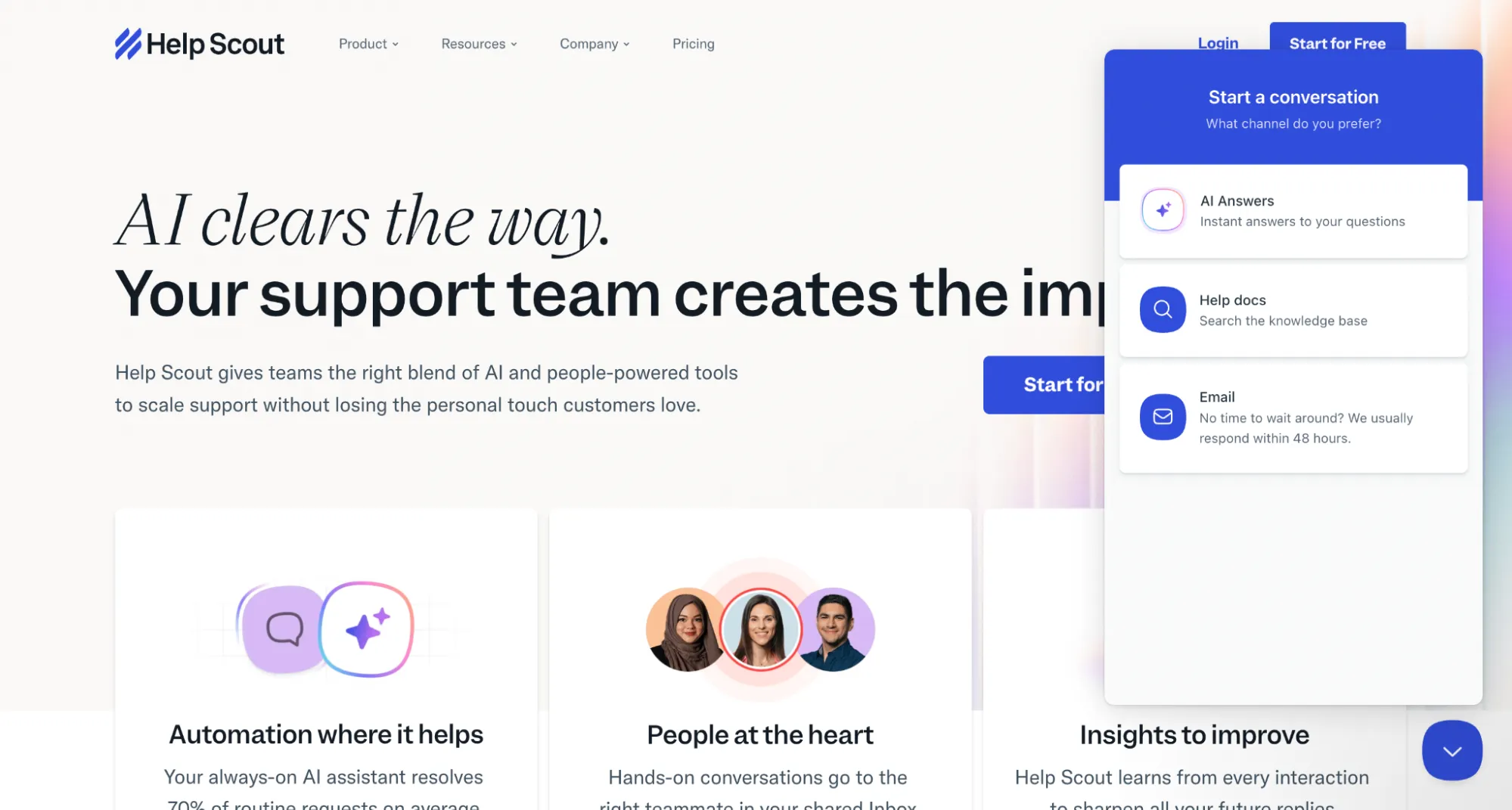
Help Scout AI Answers is customer support helpdesk with widget-only ai chatbot. Help Scout AI Answers is a customer self-service chatbot embedded in Help Scout's Beacon widget, powered by OpenAI. Critical limitation: RAG capability is NOT exposed via API—it only functions within the embedded Beacon widget. This makes it fundamentally different from RAG-as-a-Service platforms, as developers cannot query AI programmatically for custom chat interfaces, mobile apps, or backend integrations. Founded in 2011, headquartered in Boston, MA, the platform has established itself as a reliable solution in the RAG space.
Overall Rating
92/100
Starting Price
$50/mo
About Yellow.ai
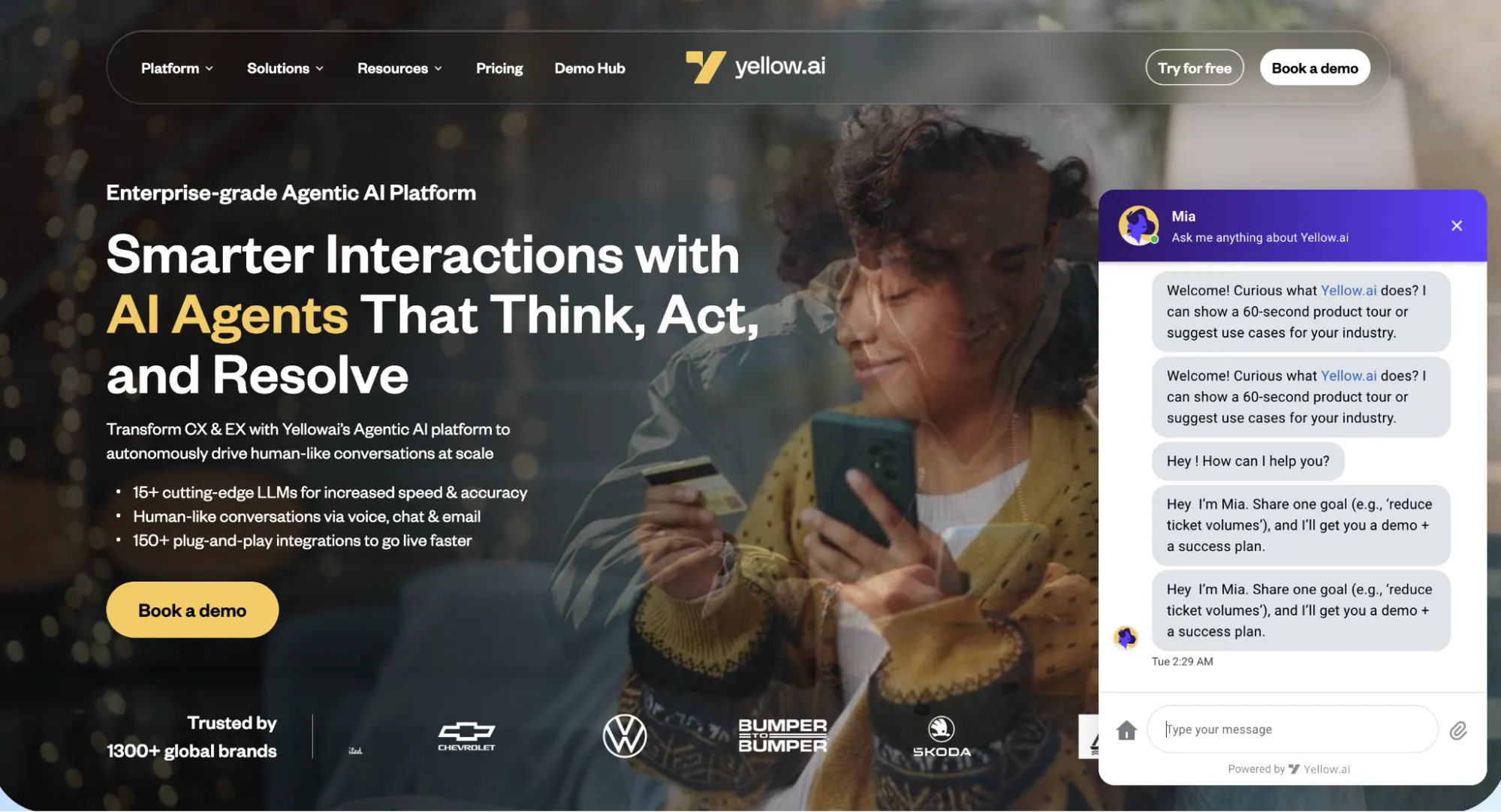
Yellow.ai is enterprise conversational ai platform with multi-llm orchestration. Enterprise conversational AI platform with embedded RAG capabilities processing 16 billion+ conversations annually. Multi-LLM orchestration across 35+ channels and 135+ languages with proprietary YellowG LLM claiming <1% hallucination rates. Founded in 2016, headquartered in San Mateo, CA, USA / Bengaluru, India, the platform has established itself as a reliable solution in the RAG space.
Overall Rating
85/100
Starting Price
Custom
Key Differences at a Glance
In terms of user ratings, Help Scout AI Answers in overall satisfaction. From a cost perspective, Yellow.ai offers more competitive entry pricing. The platforms also differ in their primary focus: Customer Support versus Conversational AI. These differences make each platform better suited for specific use cases and organizational requirements.
⚠️ What This Comparison Covers
We'll analyze features, pricing, performance benchmarks, security compliance, integration capabilities, and real-world use cases to help you determine which platform best fits your organization's needs. All data is independently verified from official documentation and third-party review platforms.
Detailed Feature Comparison
Help Scout AI Answers
Yellow.ai
CustomGPTRECOMMENDED
Data Ingestion & Knowledge Sources
Help Scout Docs: Primary native knowledge base integration
Website crawling: Single pages, entire sites, or custom page selections (publicly accessible only)
PDFs, Word docs, Excel files: From crawled web sources only (no direct upload)
Note: CRITICAL: No direct file upload - content must exist in Docs or on publicly accessible URL
Note: No cloud storage integrations: Google Drive, Dropbox, Notion, SharePoint, OneDrive not supported
Note: No YouTube or video transcript ingestion
Note: No automatic retraining - manual re-sync required for additional sources
Large site syncs can take "several minutes" with no documented volume limits
Recommendation: Target specific pages rather than entire websites for best accuracy
Improvements feature: Manually add corrections from conversation reviews with AI-suggested improvements
Document Cognition (DocCog) Engine: 75-85% accuracy depending on document complexity using T5 model fine-tuned on SQuAD/TriviaQA
Supported Formats: PDF, DOCX, DOC, PPTX, PPT, TXT via manual upload through platform UI only (no API upload)
Automatic Synchronization: Configurable intervals - hourly, daily, weekly for external knowledge base updates
Website Crawling: URL ingestion and sitemap.xml parsing for structured site content extraction
Missing Integrations: No Google Drive, Dropbox, or Notion support - significant gap vs competitors
YouTube Limitation: Transcript ingestion not natively supported
API Gap: No programmatic document upload or knowledge base management via API
Q&A Extraction: T5 model-based question-answer pair generation from ingested documents
Lets you ingest more than 1,400 file formats—PDF, DOCX, TXT, Markdown, HTML, and many more—via simple drag-and-drop or API.
Crawls entire sites through sitemaps and URLs, automatically indexing public help-desk articles, FAQs, and docs.
Turns multimedia into text on the fly: YouTube videos, podcasts, and other media are auto-transcribed with built-in OCR and speech-to-text.
View Transcription Guide
Connects to Google Drive, SharePoint, Notion, Confluence, HubSpot, and more through API connectors or Zapier.
See Zapier Connectors
Supports both manual uploads and auto-sync retraining, so your knowledge base always stays up to date.
L L M Model Options
OpenAI API exclusively powers all AI features
AI Drafts (agent-facing): GPT-4 explicitly confirmed
AI Answers (customer-facing): Undisclosed OpenAI model version
Note: No model selection: Users cannot switch between GPT-3.5, GPT-4, Claude, or other models
Note: No automatic model routing based on query complexity
Note: No temperature controls, fine-tuning, or model parameter access
Note: No context window or token limit information disclosed
Note: No streaming response capability
Data privacy: OpenAI does not use customer data for model training (30-day retention for abuse monitoring only)
Voice & Tone field: Free-text field to guide AI response style (cannot introduce new information, only adjusts messaging)
Proprietary YellowG LLM: Claims <1% hallucination rate vs GPT-3's 22.7% (vendor benchmarks), 0.6s avg response time
OAuth 2.0: Client Credentials and Authorization Code flows with 2-day token expiry
Official SDKs: PHP, JavaScript (sidebar apps), React UI Kit
Community libraries: Ruby, Python, .NET, Node.js (unofficial)
Note: Free plan has NO API access
Note: What the API does NOT provide: AI Answers queries, AI Drafts generation, AI Summarization, any AI-related functionality
Note: No OpenAPI/Swagger specification, Postman collections, or sandbox environment
Note: Rate limits vary by plan but not publicly documented
Documentation quality: Excellent for helpdesk APIs, minimal for AI features (due to widget-only nature)
Platform-First Architecture: Designed for UI-based development with APIs serving supplementary functions (not primary access)
Available via API: User management (create/update/delete/list), event pushing for custom triggers, outbound notifications, webhook integrations
NOT Available via API: Bot/agent creation or management, document upload, knowledge base management, direct RAG query endpoints, embedding/vector store access, analytics data export
Mobile SDKs: Well-documented Android (Java), iOS (Swift), React Native, Flutter, Cordova with complete code examples, Postman collections, demo applications
Python SDK: Does not exist - major limitation for backend developers and data science teams
Web SDK: Script tag injection only (no npm package) - documentation criticized as incomplete by G2 reviewers
Rate Limits: Not publicly documented - no transparency for production capacity planning
OpenAPI Spec: Not published - no Swagger documentation for API exploration
Critical Limitation: Cannot use Yellow.ai as RAG backend - queries must flow through platform conversation flows vs direct API calls
Ships a well-documented REST API for creating agents, managing projects, ingesting data, and querying chat.
API Documentation
Hallucination Prevention: YellowG LLM claims <1% hallucination rate vs GPT-3's 22.7% in vendor benchmarks
Dynamic AI Agent: Zero-training deployment with automatic model routing and next-action determination
Multi-Intent Detection: Handles complex user queries with context-aware orchestration across conversation turns
Response Speed: 0.6-second average response time (YellowG LLM performance claim)
Automatic Guardrails: Policy compliance and response relevance filtering from deployment without manual configuration
Case Study Performance: Lulu Hypermarket 3M+ unique users in 4 weeks, Sony 21,000+ voice calls in 2 months
Custom AI Agents: Build autonomous agents powered by GPT-4 and Claude that can perform tasks independently and make real-time decisions based on business knowledge
Decision-Support Capabilities: AI agents analyze proprietary data to provide insights, recommendations, and actionable responses specific to your business domain
Multi-Agent Systems: Deploy multiple specialized AI agents that can collaborate and optimize workflows in areas like customer support, sales, and internal knowledge management
Memory & Context Management: Agents maintain conversation history and persistent context for coherent multi-turn interactions
View Agent Documentation
Tool Integration: Agents can trigger actions, integrate with external APIs via webhooks, and connect to 5,000+ apps through Zapier for automated workflows
Hyper-Accurate Responses: Leverages advanced RAG technology and retrieval mechanisms to deliver context-aware, citation-backed responses grounded in your knowledge base
Continuous Learning: Agents improve over time through automatic re-indexing of knowledge sources and integration of new data without manual retraining
Core Chatbot Features
AI Answers (customer-facing): Chatbot in Beacon widget powered by knowledge base
AI Drafts (agent-facing): Unlimited on Plus/Pro plans for support team
AI Summarization: Conversation thread summaries for agents
Multilingual support: 50+ languages for AI Answers, 14 languages for AI Assist translation
Human handoff: Seamless escalation within same Beacon interface
Self-Service mode: Forces visitors to interact with AI before showing contact options
Neutral mode: AI shown alongside email, chat, or docs options simultaneously
Attempted Sources visibility: Shows which knowledge sources AI checked (Admin/Owner only)
Multi-Turn Conversations: Super Agent maintains conversation context across turns with intent detection, entity extraction, slot filling, and dialogue state management
150+ Language Support: Automatic language detection with native multilingual processing across all 150+ supported languages reducing accuracy loss vs translation-based systems
Human Handoff: Configurable escalation triggers with full conversation history transfer, agent workload balancing, queue management, and SLA tracking
Analytics & Insights: Comprehensive dashboards with containment rates, CSAT scores, conversation flows, drop-off points, user journey analytics, and business KPI tracking
Agent Performance Monitoring: Bot accuracy scoring, user satisfaction metrics, conversation success rates, A/B testing capabilities for continuous improvement
Voice AI Capabilities: Real-time voice agents in 50+ languages with sentiment analysis during calls, IVR integration, call deflection, automated transcription
Lead Capture & Qualification: Real-time lead scoring, CRM integration (Salesforce, HubSpot, Zoho), automatic contact creation, lead routing based on firmographics
Safety & Conduct Controls: Configurable filters ensuring ethical communication, avoiding harmful topics, handling sensitive data responsibly with compliance guardrails
Conversational Behavior Rules: Define conversation rules guiding agent responses in different situations ensuring consistent interactions across channels and use cases
Reduces hallucinations by grounding replies in your data and adding source citations for transparency.
Benchmark Details
Handles multi-turn, context-aware chats with persistent history and solid conversation management.
Speaks 90+ languages, making global rollouts straightforward.
Includes extras like lead capture (email collection) and smooth handoff to a human when needed.
Core Architecture: Serverless RAG infrastructure with automatic embedding generation, vector search optimization, and LLM orchestration fully managed behind API endpoints
API-First Design: Comprehensive REST API with well-documented endpoints for creating agents, managing projects, ingesting data (1,400+ formats), and querying chat
API Documentation
Developer Experience: Open-source Python SDK (customgpt-client), Postman collections, OpenAI API endpoint compatibility, and extensive cookbooks for rapid integration
No-Code Alternative: Wizard-style web dashboard enables non-developers to upload content, brand widgets, and deploy chatbots without touching code
Hybrid Target Market: Serves both developer teams wanting robust APIs AND business users seeking no-code RAG deployment - unique positioning vs pure API platforms (Cohere) or pure no-code tools (Jotform)
RAG Technology Leadership: Industry-leading answer accuracy (median 5/5 benchmarked), 1,400+ file format support with auto-transcription, proprietary anti-hallucination mechanisms, and citation-backed responses
Benchmark Details
Deployment Flexibility: Cloud-hosted SaaS with auto-scaling, API integrations, embedded chat widgets, ChatGPT Plugin support, and hosted MCP Server for Claude/Cursor/ChatGPT
Enterprise Readiness: SOC 2 Type II + GDPR compliance, full white-labeling, domain allowlisting, RBAC with 2FA/SSO, and flat-rate pricing without per-query charges
Use Case Fit: Ideal for organizations needing both rapid no-code deployment AND robust API capabilities, teams handling diverse content types (1,400+ formats, multimedia transcription), and businesses requiring production-ready RAG without building ML infrastructure from scratch
Competitive Positioning: Bridges the gap between developer-first platforms (Cohere, Deepset) requiring heavy coding and no-code chatbot builders (Jotform, Kommunicate) lacking API depth - offers best of both worlds
Competitive Positioning
Help Scout AI Answers vs CustomGPT: Opposite ends of spectrum - maximum ease-of-use with minimal developer flexibility vs API-first RAG platform with extensive customization
vs Zendesk: Lighter-weight helpdesk with simpler AI vs comprehensive enterprise CX platform
vs Intercom: Similar helpdesk + AI widget approach, both lack programmatic RAG access
Target audience: Non-technical support teams using Help Scout, NOT developers building AI applications
Unique advantage: Per-resolution pricing ($0.75) vs token-based or subscription models
Critical gap: Zero API access to AI/RAG is deal-breaker for developer use cases
Use case fit: Perfect for "add AI to existing Help Scout setup" - unsuitable for "build custom AI solution"
Primary Advantage: Complete enterprise conversational AI platform with unmatched 35+ channel coverage and 135+ language support
Compliance Leadership: SOC 2, ISO 27001/27018/27701, HIPAA, GDPR, PCI DSS, FedRAMP exceeds most AI platform competitors
Proprietary Innovation: YellowG LLM claims <1% hallucination rate, Komodo-7B for Indonesia, 0.6s response times (vendor benchmarks)
Proven Scale: 16 billion+ conversations annually, customers include Sony, Domino's, Hyundai, Volkswagen across 85+ countries
Regional Strength: Multi-region data centers (US, EU, Singapore, India, Indonesia, UAE) with Komodo-7B for Southeast Asia
Primary Challenge: NOT a RAG-as-a-Service platform - embedded RAG within closed conversational system blocks API-first use cases
Developer Friction: No Python SDK, no knowledge base API, no dedicated RAG endpoints, web SDK documentation gaps
Pricing Barrier: ~$10K-$25K annual minimum with 4-month implementation vs competitors with sub-$100/month self-service tiers
Learning Curve: G2 reviews cite steep complexity - "setup felt akin to solving a Rubik's cube blindfolded"
Market Position: Competes with enterprise CX platforms (Genesys, Twilio, LivePerson) vs RAG API services (CustomGPT.ai, Pinecone Assistant)
Use Case Fit: Exceptional for enterprises needing omnichannel CX automation at scale; poor fit for developers seeking programmable RAG capabilities
Architectural Mismatch: Platform-first vs API-first design makes direct RAG platform comparison fundamentally misleading
Market position: Leading all-in-one RAG platform balancing enterprise-grade accuracy with developer-friendly APIs and no-code usability for rapid deployment
Target customers: Mid-market to enterprise organizations needing production-ready AI assistants, development teams wanting robust APIs without building RAG infrastructure, and businesses requiring 1,400+ file format support with auto-transcription (YouTube, podcasts)
Key competitors: OpenAI Assistants API, Botsonic, Chatbase.co, Azure AI, and custom RAG implementations using LangChain
Competitive advantages: Industry-leading answer accuracy (median 5/5 benchmarked), 1,400+ file format support with auto-transcription, SOC 2 Type II + GDPR compliance, full white-labeling included, OpenAI API endpoint compatibility, hosted MCP Server support (Claude, Cursor, ChatGPT), generous data limits (60M words Standard, 300M Premium), and flat monthly pricing without per-query charges
Pricing advantage: Transparent flat-rate pricing at $99/month (Standard) and $449/month (Premium) with generous included limits; no hidden costs for API access, branding removal, or basic features; best value for teams needing both no-code dashboard and developer APIs in one platform
Use case fit: Ideal for businesses needing both rapid no-code deployment and robust API capabilities, organizations handling diverse content types (1,400+ formats, multimedia transcription), teams requiring white-label chatbots with source citations for customer-facing or internal knowledge projects, and companies wanting all-in-one RAG without managing ML infrastructure
A I Models
OpenAI GPT-4: Powers AI Drafts (agent-facing responses) with confirmed GPT-4 model
OpenAI Undisclosed Model: AI Answers (customer-facing) uses undisclosed OpenAI model version
No Model Selection: Users cannot switch between GPT-3.5, GPT-4, Claude, or other models
No Multi-Model Support: Limited to OpenAI ecosystem only, no Anthropic Claude, Google Gemini, or other providers
Fixed Configuration: No temperature controls, fine-tuning, or model parameter access
No Streaming Responses: Standard API responses without streaming capability
OpenAI Partnership: Exclusive reliance on OpenAI API service for all AI features
Data Privacy Commitment: OpenAI does not use customer data for model training (30-day retention for abuse monitoring only)
Proprietary YellowG LLM: Custom-trained model with vendor-claimed <1% hallucination rate vs GPT-3's 22.7%, 0.6-second average response time
Komodo-7B: Specialized Indonesia-focused model supporting 11+ regional language variants for Southeast Asian market dominance
Orchestrator LLM: Context switching and multi-intent detection engine with zero-training deployment capability
T5 Fine-Tuned: SQuAD/TriviaQA trained model for Document Cognition with 75-85% accuracy depending on complexity
GPT-3 & GPT-3.5: Integration documented for supplemental processing and model routing
15+ LLM Models: Multi-model architecture combining proprietary and third-party models for optimal task routing
Dynamic Model Routing: Automatic selection based on query complexity, language requirements, and performance optimization
Note: GPT-4/Claude support not explicitly confirmed - availability unclear in documentation
Enterprise Training: Models trained on 16 billion+ anonymized customer conversations with PII masking at data layer
Limited Flexibility: Users cannot manually select models - system handles routing automatically without direct control
Primary models: GPT-5.1 and 4 series from OpenAI, and Anthropic's Claude 4.5 (opus and sonnet) for enterprise needs
Automatic model selection: Balances cost and performance by automatically selecting the appropriate model for each request
Model Selection Details
Proprietary optimizations: Custom prompt engineering and retrieval enhancements for high-quality, citation-backed answers
Managed infrastructure: All model management handled behind the scenes - no API keys or fine-tuning required from users
Anti-hallucination technology: Advanced mechanisms ensure chatbot only answers based on provided content, improving trust and factual accuracy
R A G Capabilities
Basic RAG Implementation: AI retrieves information from Help Scout Docs knowledge base and website crawling
Knowledge Sources: Help Scout Docs (primary), publicly accessible web pages, PDFs/Word docs from crawled sources only
No Direct File Upload: Content must exist in Docs or on publicly accessible URLs - major RAG limitation
No Cloud Storage Integration: Cannot sync Google Drive, Dropbox, Notion, SharePoint, OneDrive
Manual Re-sync Required: No automatic retraining when knowledge sources update
Widget-Only RAG: Zero API access to RAG functionality - cannot query programmatically
Attempted Sources Tracking: Shows which knowledge sources AI consulted (Admin/Owner only)
No Embeddings Control: No access to embedding models, chunking strategies, or vector database
No Confidence Scoring: AI responses lack confidence scores or retrieval quality metrics
Limited Customization: Voice & Tone field only customization - no prompt engineering interface
Agentic RAG Architecture: Multi-checkpoint validation combining intelligent retrieval with reasoning and action - Yellow.ai's AI Agents don't just retrieve, they think, act, and learn
Document Cognition (DocCog): T5 model-based Q&A extraction with 75-85% accuracy depending on document complexity
Hallucination Prevention: Proprietary YellowG LLM approach with vendor-claimed <1% rate vs industry averages through training optimization
Automatic Guardrails: Policy compliance and response filtering from deployment without manual configuration requirements
Knowledge Synchronization: Configurable intervals (hourly, daily, weekly) for external sources including Salesforce, ServiceNow, Confluence, SharePoint
Website Crawling: URL ingestion and sitemap.xml parsing for structured site content extraction and Q&A generation
Enterprise Integrations: Bi-directional sync with AWS S3, Prismic, and major enterprise knowledge bases
Note: Closed Architecture: RAG embedded within platform - no direct endpoints, embedding customization, or vector store API access for developers
Note: No API Upload: Document upload requires manual platform UI interaction - cannot programmatically manage knowledge base
Core architecture: GPT-4 combined with Retrieval-Augmented Generation (RAG) technology, outperforming OpenAI in RAG benchmarks
RAG Performance
Anti-hallucination technology: Advanced mechanisms reduce hallucinations and ensure responses are grounded in provided content
Benchmark Details
Automatic citations: Each response includes clickable citations pointing to original source documents for transparency and verification
Optimized pipeline: Efficient vector search, smart chunking, and caching for sub-second reply times
Scalability: Maintains speed and accuracy for massive knowledge bases with tens of millions of words
Context-aware conversations: Multi-turn conversations with persistent history and comprehensive conversation management
Source verification: Always cites sources so users can verify facts on the spot
Use Cases
Customer Support Deflection: Primary use case - reduce support volume by 25-30% through AI-powered self-service
Knowledge Base Amplification: Make existing Help Scout Docs content more discoverable and accessible
Agent Productivity: AI Drafts for support agents (unlimited on Plus/Pro) speeds up response times
Conversation Summarization: AI Summarize creates concise summaries of long conversation threads
Multilingual Support: Serve international customers in 50+ languages with automatic AI translation
24/7 Self-Service: Beacon widget provides round-the-clock automated support
Email Support Teams: Existing Help Scout customers adding AI capabilities to current workflow
Non-Technical Teams: Support teams without developer resources wanting turnkey AI deployment
NOT Suitable For: Developers building custom RAG applications, multi-channel AI deployment, programmatic integrations
Customer Service Automation: 90% query automation across 35+ channels with 60% operational cost reduction - handles 16 billion+ conversations annually
Employee Experience (EX): IT support automation (password resets, hardware requests), HR policy FAQs, leave applications, pay slip access, conference room bookings with rapid response delivery even in low bandwidth environments
24/7 Support Operations: Minimal human involvement for routine queries, autonomous account issue resolution, transaction execution, multi-department coordination with full context preservation
E-commerce & Retail: Personal shopping assistance (inventory browsing, price comparison, order placement, returns handling), real-time transaction monitoring with suspicious activity blocking
Travel & Hospitality: Booking management for travel, hotels, restaurants with automatic rebooking during disruptions and 24/7 availability
Financial Services: Fraud detection workflows with automated investigation initiation and PCI DSS compliance for payment transactions
Healthcare: HIPAA-compliant patient engagement and support with protected health information handling capabilities
Government & Federal: FedRAMP authorized platform for US federal deployments with complete compliance and security requirements
Real-World Results: Lulu Hypermarket 3M+ unique users in 4 weeks, Sony 21,000+ voice calls in 2 months, Lion Parcel 85% automation rate, AirAsia employee experience transformation
Enterprise Scale: Customers include Sony, Domino's, Hyundai, Volkswagen, Ferrellgas across 85+ countries with billion+ conversation processing
Customer support automation: AI assistants handling common queries, reducing support ticket volume, providing 24/7 instant responses with source citations
Internal knowledge management: Employee self-service for HR policies, technical documentation, onboarding materials, company procedures across 1,400+ file formats
Sales enablement: Product information chatbots, lead qualification, customer education with white-labeled widgets on websites and apps
Documentation assistance: Technical docs, help centers, FAQs with automatic website crawling and sitemap indexing
Educational platforms: Course materials, research assistance, student support with multimedia content (YouTube transcriptions, podcasts)
Healthcare information: Patient education, medical knowledge bases (SOC 2 Type II compliant for sensitive data)
SSO/SAML Support: Pro plan only - Azure AD, Okta, OneLogin, Google Workspace
99.99% Uptime: Historical reliability over past 12 months
No ISO 27001: Information Security Management certification not documented
No FedRAMP: Federal Risk and Authorization Management Program certification absent
US-Only Hosting: No EU data residency option available
SOC 2 Type II: Independently audited security controls and compliance certification with annual penetration testing validation
ISO Certifications: ISO 27001 (Information Security Management), ISO 27018 (Cloud Privacy Controls), ISO 27701 (Privacy Information Management)
HIPAA Compliant: Healthcare industry ready for protected health information (PHI) handling with Business Associate Agreement support
GDPR Compliant: European data protection and privacy rights with regional data centers in EU for data residency requirements
PCI DSS Certified: Payment Card Industry Data Security Standard Level 1 compliance for financial transaction security
FedRAMP Authorized: Federal Risk and Authorization Management Program certification for US government cloud deployments
Encryption Standards: AES-256 encryption at rest, TLS 1.3 for data in transit exceeding industry baseline requirements
Regional Data Centers: 6 global regions (US, EU, Singapore, India, Indonesia, UAE) with customer-selected data residency for compliance and latency optimization
Enterprise Identity Management: SSO/SAML integration with Google, Microsoft, Azure AD, LDAP for unified access control
RBAC Controls: Six permission levels for granular team access control with IP whitelisting for network-level security
Audit Logs: 15-day API activity retention for compliance reporting and security monitoring
On-Premise Options: Private cloud and complete on-premise deployment available for air-gapped environments and complete data sovereignty
AI Training Privacy: Models trained on anonymized customer interactions with PII masking at data layer before processing
Encryption: SSL/TLS for data in transit, 256-bit AES encryption for data at rest
SOC 2 Type II certification: Industry-leading security standards with regular third-party audits
Security Certifications
GDPR compliance: Full compliance with European data protection regulations, ensuring data privacy and user rights
Access controls: Role-based access control (RBAC), two-factor authentication (2FA), SSO integration for enterprise security
Data isolation: Customer data stays isolated and private - platform never trains on user data
Domain allowlisting: Ensures chatbot appears only on approved sites for security and brand protection
Secure deployments: ChatGPT Plugin support for private use cases with controlled access
Pricing & Plans
Free Plan: $0/month - 50 contacts/month, 5 users, 1 inbox, no AI Answers access
Standard Plan: $50/month - 100 contacts, unlimited users/inboxes, API access, 2-year reports, AI Answers at $0.75/resolution
Plus Plan: $75/month - All Standard features + unlimited AI Drafts, Salesforce/HubSpot, IP restrictions, HIPAA with BAA, AI Answers at $0.75/resolution
Pro Plan: Custom pricing - 1,000+ contacts, SSO/SAML, dedicated support, volume discounts on AI resolutions, white-labeling
AI Answers Pricing: $0.75 per resolution (charged only when AI successfully answers without human escalation)
3-Month Free Trial: Unlimited AI resolutions for new accounts - risk-free evaluation
Spending Controls: Set monthly caps by dollar amount or resolution count
Additional Costs: Extra inboxes ($10/mo), additional Docs sites ($20/mo), Messages feature ($20/mo after 2K viewers)
Contact-Based Billing: Pricing based on monthly contact volume, not per-seat licensing
Volume Discounts: Pre-paid commitments available for enterprise customers
Basic Plan (AWS Marketplace): ~$10,000/year minimum for single use case implementation with limited channel access
Standard Plan: ~$25,000/year for up to 4 use cases with expanded capabilities and additional channels
Enterprise Plan: Custom pricing requiring sales engagement - unlimited bots, channels, integrations with dedicated support and SLA guarantees
Implementation Timeline: Typically 4 months from contract to full deployment with professional services included (G2 user data)
Additional Costs: Voice AI features and advanced generative AI capabilities incur separate charges beyond base platform subscription
Sales-Led Process: All paid plans beyond free tier require sales contact - no self-service purchasing or transparent public pricing
Payment Terms: Annual contracts standard for commercial plans with monthly billing unavailable for most tiers
Entry Barrier: $10K minimum annual spend creates significant barrier for small businesses, startups, and individual developers
On-Premise Pricing: Custom enterprise pricing for private cloud and on-premise deployments with additional implementation costs
Regional Variations: Pricing may vary by selected data center region and compliance requirements
Scale Justification: 16 billion+ conversations annually and enterprise customer base (Sony, Domino's, Hyundai) validates high-end positioning
Standard Plan: $99/month or $89/month annual - 10 custom chatbots, 5,000 items per chatbot, 60 million words per bot, basic helpdesk support, standard security
View Pricing
Premium Plan: $499/month or $449/month annual - 100 custom chatbots, 20,000 items per chatbot, 300 million words per bot, advanced support, enhanced security, additional customization
Enterprise Plan: Custom pricing - Comprehensive AI solutions, highest security and compliance, dedicated account managers, custom SSO, token authentication, priority support with faster SLAs
Enterprise Solutions
7-Day Free Trial: Full access to Standard features without charges - available to all users
Annual billing discount: Save 10% by paying upfront annually ($89/mo Standard, $449/mo Premium)
Flat monthly rates: No per-query charges, no hidden costs for API access or white-labeling (included in all plans)
Managed infrastructure: Auto-scaling cloud infrastructure included - no additional hosting or scaling fees
Support & Documentation
Email and Chat Support: All plans include email and chat support channels
Dedicated Support: Pro plan customers receive dedicated support team access
Comprehensive Documentation: Excellent for helpdesk API functionality, minimal for AI features due to widget-only nature
Beacon Developer Tools: Testing and debugging tools for widget integration
Community Support: Active user community for peer assistance
4.6/5 G2 Rating: Across 2,800+ reviews (G2 + Capterra combined)
3-Month AI Trial: Extended risk-free period for large-scale AI testing
Knowledge Base: Help documentation for platform features and best practices
No Phone Support: Standard plans lack phone support - email/chat only
Limited AI Documentation: Widget-only AI prevents comprehensive developer documentation
Multi-Channel Support: Email, live chat, phone support with tier-based response time guarantees
Enterprise Support: Dedicated customer success managers, priority support queues, SLA guarantees with 1-hour response times on critical issues
Professional Services: Implementation services included in enterprise packages with typical 4-month deployment timeline and project management
Documentation Portal: Available at docs.yellow.ai with API references, integration guides, mobile SDK documentation with code examples
Mobile SDK Resources: Comprehensive Android, iOS, React Native, Flutter, Cordova documentation with complete code examples, Postman collections, demo applications
Training & Onboarding: Included in enterprise packages with dedicated training resources and guided implementation support
Community Forums: Available for peer support, knowledge sharing, and best practices discussion among Yellow.ai users
Gartner Recognition: Magic Quadrant 'Challenger' status (2023/2025) provides third-party analyst validation and market positioning
Customer Base: Enterprise brands including Sony, Domino's, Hyundai, Volkswagen, Ferrellgas deployed across 85+ countries
G2 Feedback: 4.4/5 overall (106 reviews) with 9.3/10 customization, 9.2/10 proactive engagement - mixed post-onboarding support quality noted
Documentation Gaps: Web SDK documentation criticized as "hit and miss" by reviewers - mobile SDKs better documented than web integration
Learning Curve: Steep complexity curve noted by users - G2 reviewer: "Setup felt akin to solving a Rubik's cube blindfolded"
Developer Resources: Strong mobile SDK documentation, weak Python SDK (doesn't exist), limited API cookbook/advanced tutorial content
Documentation hub: Rich docs, tutorials, cookbooks, FAQs, API references for rapid onboarding
Developer Docs
Email and in-app support: Quick support via email and in-app chat for all users
Premium support: Premium and Enterprise plans include dedicated account managers and faster SLAs
Code samples: Cookbooks, step-by-step guides, and examples for every skill level
API Documentation
Welcome Messages & Greetings: Personalized welcome messages for different channels, user segments, and conversation contexts with dynamic variable substitution
Fallback Behaviors: Configurable responses for knowledge gaps, API failures, validation errors, low-confidence scenarios with escalation path options
Multi-KB Support: Multiple knowledge bases per organization with role-based access, departmental segregation, and cross-KB search capabilities
Auto-Reindexing: Automatic knowledge base refresh when source content changes in connected systems ensuring always-current information
Dynamic Prompt Engineering: Custom system prompts, temperature controls, response length limits, creativity settings configurable per use case
Channel-Specific Customization: Different agent behaviors, response formats, media handling per channel (WhatsApp, voice, web, email)
CRITICAL LIMITATION - Opaque RAG Implementation: Retrieval mechanisms, embedding models, chunking strategies, similarity thresholds not exposed for developer configuration
CRITICAL LIMITATION - NO Programmatic Knowledge API: Knowledge base management requires UI interaction - no API for document upload, embedding updates, or retrieval tuning
Lets you add, remove, or tweak content on the fly—automatic re-indexing keeps everything current.
Shapes agent behavior through system prompts and sample Q&A, ensuring a consistent voice and focus.
Learn How to Update Sources
Supports multiple agents per account, so different teams can have their own bots.
Balances hands-on control with smart defaults—no deep ML expertise required to get tailored behavior.
Additional Considerations
Native AI Features Basic: Help Scout's built-in AI described as "pretty basic" - helpful but limited, can provide summaries or draft replies but don't significantly reduce agent workload or automate resolutions
No No-Code Chatbot Builder: Still lacks no-code chatbot builder for creating custom conversational flows despite introducing AI-powered features
Beacon Live Chat Reliant on Agents: Completely reliant on agents being online - not smart 24/7 chatbot, if no one available becomes "leave a message" form
Not Ideal for Heavy Automation: Platform not ideal for support strategies leaning heavily on real-time engagement or AI-driven automation - features like proactive chat, advanced routing, or chatbot customization limited or missing
Integration Constraints: Platform doesn't connect deeply with some modern tools, mobile app often called out as unreliable
Data Requirements Historical Issue: Earlier machine learning models required more data than 95% of Help Scout customers had - may still impact smaller customer bases
SMB Focus Not Enterprise: Positions itself as enabling teams to delight more customers without adopting clunky enterprise-level tools - designed for SMB use cases rather than complex enterprise needs
Turnkey Simplicity: 4.8/5 ease of use rating, zero technical setup required, non-technical teams productive immediately with simple widget embedding
Per-Resolution Pricing Advantage: Unique $0.75 per resolution pricing (charged only when AI successfully answers without human escalation) vs token-based or subscription models
3-Month Free Trial: Unlimited AI resolutions for new accounts provides risk-free large-scale testing opportunity
Best For: Non-technical support teams using Help Scout wanting turnkey widget-based AI for knowledge base amplification and support deflection
NOT Ideal For: Developers building RAG applications, custom integrations, multi-channel AI deployment, teams requiring advanced automation and multichannel capabilities
Platform Classification: ENTERPRISE CONVERSATIONAL AI PLATFORM with RAG capabilities, NOT a pure RAG-as-a-Service API platform - emphasis on multi-channel automation and workflow orchestration
Target Audience: Mid-market to enterprise organizations (1,000+ employees) with complex conversational workflows vs individual developers or SMBs requiring simple knowledge retrieval
Primary Strength: Exceptional for enterprise-grade conversational AI across 35+ channels (WhatsApp, voice, web, social) with 150+ language support and 60%+ automation rates in regulated industries
Vertical Expertise: 50% customer concentration in financial services with deep BFSI (Banking, Financial Services, Insurance) domain knowledge and compliance capabilities (PCI DSS, SOC 2, ISO 27001, GDPR, HIPAA)
Voice AI Excellence: Real-time voice agents in 50+ languages with sentiment analysis, IVR integration, call center deflection capabilities differentiate from text-only RAG platforms
CRITICAL LIMITATION - Enterprise Sales Motion: Custom pricing requires sales engagement (2-6 week cycle) with no self-serve option - unsuitable for quick testing or developer experimentation
CRITICAL LIMITATION - Pricing Opacity: No published pricing, user reviews report costs 'much higher than competitors', estimated $1,500-$3,500/month minimum vs $99-$299 in RAG platforms
CRITICAL LIMITATION - Implementation Complexity: 8-12 week implementation timelines common with mandatory professional services vs instant deployment in self-serve platforms
Developer API Limitations: APIs oriented toward conversation orchestration vs programmatic RAG operations (semantic search, embedding controls, retrieval configuration)
Lock-In Concerns: Heavy professional services dependency and complex multi-system integrations create significant switching costs vs API-first RAG platforms
Use Case Mismatch: Exceptional for large-scale enterprise conversational AI deployments across multiple channels; inappropriate for simple document Q&A or developer-centric RAG use cases
Slashes engineering overhead with an all-in-one RAG platform—no in-house ML team required.
Gets you to value quickly: launch a functional AI assistant in minutes.
Stays current with ongoing GPT and retrieval improvements, so you’re always on the latest tech.
Balances top-tier accuracy with ease of use, perfect for customer-facing or internal knowledge projects.
Limitations & Considerations
CRITICAL: No API for AI/RAG: Zero programmatic access to AI Answers, AI Drafts, or AI Summarization - deal-breaker for developers
Widget-Only Deployment: AI features limited to Beacon web widget - no mobile SDK, email, Slack, or multi-channel AI
No File Upload: Cannot directly upload PDFs, Word docs - content must exist in Docs or public web only
No Cloud Storage: Google Drive, Dropbox, Notion, SharePoint, OneDrive not supported as knowledge sources
No Model Selection: Locked to undisclosed OpenAI model with no user control or switching capability
Manual Re-sync Required: No automatic retraining when knowledge base content updates
Limited Knowledge Sources: Help Scout Docs + public web only vs comprehensive cloud integrations
No Embeddings Control: Cannot customize chunking, embeddings, or vector search parameters
US-Only Hosting: No EU data residency option for European customers
10-15 Minute Reporting Lag: Analytics not real-time - delayed insights
No Confidence Scoring: AI responses lack transparency into retrieval quality
Free Plan Restrictions: No AI Answers access on free tier - paid plan required
NOT a RAG-as-a-Service Platform: Full-stack enterprise conversational AI with embedded RAG - cannot use Yellow.ai purely as knowledge/RAG backend for custom applications
No API-First Development: Cannot programmatically create bots/agents, upload documents, manage knowledge bases, or directly query RAG endpoints - platform-centric architecture
Missing Developer Tools: No Python SDK (major gap for backend developers), no npm package for web SDK (script tag injection only), no OpenAPI specification published
Knowledge Ingestion Gaps: No Google Drive, Dropbox, Notion integration support - significant gap vs competitors like CustomGPT and YourGPT
YouTube & Audio Limitations: No YouTube transcript ingestion, no native audio/video file processing support
High Entry Barrier: $10K-$25K annual minimum with 4-month implementation timeline vs competitors offering $19-99/month self-service tiers
Use Case Mismatch: Excellent for enterprises needing omnichannel CX automation; poor fit for developers seeking programmable RAG APIs or simple chatbot embedding
Vendor Lock-In Risk: Proprietary platform with limited portability - difficult to migrate conversation flows, knowledge bases, and integrations to alternative solutions
Managed service approach: Less control over underlying RAG pipeline configuration compared to build-your-own solutions like LangChain
Vendor lock-in: Proprietary platform - migration to alternative RAG solutions requires rebuilding knowledge bases
Model selection: Limited to OpenAI (GPT-5.1 and 4 series) and Anthropic (Claude, opus and sonnet 4.5) - no support for other LLM providers (Cohere, AI21, open-source models)
Pricing at scale: Flat-rate pricing may become expensive for very high-volume use cases (millions of queries/month) compared to pay-per-use models
Customization limits: While highly configurable, some advanced RAG techniques (custom reranking, hybrid search strategies) may not be exposed
Language support: Supports 90+ languages but performance may vary for less common languages or specialized domains
Real-time data: Knowledge bases require re-indexing for updates - not ideal for real-time data requirements (stock prices, live inventory)
Enterprise features: Some advanced features (custom SSO, token authentication) only available on Enterprise plan with custom pricing
Customization & Flexibility
N/A
Knowledge Updates: Manual via UI only - no API for programmatic document upload or management
After analyzing features, pricing, performance, and user feedback, both Help Scout AI Answers and Yellow.ai are capable platforms that serve different market segments and use cases effectively.
When to Choose Help Scout AI Answers
You value exceptional ease of use - turnkey ai chatbot with zero technical setup for support teams
Per-resolution pricing ($0.75) only charges when AI successfully helps customers
99.99% uptime with strong compliance (SOC 2 Type 2, GDPR, HIPAA with BAA on Plus/Pro)
Best For: Exceptional ease of use - turnkey AI chatbot with zero technical setup for support teams
When to Choose Yellow.ai
You value genuinely comprehensive 35+ channel coverage: whatsapp bsp, messenger, instagram, telegram, slack, teams, voice, sms
Switching between Help Scout AI Answers and Yellow.ai requires careful planning. Consider data export capabilities, API compatibility, and integration complexity. Both platforms offer migration support, but expect 2-4 weeks for complete transition including testing and team training.
Pricing Comparison Summary
Help Scout AI Answers starts at $50/month, while Yellow.ai begins at custom pricing. Total cost of ownership should factor in implementation time, training requirements, API usage fees, and ongoing support. Enterprise deployments typically see annual costs ranging from $10,000 to $500,000+ depending on scale and requirements.
Our Recommendation Process
Start with a free trial - Both platforms offer trial periods to test with your actual data
Define success metrics - Response accuracy, latency, user satisfaction, cost per query
Test with real use cases - Don't rely on generic demos; use your production data
Evaluate total cost - Factor in implementation time, training, and ongoing maintenance
Check vendor stability - Review roadmap transparency, update frequency, and support quality
For most organizations, the decision between Help Scout AI Answers and Yellow.ai comes down to specific requirements rather than overall superiority. Evaluate both platforms with your actual data during trial periods, focusing on accuracy, latency, ease of integration, and total cost of ownership.
📚 Next Steps
Ready to make your decision? We recommend starting with a hands-on evaluation of both platforms using your specific use case and data.
• Review: Check the detailed feature comparison table above
• Test: Sign up for free trials and test with real queries
• Calculate: Estimate your monthly costs based on expected usage
• Decide: Choose the platform that best aligns with your requirements
Last updated: December 11, 2025 | This comparison is regularly reviewed and updated to reflect the latest platform capabilities, pricing, and user feedback.
The most accurate RAG-as-a-Service API. Deliver production-ready reliable RAG applications faster. Benchmarked #1 in accuracy and hallucinations for fully managed RAG-as-a-Service API.
DevRel at CustomGPT.ai. Passionate about AI and its applications. Here to help you navigate the world of AI tools and make informed decisions for your business.
People Also Compare
Explore more AI tool comparisons to find the perfect solution for your needs

Join the Discussion
Loading comments...