In this comprehensive guide, we compare Pinecone Assistant and Progress Agentic RAG across various parameters including features, pricing, performance, and customer support to help you make the best decision for your business needs.
Overview
When choosing between Pinecone Assistant and Progress Agentic RAG, understanding their unique strengths and architectural differences is crucial for making an informed decision. Both platforms serve the RAG (Retrieval-Augmented Generation) space but cater to different use cases and organizational needs.
Quick Decision Guide
Choose Pinecone Assistant if: you value very quick setup (under 30 minutes)
Choose Progress Agentic RAG if: you value proprietary remi v2 model (30x faster inference) addresses hallucination problem with continuous quality monitoring - differentiated capability absent from most competitors
About Pinecone Assistant
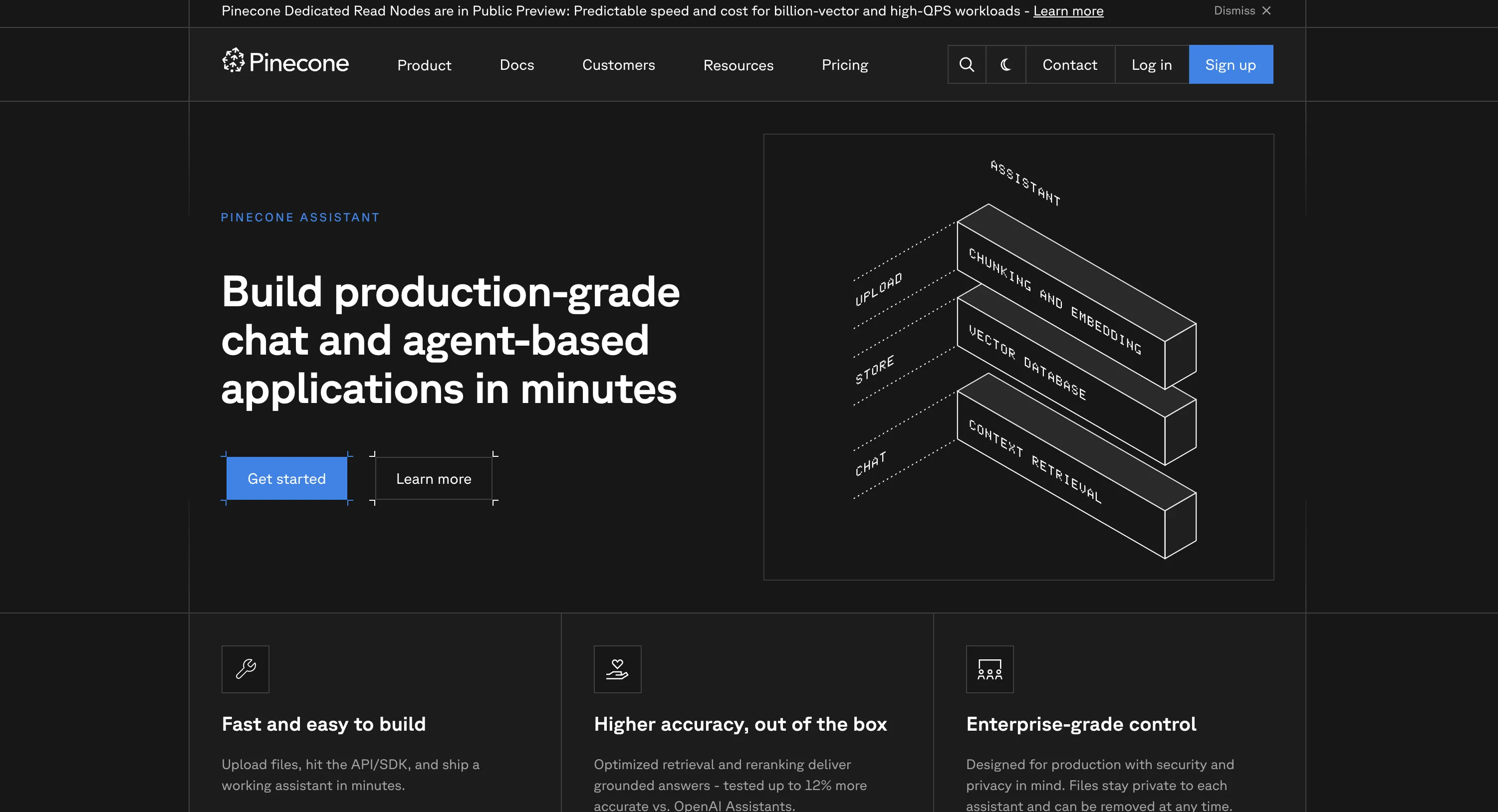
Pinecone Assistant is build knowledgeable ai assistants in minutes with managed rag. Pinecone Assistant is an API service that abstracts away the complexity of RAG development, enabling developers to build grounded chat and agent-based applications quickly with built-in document processing, vector search, and evaluation tools. Founded in 2019, headquartered in New York, NY, the platform has established itself as a reliable solution in the RAG space.
Overall Rating
84/100
Starting Price
$25/mo
About Progress Agentic RAG
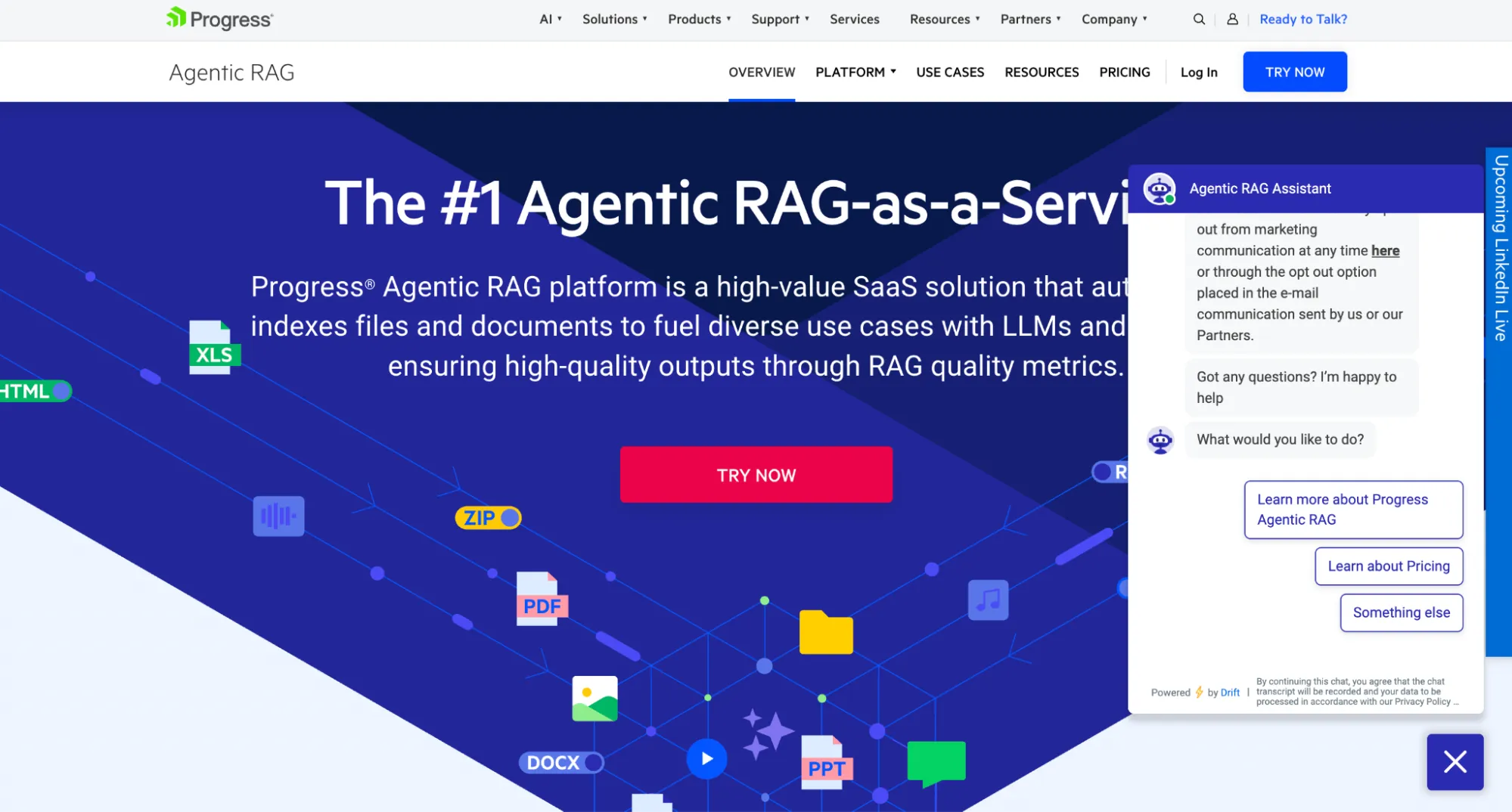
Progress Agentic RAG is enterprise application development and deployment platform. Enterprise RAG-as-a-Service platform launched Sept 2025 following Progress Software's acquisition of Barcelona-based Nuclia. Combines SOC2/ISO 27001 security with proprietary REMi evaluation model for continuous answer quality monitoring. Built on open-source NucliaDB (710+ GitHub stars) with Python/JavaScript SDKs. Starting at $700/month. Founded in 2019 (Nuclia), acquired 2025, headquartered in Barcelona, Spain (Nuclia) / Bedford, MA, USA (Progress), the platform has established itself as a reliable solution in the RAG space.
Overall Rating
82/100
Starting Price
$700/mo
Key Differences at a Glance
In terms of user ratings, both platforms score similarly in overall satisfaction. From a cost perspective, Pinecone Assistant starts at a lower price point. The platforms also differ in their primary focus: RAG Platform versus Enterprise Software. These differences make each platform better suited for specific use cases and organizational requirements.
⚠️ What This Comparison Covers
We'll analyze features, pricing, performance benchmarks, security compliance, integration capabilities, and real-world use cases to help you determine which platform best fits your organization's needs. All data is independently verified from official documentation and third-party review platforms.
Detailed Feature Comparison
Pinecone Assistant
Progress Agentic RAG
CustomGPTRECOMMENDED
Data Ingestion & Knowledge Sources
Handles common text docs—PDF, JSON, Markdown, plain text, Word, and more. [Pinecone Learn]
Automatically chunks, embeds, and stores every upload in a Pinecone index for lightning-fast search.
Add metadata to files for smarter filtering when you retrieve results. [Metadata Filtering]
No native web crawler or Google Drive connector—devs typically push files via the API / SDK.
Scales effortlessly on Pinecone’s vector DB (billions of embeddings). Current preview tier supports up to 10 k files or 10 GB per assistant.
60+ Document Formats: PDF, Word (.docx), Excel, PowerPoint, plain text, email formats with automatic parsing
Multimedia Processing: Automatic speech-to-text (MP3, WAV, AIFF), video transcript extraction (MP4, etc.), OCR for scanned documents/images
Cloud Connectors: SharePoint, Confluence, OneDrive, Google Drive, Amazon S3 with direct integration
Sync Agent Desktop App: 60-minute automatic sync with content hashing to prevent redundant reindexing
Manual Upload Interface: Files, folders, web links, sitemaps, Q&A pairs via dashboard
Fast Deployment: 2-hour initial ingestion, 48-hour full deployment timeline
CRITICAL GAPS: NO Dropbox integration, NO Notion integration, NO explicit YouTube transcript extraction documented
Architecture Focus: Comprehensive knowledge retrieval vs lead conversion focus (unlike Drift)
Lets you ingest more than 1,400 file formats—PDF, DOCX, TXT, Markdown, HTML, and many more—via simple drag-and-drop or API.
Crawls entire sites through sitemaps and URLs, automatically indexing public help-desk articles, FAQs, and docs.
Turns multimedia into text on the fly: YouTube videos, podcasts, and other media are auto-transcribed with built-in OCR and speech-to-text.
View Transcription Guide
Connects to Google Drive, SharePoint, Notion, Confluence, HubSpot, and more through API connectors or Zapier.
See Zapier Connectors
Supports both manual uploads and auto-sync retraining, so your knowledge base always stays up to date.
Integrations & Channels
Pure back-end service—no built-in chat widget or turnkey Slack integration.
Dev teams craft their own front-ends or glue it into Slack/Teams via code or tools like Pipedream.
No one-click Zapier; you embed the Assistant anywhere by hitting its REST endpoints.
That freedom means you can drop it into any environment you like—just bring your own UI.
RAG Cookbook: Comprehensive downloadable guide for developers
SDK Ecosystem: Python (~21K weekly downloads) + JavaScript/TypeScript with active developer usage
14-Day Free Trial: Hands-on evaluation without credit card requirement
Progress Enterprise Support: Backed by 2,000+ employee parent company infrastructure
AWS Marketplace: Available November 2025 for streamlined enterprise procurement
Open-Source Community: NucliaDB 710+ GitHub stars with AGPLv3 license transparency
API-First Support: Comprehensive REST API documentation with regional endpoints
Supplies rich docs, tutorials, cookbooks, and FAQs to get you started fast.
Developer Docs
Offers quick email and in-app chat support—Premium and Enterprise plans add dedicated managers and faster SLAs.
Enterprise Solutions
Benefits from an active user community plus integrations through Zapier and GitHub resources.
Additional Considerations
Pure developer platform: super flexible, but no off-the-shelf UI or business extras.
Built on Pinecone’s blazing vector DB—ideal for massive data or high concurrency.
Evaluation tools let you iterate quickly on retrieval and prompt strategies.
If you need no-code tools, multi-agent flows, or lead capture, you’ll add them yourself.
Recent Acquisition (June 2025): Progress Software acquired Nuclia for $50M - platform transitioning under new ownership with potential strategic direction changes
Genuine No-Code + Developer Appeal: Dual-track value proposition - non-technical teams use dashboard, developers leverage API/SDKs for custom builds
REMi Quality Differentiator: Proprietary continuous evaluation model (30x faster in v2) addresses hallucination problem absent from most RAG competitors
Open-Source Trust Factor: NucliaDB (710+ GitHub stars, AGPLv3) provides code transparency vs black-box platforms - security audits possible
Multimodal Strength: OCR for images, speech-to-text for audio/video creates comprehensive searchable corpus beyond text-only competitors
Enterprise RAG Focus: Platform optimized for knowledge retrieval and semantic search - not conversational marketing/sales engagement like Drift/Yellow.ai
Progress Ecosystem Integration: OpenEdge database connector, Sitefinity CMS integration provides distribution channels unavailable to standalone platforms
Documentation Fragmentation: Dual portals (docs.rag.progress.cloud + legacy docs.nuclia.dev) during transition may cause developer confusion
Competitive Pricing Entry: $700/month Fly tier undercuts enterprise RAG alternatives while providing genuine capabilities vs limited free tiers
Best For: Organizations wanting model flexibility (7 providers), multimodal indexing, open-source transparency, and developer API access without managing infrastructure
Slashes engineering overhead with an all-in-one RAG platform—no in-house ML team required.
Gets you to value quickly: launch a functional AI assistant in minutes.
Stays current with ongoing GPT and retrieval improvements, so you’re always on the latest tech.
Balances top-tier accuracy with ease of use, perfect for customer-facing or internal knowledge projects.
No- Code Interface & Usability
Developer-centric—no no-code editor or chat widget; console UI works for quick uploads and tests.
To launch a branded chatbot, you'll code the front-end and call Pinecone's API for Q&A.
No built-in role-based admin UI for non-tech staff—you'd build your own if needed.
Perfect for teams with dev resources; not plug-and-play for non-coders.
Target Users: Non-technical teams (marketing, HR, legal, customer support) with zero coding required
Visual Dashboard: Create Knowledge Box, upload documents, deploy search widget in single session
Rapid Deployment: Progress explicitly markets minutes-to-production capability for business users
Shadow DOM Architecture: Advanced users can apply CSS styling via cssPath attribute for customization
Offers a wizard-style web dashboard so non-devs can upload content, brand the widget, and monitor performance.
Supports drag-and-drop uploads, visual theme editing, and in-browser chatbot testing.
User Experience Review
Uses role-based access so business users and devs can collaborate smoothly.
Competitive Positioning
Market position: Developer-focused RAG backend built on Pinecone's industry-leading vector database (billions of embeddings at scale), offering pure API service without UI layer
Target customers: Development teams building custom RAG applications, enterprises requiring massive scale and high concurrency, and organizations wanting best-in-class vector search with GPT-4/Claude integration without building retrieval infrastructure from scratch
Key competitors: OpenAI Assistants API (File Search), Weaviate, Milvus, custom implementations using Pinecone vector DB + LangChain, and complete RAG platforms like CustomGPT/Vectara
Competitive advantages: Built on Pinecone's proven vector DB infrastructure (billions of embeddings, enterprise-scale), automatic chunking/embedding/storage eliminating setup complexity, OpenAI-compatible chat endpoint for easy migration, model choice between GPT-4 and Claude 3.5 Sonnet, metadata filtering for smart retrieval, SOC 2 Type II compliance with optional dedicated VPC, and Evaluation API for accuracy tracking over time
Pricing advantage: Usage-based with free Starter tier then transparent per-use pricing (~$3/GB-month storage, $8/M input tokens, $15/M output tokens, $0.20/day per assistant); scales linearly with usage; best value for high-volume applications requiring enterprise-grade vector search without managing infrastructure; more expensive than DIY solutions but saves significant development time
Use case fit: Perfect for development teams needing enterprise-grade vector search at massive scale (billions of embeddings), applications requiring high concurrency and low latency, and teams wanting to build custom RAG front-ends while delegating retrieval infrastructure to proven platform; not suitable for non-technical teams needing turnkey chatbot with UI
Market Position: Enterprise RAG-as-a-Service with genuine no-code accessibility + developer-first API design (dual-track appeal)
vs. CustomGPT: Similar RAG-as-a-Service category, Progress emphasizes REMi quality monitoring + open-source foundation differentiation
vs. Drift/Yellow.ai: TRUE RAG platform vs conversational marketing/sales engagement platforms (fundamentally different categories)
vs. Lindy.ai: Full API/SDK access vs NO public API (Progress developer-friendly, Lindy no-code only)
Integration Gaps: NO native messaging channels (Slack/WhatsApp/Teams) vs omnichannel competitors - requires custom development
HIPAA Gap: No documented certification creates healthcare trust gap vs compliant competitors (Drift has HIPAA)
Recent Acquisition Risk: June 2025 Progress purchase means platform still maturing under new ownership with potential direction changes
Progress Ecosystem Advantage: Integration with OpenEdge, Sitefinity CMS provides distribution channels unavailable to standalone competitors
Market position: Leading all-in-one RAG platform balancing enterprise-grade accuracy with developer-friendly APIs and no-code usability for rapid deployment
Target customers: Mid-market to enterprise organizations needing production-ready AI assistants, development teams wanting robust APIs without building RAG infrastructure, and businesses requiring 1,400+ file format support with auto-transcription (YouTube, podcasts)
Key competitors: OpenAI Assistants API, Botsonic, Chatbase.co, Azure AI, and custom RAG implementations using LangChain
Competitive advantages: Industry-leading answer accuracy (median 5/5 benchmarked), 1,400+ file format support with auto-transcription, SOC 2 Type II + GDPR compliance, full white-labeling included, OpenAI API endpoint compatibility, hosted MCP Server support (Claude, Cursor, ChatGPT), generous data limits (60M words Standard, 300M Premium), and flat monthly pricing without per-query charges
Pricing advantage: Transparent flat-rate pricing at $99/month (Standard) and $449/month (Premium) with generous included limits; no hidden costs for API access, branding removal, or basic features; best value for teams needing both no-code dashboard and developer APIs in one platform
Use case fit: Ideal for businesses needing both rapid no-code deployment and robust API capabilities, organizations handling diverse content types (1,400+ formats, multimedia transcription), teams requiring white-label chatbots with source citations for customer-facing or internal knowledge projects, and companies wanting all-in-one RAG without managing ML infrastructure
A I Models
GPT-4 Support: Supports GPT-4o and GPT-4 models from OpenAI for industry-leading language generation quality
Anthropic Claude 3.5: Claude 3.5 "Sonnet" available for users preferring Anthropic's safety-focused approach
Model Selection Per Query: Explicitly choose GPT-4 or Claude for each request based on use case requirements
No Auto-Routing: Developers control model selection - no automatic routing between models based on query complexity
More LLMs Coming: Platform roadmap includes additional model providers - GPT-3.5 not currently in preview
No Proprietary Reranking: Standard vector search without proprietary rerank layers - raw LLM handles final answer generation
OpenAI-Style Endpoint: OpenAI-compatible chat API simplifies migration from OpenAI Assistants to Pinecone Assistant
Anthropic Models: Claude 3.7, Claude 3.5 Sonnet v2 for safety-focused, high-quality generation
OpenAI Models: ChatGPT 4o, 4o mini for industry-leading language capabilities
Google Models: Gemini Flash 2.5, PaLM2 for multimodal and search-optimized tasks
Meta Models: Llama 3.2 for open-source flexibility and customization
Microsoft/Azure: Mistral Large 2 for enterprise deployments with Azure integration
Cohere Models: Command-R suite for retrieval-optimized generation
Nuclia Private GenAI: 100% data isolation mode for maximum security without third-party LLM exposure
Model Switching: Change providers without architectural changes via Prompt Lab for side-by-side testing
Dynamic Knowledge Management: Continuous updates, gap identification, and automatic documentation generation
Developer RAG Backend: API-first infrastructure for building custom AI applications with Prompt Lab experimentation
Customer support automation: AI assistants handling common queries, reducing support ticket volume, providing 24/7 instant responses with source citations
Internal knowledge management: Employee self-service for HR policies, technical documentation, onboarding materials, company procedures across 1,400+ file formats
Sales enablement: Product information chatbots, lead qualification, customer education with white-labeled widgets on websites and apps
Documentation assistance: Technical docs, help centers, FAQs with automatic website crawling and sitemap indexing
Educational platforms: Course materials, research assistance, student support with multimedia content (YouTube transcriptions, podcasts)
Healthcare information: Patient education, medical knowledge bases (SOC 2 Type II compliant for sensitive data)
Scaling Consideration: Token-based consumption pricing requires careful usage forecasting for budget predictability beyond included tier
Best Value For: Organizations wanting to control costs through usage optimization vs fixed seat-based or per-project pricing models
Standard Plan: $99/month or $89/month annual - 10 custom chatbots, 5,000 items per chatbot, 60 million words per bot, basic helpdesk support, standard security
View Pricing
Premium Plan: $499/month or $449/month annual - 100 custom chatbots, 20,000 items per chatbot, 300 million words per bot, advanced support, enhanced security, additional customization
Enterprise Plan: Custom pricing - Comprehensive AI solutions, highest security and compliance, dedicated account managers, custom SSO, token authentication, priority support with faster SLAs
Enterprise Solutions
7-Day Free Trial: Full access to Standard features without charges - available to all users
Annual billing discount: Save 10% by paying upfront annually ($89/mo Standard, $449/mo Premium)
Flat monthly rates: No per-query charges, no hidden costs for API access or white-labeling (included in all plans)
Managed infrastructure: Auto-scaling cloud infrastructure included - no additional hosting or scaling fees
Support & Documentation
Comprehensive Documentation: docs.pinecone.io with detailed guides, API reference, and copy-paste RAG examples
Developer Community: Lively forums, Slack/Discord channels, and Stack Overflow tags for peer support
Quickstart Guides: Reference architectures and tutorials for typical RAG workflows and implementation patterns
Python & Node.js SDKs: Feature-rich official libraries with clean REST API fallback
OpenAI-Compatible Endpoint: Familiar API design for developers migrating from OpenAI Assistants
Enterprise Support: Email and priority support for paid tiers with custom SLAs for Enterprise plans
Framework Integration: Smooth integration with LangChain, LlamaIndex, and open-source RAG frameworks
RAG Best Practices: Extensive content on retrieval optimization, prompt strategies, and accuracy improvement
Rate Limits: 429 TOO_MANY_REQUESTS errors when exceeding limits - contact support for increases
Starter Plan Limits: 3 assistants max, 1GB storage per assistant, 10 total uploads - restrictive for production
NO Business Features: No lead capture, handoff workflows, or chat logs - pure RAG backend only
Console UI Basics: Admin dashboard limited - no role-based UI for non-technical staff management
Best For Developers: Perfect for teams with dev resources, inappropriate for non-coders wanting plug-and-play solution
NO HIPAA Certification Documented: Healthcare organizations processing PHI must contact sales - major compliance gap vs competitors with documented HIPAA
NO Native Messaging Channels: No Slack, WhatsApp, Telegram, or Microsoft Teams integrations - requires custom API-based development
Documentation Fragmentation: Dual portals (docs.rag.progress.cloud + docs.nuclia.dev) during Progress acquisition transition may cause confusion
Recent Acquisition Risk: June 2025 Progress purchase means platform still maturing under new ownership with potential direction changes
Scalability Concerns: Multiple problems limit scalability - hard to scale nodes up/down, write operations affect concurrent search performance
NO Dropbox Integration: Missing Dropbox connector vs competitors - limits cloud storage sync options
NO Notion Integration: Missing Notion connector - gap for knowledge management workflows
NO YouTube Transcript Extraction: Not explicitly documented vs competitors with video indexing features
Missing Features: NO lead capture, NO human handoff/escalation workflows, NO proactive alerting (monitoring exists, alerting undocumented)
Learning Curve: 30+ RAG parameters and Prompt Lab may feel technical for non-developer teams despite no-code dashboard
Best For: Development teams and technical users - powerful for experts but may overwhelm business users wanting simple deployment
Managed service approach: Less control over underlying RAG pipeline configuration compared to build-your-own solutions like LangChain
Vendor lock-in: Proprietary platform - migration to alternative RAG solutions requires rebuilding knowledge bases
Model selection: Limited to OpenAI (GPT-5.1 and 4 series) and Anthropic (Claude, opus and sonnet 4.5) - no support for other LLM providers (Cohere, AI21, open-source models)
Pricing at scale: Flat-rate pricing may become expensive for very high-volume use cases (millions of queries/month) compared to pay-per-use models
Customization limits: While highly configurable, some advanced RAG techniques (custom reranking, hybrid search strategies) may not be exposed
Language support: Supports 90+ languages but performance may vary for less common languages or specialized domains
Real-time data: Knowledge bases require re-indexing for updates - not ideal for real-time data requirements (stock prices, live inventory)
Enterprise features: Some advanced features (custom SSO, token authentication) only available on Enterprise plan with custom pricing
Core Agent Features
Context API for Agentic Workflows: Delivers structured context as expanded chunks with relevancy scores and references - powerful tool for agentic systems requiring verifiable data
Hallucination Prevention: Context snippets enable agents to verify source data, preventing hallucinations and identifying most relevant data for precise responses
Multi-Source Processing: Context can be used as input to agentic system for further processing or combined with other data sources for comprehensive intelligence
MCP Server Integration: Every Pinecone Assistant is also an MCP server - connect Assistant as context tool in agents and AI applications since November 2024
Model Context Protocol: Anthropic's open standard enables secure, two-way connections between data sources and AI-powered agentic applications
Custom Instructions Support: Metadata filters restrict vector search by user/group/category, instructions tailor responses with short descriptions or directives
Agent Context Grounding: Provides structured, cited context preventing agent drift and ensuring responses grounded in actual knowledge base
Retrieval-Only Mode: Can be used purely for context retrieval without generation - agents use Context API to gather information, then process with own logic
Parallel Context Retrieval: Agents can query multiple Assistants simultaneously for distributed knowledge across specialized domains
Task-Driven Agent Support: Compatible with task-driven autonomous agents utilizing GPT-4, Pinecone, and LangChain for diverse applications
Production Accuracy: Tested up to 12% more accurate vs OpenAI Assistants - optimized retrieval and reranking for agent reliability
Agent Limitations: Stateless design means orchestration logic, multi-agent coordination, long-term memory all in application layer - not built-in agent orchestration
Retrieval Agents: Autonomously select optimal retrieval strategies based on query characteristics
CSS Customization: Shadow DOM architecture with cssPath attribute for advanced styling
White-Labeling: Full OEM deployment support via API-first design
MISSING FEATURES: NO lead capture, NO human handoff/escalation workflows, NO proactive alerting (monitoring exists, alerting undocumented)
Custom AI Agents: Build autonomous agents powered by GPT-4 and Claude that can perform tasks independently and make real-time decisions based on business knowledge
Decision-Support Capabilities: AI agents analyze proprietary data to provide insights, recommendations, and actionable responses specific to your business domain
Multi-Agent Systems: Deploy multiple specialized AI agents that can collaborate and optimize workflows in areas like customer support, sales, and internal knowledge management
Memory & Context Management: Agents maintain conversation history and persistent context for coherent multi-turn interactions
View Agent Documentation
Tool Integration: Agents can trigger actions, integrate with external APIs via webhooks, and connect to 5,000+ apps through Zapier for automated workflows
Hyper-Accurate Responses: Leverages advanced RAG technology and retrieval mechanisms to deliver context-aware, citation-backed responses grounded in your knowledge base
Continuous Learning: Agents improve over time through automatic re-indexing of knowledge sources and integration of new data without manual retraining
Core Focus: Developer-focused RAG infrastructure built on Pinecone's enterprise-grade vector database - accelerates RAG development without UI layer
Fully Managed Backend: All RAG systems and steps handled automatically (chunking, embedding, storage, retrieval, reranking, generation) - no infrastructure management
API-First Service: Pure backend service with Python/Node SDKs and REST API - developers build custom front-ends on top
Model Choice: Supports GPT-4o, GPT-4, Claude 3.5 Sonnet with explicit per-query selection - more LLMs coming soon on roadmap
Pinecone Vector DB Foundation: Built on blazing-fast vector database supporting billions of embeddings at enterprise scale with proven reliability
Evaluation API: Score accuracy against gold-standard datasets for continuous RAG quality improvement - production optimization built-in
OpenAI-Compatible API: OpenAI-style chat endpoint simplifies migration from OpenAI Assistants to Pinecone Assistant
Comparison Alignment: Valid comparison to CustomGPT, Vectara, Nuclia - all are managed RAG services with API access
Key Difference: No no-code UI or widgets - pure backend service vs full-stack platforms (CustomGPT) with embeddable chat interfaces
Use Case Fit: Development teams needing enterprise-grade vector search backend without managing infrastructure - not for non-technical users wanting turnkey chatbot
Generally Available (2024): Thousands of AI assistants created across financial analysis, legal discovery, compliance, shopping, technical support use cases
Platform Type: TRUE RAG-AS-A-SERVICE PLATFORM - Core mission is retrieval-augmented generation backend with developer-first API access
Core Focus: Semantic search and generative Q&A across knowledge bases with transparent NucliaDB architecture
RAG Backend Design: Fully managed RAG infrastructure with embeddable widgets (NOT closed conversational marketing like Drift/Yellow.ai)
Programmatic Access: Complete REST API + dual SDKs (Python/JavaScript) for full knowledge base management
Core Architecture: Serverless RAG infrastructure with automatic embedding generation, vector search optimization, and LLM orchestration fully managed behind API endpoints
API-First Design: Comprehensive REST API with well-documented endpoints for creating agents, managing projects, ingesting data (1,400+ formats), and querying chat
API Documentation
Developer Experience: Open-source Python SDK (customgpt-client), Postman collections, OpenAI API endpoint compatibility, and extensive cookbooks for rapid integration
No-Code Alternative: Wizard-style web dashboard enables non-developers to upload content, brand widgets, and deploy chatbots without touching code
Hybrid Target Market: Serves both developer teams wanting robust APIs AND business users seeking no-code RAG deployment - unique positioning vs pure API platforms (Cohere) or pure no-code tools (Jotform)
RAG Technology Leadership: Industry-leading answer accuracy (median 5/5 benchmarked), 1,400+ file format support with auto-transcription, proprietary anti-hallucination mechanisms, and citation-backed responses
Benchmark Details
Deployment Flexibility: Cloud-hosted SaaS with auto-scaling, API integrations, embedded chat widgets, ChatGPT Plugin support, and hosted MCP Server for Claude/Cursor/ChatGPT
Enterprise Readiness: SOC 2 Type II + GDPR compliance, full white-labeling, domain allowlisting, RBAC with 2FA/SSO, and flat-rate pricing without per-query charges
Use Case Fit: Ideal for organizations needing both rapid no-code deployment AND robust API capabilities, teams handling diverse content types (1,400+ formats, multimedia transcription), and businesses requiring production-ready RAG without building ML infrastructure from scratch
Competitive Positioning: Bridges the gap between developer-first platforms (Cohere, Deepset) requiring heavy coding and no-code chatbot builders (Jotform, Kommunicate) lacking API depth - offers best of both worlds
R E Mi Evaluation Model ( Core Differentiator)
N/A
Proprietary Investment: Significant R&D differentiator addressing hallucination problem - absent from most competitors
REMi v2 (Current): Llama-REMi v1 based on Llama 3.2-3B with 30x faster inference vs original Mistral implementation
Continuous Quality Monitoring: Evaluates EVERY interaction across four dimensions (0-5 scale)
Answer Relevance: Measures how directly response addresses the query
Context Relevance: Assesses quality of retrieved passages relative to question
Groundedness: Evaluates degree to which answers derive from source context (hallucination detection)
Answer Correctness: Alignment with ground truth when available (optional dimension)
Benchmark Validation: Nuclia with OpenAI embeddings achieved highest scores vs Vectara on Docmatix 1.4k dataset across answer relevance, context relevance, correctness
Real-Time Visibility: Dashboard health displays with 7-day rolling averages and performance graphs (24h to 30d)
Competitive Advantage: Most RAG platforms lack continuous quality evaluation - Progress makes this core differentiator
N/A
Open- Source Nuclia D B Foundation
N/A
GitHub Presence: 710+ stars, AGPLv3 license provides full transparency into core retrieval mechanisms
Technology Stack: Python and Rust implementation for performance and reliability
Managed Infrastructure: Progress removes operational burden while maintaining technical transparency
Four Index Types: Document Index (property filtering), Full Text (keyword/fuzzy search), Chunk/Vector (semantic similarity), Knowledge Graph (entity relationships)
Dynamic Sharding: Automatic shard creation as vectors grow with index node replication for fault tolerance
Dynamic Scaling: Automatic shard creation as vector counts grow with index node replication
Web Component Embedding: <nuclia-search-bar> and <nuclia-chat> for website integration
Multi-Region Support: Regional data residency options (EU/US) for compliance requirements
N/A
Customer Base & Case Studies
N/A
SRS Distribution (Wholesale Building Materials): "Progress Agentic RAG has fundamentally changed how we access and act on information across our organisation. Its ability to deliver fast, accurate, and verifiable insights from our unstructured data has been a game-changer for productivity and decision-making."
BrokerChooser (Financial Services): Replaced keyword search with generative AI, reporting significant conversion increases and better user experience
NAFEMS (Engineering Simulation Association): Knowledge discovery across thousands of technical publications for international membership community
Althaia Hospitals (Spain's Largest Central Catalonia Hospital): Medical protocol search supporting 5,000+ healthcare professionals
Columbia Business School: Academic knowledge discovery and research support
Barry University: Education sector deployment for institutional knowledge management
CCOO (Spain's Largest Trade Union): 1M+ members served with knowledge retrieval platform
Buff Sportswear: Commercial deployment for product and customer knowledge management
Pre-Acquisition Scale: ~20 customers across healthcare, pharmaceutical, education, public administration sectors
Final Verdict: Pinecone Assistant vs Progress Agentic RAG
After analyzing features, pricing, performance, and user feedback, both Pinecone Assistant and Progress Agentic RAG are capable platforms that serve different market segments and use cases effectively.
When to Choose Pinecone Assistant
You value very quick setup (under 30 minutes)
Abstracts away RAG complexity
Built on proven Pinecone vector database
Best For: Very quick setup (under 30 minutes)
When to Choose Progress Agentic RAG
You value proprietary remi v2 model (30x faster inference) addresses hallucination problem with continuous quality monitoring - differentiated capability absent from most competitors
Open-source NucliaDB transparency (710+ GitHub stars) with managed infrastructure removes operational burden while maintaining technical visibility
Genuine no-code accessibility: business users (marketing, HR, legal, support) can deploy functional RAG pipelines in minutes via visual dashboard
Best For: Proprietary REMi v2 model (30x faster inference) addresses hallucination problem with continuous quality monitoring - differentiated capability absent from most competitors
Migration & Switching Considerations
Switching between Pinecone Assistant and Progress Agentic RAG requires careful planning. Consider data export capabilities, API compatibility, and integration complexity. Both platforms offer migration support, but expect 2-4 weeks for complete transition including testing and team training.
Pricing Comparison Summary
Pinecone Assistant starts at $25/month, while Progress Agentic RAG begins at $700/month. Total cost of ownership should factor in implementation time, training requirements, API usage fees, and ongoing support. Enterprise deployments typically see annual costs ranging from $10,000 to $500,000+ depending on scale and requirements.
Our Recommendation Process
Start with a free trial - Both platforms offer trial periods to test with your actual data
Define success metrics - Response accuracy, latency, user satisfaction, cost per query
Test with real use cases - Don't rely on generic demos; use your production data
Evaluate total cost - Factor in implementation time, training, and ongoing maintenance
Check vendor stability - Review roadmap transparency, update frequency, and support quality
For most organizations, the decision between Pinecone Assistant and Progress Agentic RAG comes down to specific requirements rather than overall superiority. Evaluate both platforms with your actual data during trial periods, focusing on accuracy, latency, ease of integration, and total cost of ownership.
📚 Next Steps
Ready to make your decision? We recommend starting with a hands-on evaluation of both platforms using your specific use case and data.
• Review: Check the detailed feature comparison table above
• Test: Sign up for free trials and test with real queries
• Calculate: Estimate your monthly costs based on expected usage
• Decide: Choose the platform that best aligns with your requirements
Last updated: December 15, 2025 | This comparison is regularly reviewed and updated to reflect the latest platform capabilities, pricing, and user feedback.
The most accurate RAG-as-a-Service API. Deliver production-ready reliable RAG applications faster. Benchmarked #1 in accuracy and hallucinations for fully managed RAG-as-a-Service API.
DevRel at CustomGPT.ai. Passionate about AI and its applications. Here to help you navigate the world of AI tools and make informed decisions for your business.
People Also Compare
Explore more AI tool comparisons to find the perfect solution for your needs

Join the Discussion
Loading comments...