In this comprehensive guide, we compare Contextual AI and Guru across various parameters including features, pricing, performance, and customer support to help you make the best decision for your business needs.
Overview
When choosing between Contextual AI and Guru, understanding their unique strengths and architectural differences is crucial for making an informed decision. Both platforms serve the RAG (Retrieval-Augmented Generation) space but cater to different use cases and organizational needs.
Quick Decision Guide
Choose Contextual AI if: you value invented by the original creator of rag technology
Choose Guru if: you value permission-aware ai is unique differentiator - answers respect real-time access control
About Contextual AI
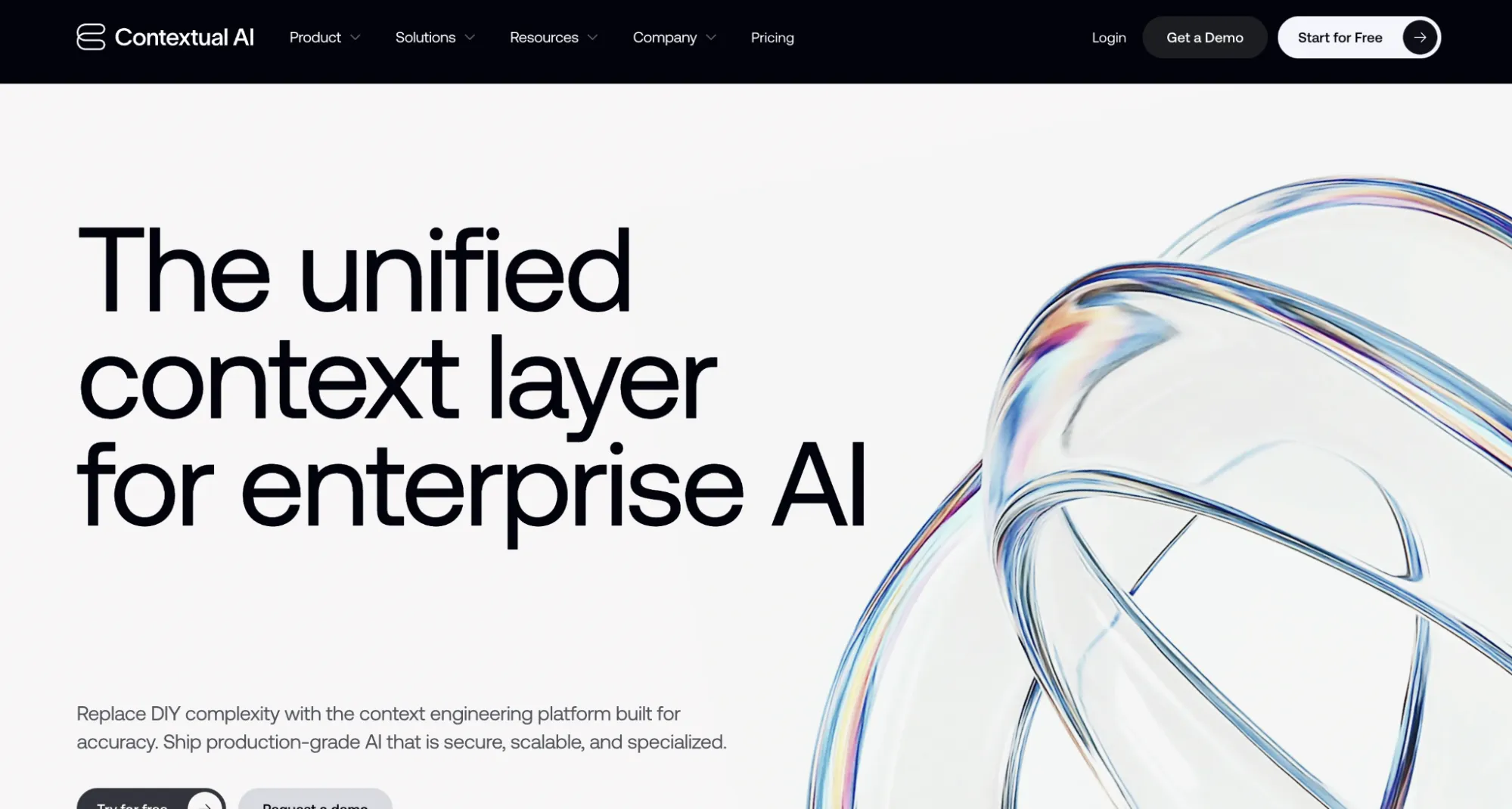
Contextual AI is rag 2.0 platform for enterprise-grade specialized ai agents. Contextual AI is an enterprise platform that pioneered RAG 2.0 technology, enabling organizations to build specialized RAG agents with exceptional accuracy for complex, knowledge-intensive workloads through end-to-end optimized systems. Founded in 2023, headquartered in Mountain View, CA, the platform has established itself as a reliable solution in the RAG space.
Overall Rating
91/100
Starting Price
Custom
About Guru
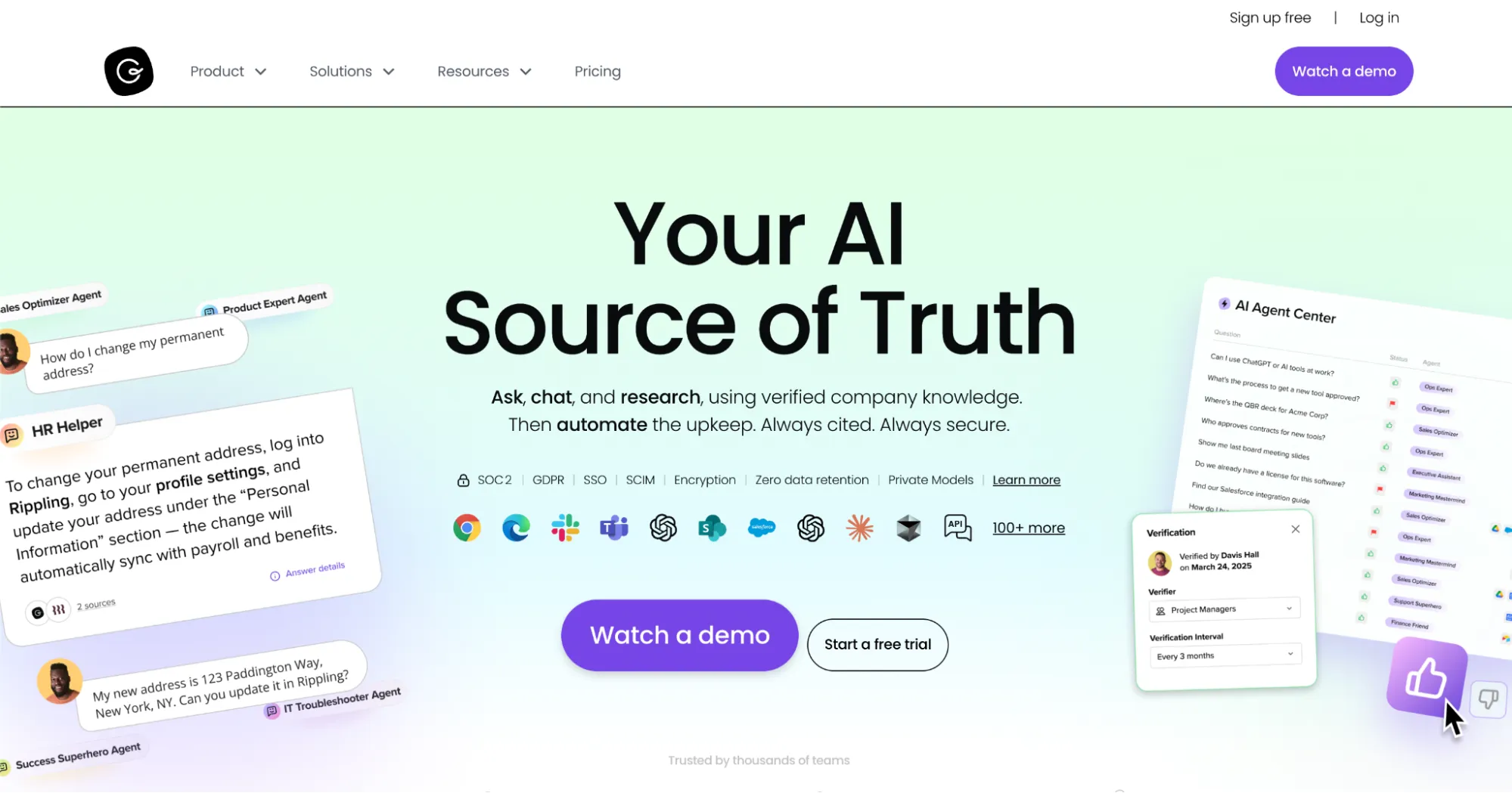
Guru is ai-powered knowledge management and search platform. Enterprise AI knowledge platform with permission-aware Knowledge Agents that deliver trusted, cited answers from your company's verified knowledge base across all workflows. Founded in 2015, headquartered in Philadelphia, PA, USA, the platform has established itself as a reliable solution in the RAG space.
Overall Rating
86/100
Starting Price
$25/mo
Key Differences at a Glance
In terms of user ratings, both platforms score similarly in overall satisfaction. From a cost perspective, Contextual AI starts at a lower price point. The platforms also differ in their primary focus: RAG Platform versus Knowledge Management. These differences make each platform better suited for specific use cases and organizational requirements.
⚠️ What This Comparison Covers
We'll analyze features, pricing, performance benchmarks, security compliance, integration capabilities, and real-world use cases to help you determine which platform best fits your organization's needs. All data is independently verified from official documentation and third-party review platforms.
Detailed Feature Comparison
Contextual AI
Guru
CustomGPTRECOMMENDED
Data Ingestion & Knowledge Sources
Easily brings in both unstructured files (PDFs, HTML, images, charts) and structured data (databases, spreadsheets) through ready-made connectors.
Does multimodal retrieval—turns images and charts into embeddings so everything is searchable together. Source
Hooks into popular SaaS tools like Slack, GitHub, and Google Drive for seamless data flow.
Native Knowledge Base: Guru Cards - verified knowledge articles with expert ownership and verification workflows
External Sources: Optionally approved public websites and web content
Content Types: Structured (Cards, wikis) and unstructured (documents, conversations, attachments)
Automated Syncing: API/SDK for automated Card creation, Zapier/Workato/Prismatic integrations for continuous sync
Real-Time Indexing: Knowledge updates reflected immediately in AI agent responses
Verification System: Regular verification intervals prompt content owners to review and update knowledge
Enterprise Scale: Handles millions of knowledge items across large organizations (thousands of employees)
Single Source of Truth: Centralized, verified company knowledge accessible to all AI agents
Lets you ingest more than 1,400 file formats—PDF, DOCX, TXT, Markdown, HTML, and many more—via simple drag-and-drop or API.
Crawls entire sites through sitemaps and URLs, automatically indexing public help-desk articles, FAQs, and docs.
Turns multimedia into text on the fly: YouTube videos, podcasts, and other media are auto-transcribed with built-in OCR and speech-to-text.
View Transcription Guide
Connects to Google Drive, SharePoint, Notion, Confluence, HubSpot, and more through API connectors or Zapier.
See Zapier Connectors
Supports both manual uploads and auto-sync retraining, so your knowledge base always stays up to date.
Integrations & Channels
Built for API integration first—no plug-and-play web widget included.
Enterprise-grade endpoints and a Snowflake Native App option make tight data integration straightforward. Source
Native Workplace Apps: Slack workspace bot, Microsoft Teams bot, browser extension for any web app
AI Tool Integration: ChatGPT, Claude, GitHub Copilot via MCP (Model Context Protocol) Server
Business Apps: Salesforce knowledge integration, Zendesk support integration, intranet portals
Automation Platforms: Zapier (1,000+ apps), Workato, Prismatic for custom workflows
Developer Access: REST API, Python SDK, webhooks for event-driven integrations
Mobile Apps: iOS and Android native apps for on-the-go knowledge access
Embedded Knowledge: Widgets for internal portals, API-driven custom chat interfaces
MCP Server: Universal connector for any AI tool to access Guru's permission-aware knowledge layer
Focus: Strong internal channel support (Slack/Teams), less emphasis on public consumer channels (WhatsApp, Telegram)
Embeds easily—a lightweight script or iframe drops the chat widget into any website or mobile app.
Offers ready-made hooks for Slack, Zendesk, Confluence, YouTube, Sharepoint, 100+ more.
Explore API Integrations
Connects with 5,000+ apps via Zapier and webhooks to automate your workflows.
Supports secure deployments with domain allowlisting and a ChatGPT Plugin for private use cases.
Hosted CustomGPT.ai offers hosted MCP Server with support for Claude Web, Claude Desktop, Cursor, ChatGPT, Windsurf, Trae, etc.
Read more here.
Powers advanced RAG agents with multi-hop retrieval and chain-of-thought reasoning for tough questions.
Uses a reranker plus groundedness scoring for factual answers with precise attribution. Source
“Instant Viewer” highlights the exact source text backing each part of the answer.
Conversational AI: Multi-turn dialogue with context retention - feels like talking to a knowledgeable co-worker
Multi-Lingual: Content in all languages supported, instant translation to 50+ languages (UI English-only)
Grounded Answers: All responses backed by verified company knowledge with automatic citations
Customizable Knowledge Agents: Create and deploy specialized AI agents for any team or project tailoring knowledge sources, tone, and focus to provide highly relevant role-specific insights that improve over time
Research Mode: Complex queries generate structured multi-source reports with detailed analysis
Permission-Aware: Answers automatically tailored to user's role and access permissions
Content Assist Features: Actions include "Fix grammar," "Summarize," "Make more concise," or custom prompts to match team tone or formatting needs
Admin Customization Controls: Admins can toggle specific actions on or off and create custom assist actions for different user groups ensuring alignment across teams
Conversation Logging: Complete audit trail via AI Agent Center - every question, answer, and source tracked
Analytics Dashboard: Usage stats, deflection rates, time saved, trending questions, knowledge gap identification
Human Escalation: Seamless handoff to subject-matter experts when AI cannot answer, convert queries to Card requests
Internal Focus: Optimized for employee knowledge access vs. external customer engagement features (lead capture not core)
Reduces hallucinations by grounding replies in your data and adding source citations for transparency.
Benchmark Details
Handles multi-turn, context-aware chats with persistent history and solid conversation management.
Speaks 90+ languages, making global rollouts straightforward.
Includes extras like lead capture (email collection) and smooth handoff to a human when needed.
Customization & Branding
Lets you tweak system prompts, tone, and content filters to match company policies—on the back end.
No out-of-the-box UI builder; you’ll embed it in your own branded front end. Source
Custom Agents: Each Knowledge Agent has unique name, avatar, scope, and purpose (IT, HR, Sales, Marketing, Product)
Prompt Configuration: Custom instructions and system messages per agent to shape behavior and response style
Permission Scoping: Agents automatically respect user roles - managers see more detail than general employees
Department Specialization: Create specialized agents for different teams using relevant knowledge Collections
Portal Branding: Guru Pages/Portal can include company logos, colors, custom styling for internal knowledge sites
Limited White-Labeling: Guru branding typically present in web app and extension (internal tool focus, not external)
Create multiple datastores and link them to agents by role or permission for fine-grained access.
Tune the LLM on your own data, add guardrails, and embed custom logic as needed. Source
Real-Time Knowledge Updates: Always available manual retraining across all plans through browser extension and integration sync triggers
Automatic Syncing: Continuous synchronization with integrated systems (Confluence, SharePoint, Notion, Google Drive, Salesforce, Zendesk) for real-time knowledge base updates
Custom Knowledge Agents: Each agent has unique name, avatar, scope, and purpose (IT, HR, Sales, Marketing, Product) with prompt configuration to shape behavior and response style
Department Specialization: Create specialized agents for different teams using relevant knowledge Collections with permission scoping automatically respecting user roles
Permission-Aware Responses: Answers automatically tailored to user's role and access permissions - managers see more detail than general employees
Content Assist Customization: Create custom assist actions for different user groups with admin controls to toggle specific actions on or off ensuring alignment across teams
Verification Workflows: Collaborative knowledge management where Card Owners receive verification reminders, experts can trigger out-of-cycle reviews, and verification intervals are configurable
Knowledge Attribution: Every Card has designated Owner (subject-matter expert), last verified timestamp, trusted status indicator, audit trail of changes
LIMITATION: No programmatic personality management - agent configuration dashboard-only, cannot modify per-user or via API (no /agents endpoint for creating/updating agents)
LIMITATION: Model Abstraction - no user control over LLM selection optimized for simplicity but reduces flexibility for technical users
Lets you add, remove, or tweak content on the fly—automatic re-indexing keeps everything current.
Shapes agent behavior through system prompts and sample Q&A, ensuring a consistent voice and focus.
Learn How to Update Sources
Supports multiple agents per account, so different teams can have their own bots.
Balances hands-on control with smart defaults—no deep ML expertise required to get tailored behavior.
Pricing & Scalability
Usage-based pricing tailored for enterprises—cost scales with agent capacity, data size, and query load. Source
Standalone component APIs are priced per token, letting you mix and match pieces as you grow.
Guru Champions Program: Internal advocates drive adoption and share success stories
Exceptional Support Reputation: Praised in G2 reviews for responsive, effective assistance
Content Library: Knowledge base guides, webinars, case studies, RAG education materials
Supplies rich docs, tutorials, cookbooks, and FAQs to get you started fast.
Developer Docs
Offers quick email and in-app chat support—Premium and Enterprise plans add dedicated managers and faster SLAs.
Enterprise Solutions
Benefits from an active user community plus integrations through Zapier and GitHub resources.
Additional Considerations
Great for mission-critical apps that need multimodal retrieval and advanced reasoning.
Requires more up-front setup and technical know-how than no-code tools—best for teams with ML expertise.
Handles complex needs like role-based data access and evolving multimodal content. Source
Content Maintenance Requirements: Platform value depends on organizational discipline in refreshing knowledge base regularly - requires disciplined maintenance where teams must actively verify cards and keep ownership clear
Search Limitations: Guru's search struggles when knowledge isn't perfectly documented and tagged within its system of Cards - if answer exists only in Slack thread or past conversation, Guru's search won't find it leading to "no results found" dead ends
Enterprise-Specific Limitations: Version history for published cards but not for drafts making collaborative edits hard to track or revert; editor cannot create step-by-step guides or decision trees requiring employees to scan long text
UI Performance Concerns: UI becomes laggy when Knowledge base and team grows - performance degradation at scale
Initial Setup Complexity: New users may find UI slightly complex particularly when managing large collections or reorganizing knowledge across departments - initial setup defining collections, permissions, and verification rules can take time especially for companies with many departments
Pricing Consideration: Per-user seat-based model can be expensive for very large deployments (1,000+ users) vs query-based alternatives - pricing structure requires consideration especially for smaller businesses
Limited Customization: User interface while generally user-friendly may lack flexibility in terms of customization potentially limiting company's ability to fully brand experience or tailor to specific visual preferences
Integration Gaps: While Guru integrates with popular tools like Slack users desire more native integrations with other platforms to further streamline workflows and data synchronization
No Built-In Customer Portal: Guru offers no built-in portal for customers - publishing content online needs extra API work
Internal Focus Trade-off: Platform designed for internal teams - NOT optimized for external customer support chatbots, public-facing agents, or lead capture capabilities
Best For: Companies prioritizing internal knowledge management with verified content workflows and distributed expertise capture
NOT Ideal For: External customer support chatbots, public-facing conversational AI, organizations without verification workflow culture, teams needing deep LLM customization
Slashes engineering overhead with an all-in-one RAG platform—no in-house ML team required.
Gets you to value quickly: launch a functional AI assistant in minutes.
Stays current with ongoing GPT and retrieval improvements, so you’re always on the latest tech.
Balances top-tier accuracy with ease of use, perfect for customer-facing or internal knowledge projects.
No- Code Interface & Usability
Web console helps manage agents, but there's no drag-and-drop chatbot builder.
UI integration is a coding project—APIs are powerful, but non-tech users will need developer help.
Business User Focus: Designed for non-technical knowledge managers, content creators, department leads
Intuitive Card Editor: Wiki-like interface (similar to Notion) for creating and editing knowledge articles
Agent Configuration UI: "Manage > Knowledge Agents" menu with guided setup - no coding required
Point-and-Click Integrations: OAuth connections to Google Drive, Confluence, Slack via simple clicks
Organizational Tools: Tags, folders, Collections for systematic knowledge organization
Verification Workflows: Built-in prompts for regular content review - ensures accuracy without admin overhead
In-App Guidance: Tooltips, help articles, video tutorials (YouTube) guide users through processes
Mobile-Friendly: iOS and Android apps provide full knowledge management on-the-go
No Developer Required: Business users can deploy and maintain AI agents independently after initial setup
Offers a wizard-style web dashboard so non-devs can upload content, brand the widget, and monitor performance.
Supports drag-and-drop uploads, visual theme editing, and in-browser chatbot testing.
User Experience Review
Uses role-based access so business users and devs can collaborate smoothly.
Competitive Positioning
Market position: Enterprise RAG 2.0 platform with proprietary Grounded Language Model (GLM) optimized for factual accuracy and multimodal retrieval capabilities
Target customers: Large enterprises and ML teams requiring mission-critical AI applications with advanced reasoning, multimodal content handling (images, charts), and strict accuracy requirements (88% factual accuracy benchmarked)
Key competitors: OpenAI Enterprise, Azure AI, Deepset, Vectara.ai, and custom-built RAG solutions using LangChain/Haystack
Competitive advantages: Proprietary GLM model with superior RAG performance, multimodal retrieval (images/charts), SOC 2 compliance with VPC/on-prem deployment options, Snowflake Native App integration, groundedness scoring with "Instant Viewer" for source attribution, and multi-hop retrieval with chain-of-thought reasoning
Pricing advantage: Usage-based enterprise pricing with standalone component APIs (reranker, generator) priced per token; flexible for organizations that want to mix and match components; best value for high-accuracy, high-volume use cases
Use case fit: Ideal for mission-critical enterprise applications requiring multimodal retrieval (technical documentation with diagrams), domain-specific AI agents with advanced reasoning, and organizations needing role-based data access with query-time permission checks
Primary Advantage: Permission-aware AI with real-time access control - unique in market
Knowledge Foundation: 10+ years enterprise KM expertise ensures verified, trustworthy knowledge base
Enterprise Focus: Built for large organizations with complex permission structures and compliance needs
Integration Breadth: MCP Server enables universal AI tool connectivity without custom RAG
Primary Challenge: Per-user pricing can be expensive for very large deployments vs. query-based models
Internal Focus: Optimized for internal knowledge vs. external customer-facing chatbots
Market Position: Premium enterprise knowledge platform with AI vs. pure-play RAG chatbot services
Use Case Fit: Ideal for enterprises prioritizing trust, governance, and internal knowledge access
Proven Scale: Handles thousands of users and millions of knowledge items in production deployments
Market position: Leading all-in-one RAG platform balancing enterprise-grade accuracy with developer-friendly APIs and no-code usability for rapid deployment
Target customers: Mid-market to enterprise organizations needing production-ready AI assistants, development teams wanting robust APIs without building RAG infrastructure, and businesses requiring 1,400+ file format support with auto-transcription (YouTube, podcasts)
Key competitors: OpenAI Assistants API, Botsonic, Chatbase.co, Azure AI, and custom RAG implementations using LangChain
Competitive advantages: Industry-leading answer accuracy (median 5/5 benchmarked), 1,400+ file format support with auto-transcription, SOC 2 Type II + GDPR compliance, full white-labeling included, OpenAI API endpoint compatibility, hosted MCP Server support (Claude, Cursor, ChatGPT), generous data limits (60M words Standard, 300M Premium), and flat monthly pricing without per-query charges
Pricing advantage: Transparent flat-rate pricing at $99/month (Standard) and $449/month (Premium) with generous included limits; no hidden costs for API access, branding removal, or basic features; best value for teams needing both no-code dashboard and developer APIs in one platform
Use case fit: Ideal for businesses needing both rapid no-code deployment and robust API capabilities, organizations handling diverse content types (1,400+ formats, multimedia transcription), teams requiring white-label chatbots with source citations for customer-facing or internal knowledge projects, and companies wanting all-in-one RAG without managing ML infrastructure
A I Models
Grounded Language Model (GLM): Proprietary model tuned specifically for RAG with ~88% factual accuracy on FACTS benchmark
Industry-Leading Groundedness: GLM achieves 88% vs. Gemini 2.0 Flash (84.6%), Claude 3.5 Sonnet (79.4%), GPT-4o (78.8%) on factuality benchmarks
Inline Attribution: Model provides citations showing exact source documents for each part of response as generated
Standalone APIs: Exposes separate reranker and generator APIs with simple token-based pricing for flexible integration
Model-Agnostic Option: Platform supports integration with other LLMs if needed for specific use cases
Optimized for RAG: GLM specifically designed for retrieval-augmented generation scenarios vs. general-purpose LLMs
Abstracted Model Architecture: LLM selection handled internally - likely OpenAI GPT (GPT-3.5/GPT-4) by default for standard operations
No User-Facing Selection: No UI toggle for model choice - platform optimized for trust and simplicity over technical control
LLM-Agnostic Design: Architecture designed to work with different models providing enterprise flexibility for future model changes
Private Model Options: Enterprise can opt for dedicated private AI model instance (e.g., Azure OpenAI in customer tenant) for data sovereignty
Zero Data Retention: Third-party LLM endpoints configured to never store or train on customer data - critical privacy guarantee
Automatic Optimization: System may use different models for simple FAQ responses vs. complex Research Mode queries for cost/quality balance
Security-First Selection: Model choice prioritizes compliance, data sovereignty, and zero leakage guarantees over raw performance metrics
Quality Assurance Layer: All answers cited and permission-aware regardless of underlying model - trust layer above LLM capabilities
Primary models: GPT-5.1 and 4 series from OpenAI, and Anthropic's Claude 4.5 (opus and sonnet) for enterprise needs
Automatic model selection: Balances cost and performance by automatically selecting the appropriate model for each request
Model Selection Details
Proprietary optimizations: Custom prompt engineering and retrieval enhancements for high-quality, citation-backed answers
Managed infrastructure: All model management handled behind the scenes - no API keys or fine-tuning required from users
Anti-hallucination technology: Advanced mechanisms ensure chatbot only answers based on provided content, improving trust and factual accuracy
R A G Capabilities
RAG 2.0 Architecture: Advanced approach tops industry benchmarks for document understanding and factuality with multi-hop retrieval
Multimodal Retrieval: Turns images and charts into embeddings for unified search across text and visual content
Groundedness Scoring: Built-in evaluation shows groundedness scores with "Instant Viewer" highlighting exact source text backing each answer part
Reranker + Scoring: Uses reranker plus groundedness scoring for factual answers with precise attribution
Multi-Hop Retrieval: Advanced RAG agents with multi-hop retrieval and chain-of-thought reasoning for tough questions
Handles Noisy Datasets: Robust reranking and retrieval for large, noisy datasets with multiple datastores by role or permission
Query-Time Access Checks: Role-based permissions with query-time access validation for secure data retrieval
RAG Foundation: Retrieval-Augmented Generation grounds all answers in verified company knowledge with automatic citations
Multiple Retrieval Techniques: Several search algorithms ensure best information found for each query type and context
Synthesis Capability: Combines insights from multiple documents for comprehensive answers to complex questions
Automatic Citations: Every answer includes exact source references (specific slide, Card, document section) for verification
Permission Filtering: Retrieval only uses content user is authorized to see - prevents context contamination and information leakage
Verified Knowledge Base: Expert verification workflows ensure underlying data is reliable, current, and trustworthy
Real-Time Accuracy: Knowledge updates immediately reflected in AI responses - no stale data lag or cache delays
Hallucination Reduction: RAG architecture significantly reduces AI hallucinations vs. LLM-only approaches through knowledge grounding
Confidence Handling: When unsure, agent indicates lack of knowledge rather than guessing wrong answer - transparency over completeness
Core architecture: GPT-4 combined with Retrieval-Augmented Generation (RAG) technology, outperforming OpenAI in RAG benchmarks
RAG Performance
Anti-hallucination technology: Advanced mechanisms reduce hallucinations and ensure responses are grounded in provided content
Benchmark Details
Automatic citations: Each response includes clickable citations pointing to original source documents for transparency and verification
Optimized pipeline: Efficient vector search, smart chunking, and caching for sub-second reply times
Scalability: Maintains speed and accuracy for massive knowledge bases with tens of millions of words
Context-aware conversations: Multi-turn conversations with persistent history and comprehensive conversation management
Source verification: Always cites sources so users can verify facts on the spot
Use Cases
Industries Served: Finance, technology, media, professional services, regulated industries (healthcare, telecommunications) requiring high-accuracy AI
Mission-Critical Applications: Applications where factual accuracy is paramount and hallucinations must be minimized
Multimodal Use Cases: Technical documentation with diagrams, charts in business documents, visual content requiring understanding
Domain-Specific AI Agents: Custom agents requiring advanced reasoning with access to structured and unstructured data
Role-Based Access: Organizations needing fine-grained data access control with query-time permission enforcement
Team Sizes: Large enterprises and ML teams with technical expertise for integration and deployment
Enterprise Internal Support: IT, HR, Sales, Support, Marketing, Product teams accessing verified company knowledge through AI agents
Knowledge Base Unification: Single source of truth aggregating content from SharePoint, Confluence, Notion, Salesforce, Google Drive
Employee Onboarding: New hires access role-appropriate information automatically filtered by permission level and department
Sales Enablement: Real-time access to product information, competitive intelligence, pricing, and deal strategies during customer conversations
Regulatory Compliance: Financial services, healthcare, legal industries requiring strict information controls and audit trails
Research Mode Queries: Complex multi-source research generating structured reports with detailed analysis and citations
Cross-System Integration: MCP Server enables ChatGPT, Claude, GitHub Copilot to access Guru knowledge with preserved permissions
Knowledge Gap Identification: Analytics identify missing content based on unanswered questions to drive content creation priorities
Large Organization Scale: Supports organizations with thousands of employees and millions of knowledge items in production
Customer support automation: AI assistants handling common queries, reducing support ticket volume, providing 24/7 instant responses with source citations
Internal knowledge management: Employee self-service for HR policies, technical documentation, onboarding materials, company procedures across 1,400+ file formats
Sales enablement: Product information chatbots, lead qualification, customer education with white-labeled widgets on websites and apps
Documentation assistance: Technical docs, help centers, FAQs with automatic website crawling and sitemap indexing
Educational platforms: Course materials, research assistance, student support with multimedia content (YouTube transcriptions, podcasts)
Healthcare information: Patient education, medical knowledge bases (SOC 2 Type II compliant for sensitive data)
AI Usage Credits: AI credits included with usage limits appropriate for typical internal usage patterns - not per-query charges
Enterprise Plan: Custom pricing with flexible usage-based model, volume discounts, overage pricing for scale
Seat-Based Model: Cost scales linearly with user count - can be expensive for very large deployments vs query-based pricing
Predictable Scaling: Start with per-seat pricing, transition to usage-based for enterprise scale to avoid surprise costs
No Content Limits: No explicit cap on knowledge items or documents - can store thousands of Cards without additional fees
Enterprise Scalability: Supports organizations with thousands of employees and extensive knowledge bases in production
ROI Focus: Guru claims 10x+ ROI from day one through productivity gains and time savings for knowledge workers
Total Cost Coverage: Includes full platform (knowledge management + AI) vs. AI-only pricing of pure RAG competitors
Credit System: A credit consumed whenever Guru's AI executes specific unit of work on behalf of users
Standard Plan: $99/month or $89/month annual - 10 custom chatbots, 5,000 items per chatbot, 60 million words per bot, basic helpdesk support, standard security
View Pricing
Premium Plan: $499/month or $449/month annual - 100 custom chatbots, 20,000 items per chatbot, 300 million words per bot, advanced support, enhanced security, additional customization
Enterprise Plan: Custom pricing - Comprehensive AI solutions, highest security and compliance, dedicated account managers, custom SSO, token authentication, priority support with faster SLAs
Enterprise Solutions
7-Day Free Trial: Full access to Standard features without charges - available to all users
Annual billing discount: Save 10% by paying upfront annually ($89/mo Standard, $449/mo Premium)
Flat monthly rates: No per-query charges, no hidden costs for API access or white-labeling (included in all plans)
Managed infrastructure: Auto-scaling cloud infrastructure included - no additional hosting or scaling fees
Support & Documentation
High-Touch Enterprise Support: Solution engineers and technical account managers for dedicated customer success
API Documentation: Solid REST APIs and Python SDK documentation for managing agents, ingesting data, and querying
Endpoint Coverage: APIs for tuning, evaluation, standalone components with clear, token-based pricing transparency
Partnership Ecosystem: Grows via partnerships (Snowflake) and industry thought leadership for enterprise integration
Learning Resources: Technical documentation and integration guides for ML teams and developers
Response Times: Enterprise support includes dedicated resources for onboarding and technical assistance
Multi-Channel Support: Help Center with comprehensive guides, Community forum for peer learning, live chat for paying customers
Enterprise Support: Dedicated Customer Success Manager, priority support queues, SLA guarantees for response times
Guru University: Training programs, workshops, office hours, certification courses for user skill development
Active Community: User forum for peer learning, knowledge sharing, best practice discussions across industries
Developer Resources: Extensive API docs at developer.getguru.com, Python SDK, integration examples, developer blog
Active community: User community plus 5,000+ app integrations through Zapier ecosystem
Regular updates: Platform stays current with ongoing GPT and retrieval improvements automatically
Limitations & Considerations
Technical Expertise Required: Best for teams with ML expertise - more up-front setup and technical know-how than no-code tools
NO Drag-and-Drop Builder: Web console helps manage agents, but no drag-and-drop chatbot builder for non-technical users
UI Integration is Coding Project: APIs are powerful, but non-tech users will need developer help for implementation
Learning Curve: Platform requires understanding of RAG concepts, embeddings, and AI agent architecture
NO Pre-Built UI: No out-of-the-box UI builder; customers embed in their own branded front end
API-First Platform: Built for API integration first - no plug-and-play web widget included
Enterprise Focus: Pricing and features target large enterprises vs. SMBs or individual developers
NOT Ideal For: Small teams without ML/AI expertise, organizations wanting no-code deployment, businesses needing immediate plug-and-play solutions
Per-User Pricing Challenges: Seat-based model can be expensive for very large deployments (1,000+ users) vs query-based alternatives
Internal Focus Trade-off: Optimized for internal knowledge access vs external customer-facing chatbot capabilities (lead capture not core)
Limited White-Labeling: Guru branding typically present in web app and extension - internal tool focus vs external customer experiences
English-Only UI: Content supports all languages with translation to 50+, but user interface remains English-only for administrators
Model Abstraction: No user control over LLM selection - optimized for simplicity but reduces flexibility for technical users
AI Credit Management: Usage limits require monitoring and management - organizations may need to purchase additional credits
Enterprise Requirements: Advanced features (IP whitelisting, SSO, SCIM, private models) require Enterprise plan with custom pricing
Setup Complexity: Initial configuration of integrations, permissions, and verification workflows requires thoughtful planning
Change Management: Successful deployment requires organizational adoption of verification workflows and knowledge ownership culture
External Use Limitations: Platform designed for internal teams - not optimized for external customer support chatbots or public-facing agents
Managed service approach: Less control over underlying RAG pipeline configuration compared to build-your-own solutions like LangChain
Vendor lock-in: Proprietary platform - migration to alternative RAG solutions requires rebuilding knowledge bases
Model selection: Limited to OpenAI (GPT-5.1 and 4 series) and Anthropic (Claude, opus and sonnet 4.5) - no support for other LLM providers (Cohere, AI21, open-source models)
Pricing at scale: Flat-rate pricing may become expensive for very high-volume use cases (millions of queries/month) compared to pay-per-use models
Customization limits: While highly configurable, some advanced RAG techniques (custom reranking, hybrid search strategies) may not be exposed
Language support: Supports 90+ languages but performance may vary for less common languages or specialized domains
Real-time data: Knowledge bases require re-indexing for updates - not ideal for real-time data requirements (stock prices, live inventory)
Enterprise features: Some advanced features (custom SSO, token authentication) only available on Enterprise plan with custom pricing
Core Agent Features
RAG 2.0 Agents: Specialized RAG agents for expert knowledge work with advanced contextual understanding and multi-hop retrieval capabilities
Multi-Hop Retrieval: Advanced RAG agents execute multi-hop retrieval and chain-of-thought reasoning for tough, complex questions
Task-Oriented Assistants: Domain-specific AI agents designed for mission-critical applications requiring high accuracy and minimal hallucinations
Multiple Datastore Support: Create multiple datastores and link them to agents by role or permission for fine-grained access control
Custom Logic Integration: Tune LLM on your own data, add guardrails, and embed custom logic as needed for specialized workflows
Agent APIs: Programmatic agent creation, management, and querying through comprehensive REST APIs and Python SDK
Grounded Generation: Inline citations showing exact document spans that informed each response part with built-in hallucination reduction
Document-Level Security: Enterprise controls for access permissions on sensitive data with query-time access validation
Platform Generally Available (January 2025): Helping enterprises build specialized RAG agents to support expert knowledge work
State-of-the-Art Performance: Each component achieves state-of-the-art benchmarks on BIRD (structured reasoning), RAG-QA Arena (end-to-end RAG), OmniDocBench (document understanding)
N/A
Custom AI Agents: Build autonomous agents powered by GPT-4 and Claude that can perform tasks independently and make real-time decisions based on business knowledge
Decision-Support Capabilities: AI agents analyze proprietary data to provide insights, recommendations, and actionable responses specific to your business domain
Multi-Agent Systems: Deploy multiple specialized AI agents that can collaborate and optimize workflows in areas like customer support, sales, and internal knowledge management
Memory & Context Management: Agents maintain conversation history and persistent context for coherent multi-turn interactions
View Agent Documentation
Tool Integration: Agents can trigger actions, integrate with external APIs via webhooks, and connect to 5,000+ apps through Zapier for automated workflows
Hyper-Accurate Responses: Leverages advanced RAG technology and retrieval mechanisms to deliver context-aware, citation-backed responses grounded in your knowledge base
Continuous Learning: Agents improve over time through automatic re-indexing of knowledge sources and integration of new data without manual retraining
R A G-as-a- Service Assessment
Platform Type: TRUE ENTERPRISE RAG 2.0 PLATFORM - Proprietary Grounded Language Model (GLM) optimized for factual accuracy and multimodal retrieval
RAG 2.0 Architecture: Advanced approach tops industry benchmarks for document understanding and factuality with multi-hop retrieval (announced general availability January 2025)
Proprietary GLM Model: ~88% factual accuracy on FACTS benchmark outperforming Gemini 2.0 Flash (84.6%), Claude 3.5 Sonnet (79.4%), GPT-4o (78.8%)
Built-in Evaluation Tools: Assess generated responses for equivalence and groundedness with comprehensive evaluation across every critical component
Multimodal Retrieval: Turns images and charts into embeddings for unified search across text and visual content in technical documentation
Groundedness Scoring: Built-in scoring with "Instant Viewer" highlighting exact source text backing each answer part for transparency
Reranker + Scoring: Uses reranker plus groundedness scoring for factual answers with precise attribution and hallucination reduction
Handles Noisy Datasets: Robust reranking and retrieval for large, noisy datasets with multiple datastores by role or permission
Production-Grade Accuracy: Delivers production-grade accuracy for specialized knowledge tasks with enterprise security, audit trails, high availability, scalability, compliance
Joint Tuning Capability: Retrieval and generation components can be jointly tuned by providing sample queries, gold-standard responses, supporting evidence
Comprehensive Assessment: Measures end-to-end RAG performance, multi-modal document understanding, structured data retrieval, and grounded language generation
Target Market: Large enterprises and ML teams requiring mission-critical AI applications with advanced reasoning and strict accuracy requirements
Use Case Fit: Ideal for mission-critical enterprise applications requiring multimodal retrieval, domain-specific AI agents, and role-based data access with query-time permission checks
Core Architecture: Serverless RAG infrastructure with automatic embedding generation, vector search optimization, and LLM orchestration fully managed behind API endpoints
API-First Design: Comprehensive REST API with well-documented endpoints for creating agents, managing projects, ingesting data (1,400+ formats), and querying chat
API Documentation
Developer Experience: Open-source Python SDK (customgpt-client), Postman collections, OpenAI API endpoint compatibility, and extensive cookbooks for rapid integration
No-Code Alternative: Wizard-style web dashboard enables non-developers to upload content, brand widgets, and deploy chatbots without touching code
Hybrid Target Market: Serves both developer teams wanting robust APIs AND business users seeking no-code RAG deployment - unique positioning vs pure API platforms (Cohere) or pure no-code tools (Jotform)
RAG Technology Leadership: Industry-leading answer accuracy (median 5/5 benchmarked), 1,400+ file format support with auto-transcription, proprietary anti-hallucination mechanisms, and citation-backed responses
Benchmark Details
Deployment Flexibility: Cloud-hosted SaaS with auto-scaling, API integrations, embedded chat widgets, ChatGPT Plugin support, and hosted MCP Server for Claude/Cursor/ChatGPT
Enterprise Readiness: SOC 2 Type II + GDPR compliance, full white-labeling, domain allowlisting, RBAC with 2FA/SSO, and flat-rate pricing without per-query charges
Use Case Fit: Ideal for organizations needing both rapid no-code deployment AND robust API capabilities, teams handling diverse content types (1,400+ formats, multimedia transcription), and businesses requiring production-ready RAG without building ML infrastructure from scratch
Competitive Positioning: Bridges the gap between developer-first platforms (Cohere, Deepset) requiring heavy coding and no-code chatbot builders (Jotform, Kommunicate) lacking API depth - offers best of both worlds
Customization & Flexibility
N/A
Real-Time Knowledge Updates: Edit Guru Cards anytime via web UI or API - changes immediately available to AI
Continuous Syncing: External sources (Google Drive, Confluence, etc.) can auto-sync on schedules
Verification Workflows: Regular prompts to content owners ensure knowledge stays fresh and accurate
Agent Configuration: Custom prompt settings, intro messages, response style per agent via configuration UI
Permission-Based Personalization: Answers automatically tailored to user role without manual multi-bot setup
Draft Mode: Capture new AI-generated insights as draft Cards for human review and approval
Human-in-Loop: Subject-matter experts can refine AI answers and incorporate into knowledge base
Multi-Agent Flexibility: Create specialized agents for different departments, each with unique scope and behavior
No Downtime Updates: Knowledge base modifications happen live without service interruption
N/A
Permission- Aware A I
N/A
Real-Time Access Control: AI respects user permissions from connected systems (SharePoint, Confluence, etc.)
Role-Based Answers: Manager asking same question as employee gets different answer based on accessible content
Prevents Information Leakage: Confidential knowledge never used in answers for unauthorized users
No Manual Segmentation: Don't need separate bots per role - single agent adapts automatically
After analyzing features, pricing, performance, and user feedback, both Contextual AI and Guru are capable platforms that serve different market segments and use cases effectively.
When to Choose Contextual AI
You value invented by the original creator of rag technology
Best-in-class accuracy on RAG benchmarks
End-to-end optimized system vs cobbled together solutions
Best For: Invented by the original creator of RAG technology
When to Choose Guru
You value permission-aware ai is unique differentiator - answers respect real-time access control
Enterprise-grade security: SOC 2, GDPR, zero LLM data retention, private models
Verified knowledge base with expert verification workflows ensures accuracy
Best For: Permission-aware AI is unique differentiator - answers respect real-time access control
Migration & Switching Considerations
Switching between Contextual AI and Guru requires careful planning. Consider data export capabilities, API compatibility, and integration complexity. Both platforms offer migration support, but expect 2-4 weeks for complete transition including testing and team training.
Pricing Comparison Summary
Contextual AI starts at custom pricing, while Guru begins at $25/month. Total cost of ownership should factor in implementation time, training requirements, API usage fees, and ongoing support. Enterprise deployments typically see annual costs ranging from $10,000 to $500,000+ depending on scale and requirements.
Our Recommendation Process
Start with a free trial - Both platforms offer trial periods to test with your actual data
Define success metrics - Response accuracy, latency, user satisfaction, cost per query
Test with real use cases - Don't rely on generic demos; use your production data
Evaluate total cost - Factor in implementation time, training, and ongoing maintenance
Check vendor stability - Review roadmap transparency, update frequency, and support quality
For most organizations, the decision between Contextual AI and Guru comes down to specific requirements rather than overall superiority. Evaluate both platforms with your actual data during trial periods, focusing on accuracy, latency, ease of integration, and total cost of ownership.
📚 Next Steps
Ready to make your decision? We recommend starting with a hands-on evaluation of both platforms using your specific use case and data.
• Review: Check the detailed feature comparison table above
• Test: Sign up for free trials and test with real queries
• Calculate: Estimate your monthly costs based on expected usage
• Decide: Choose the platform that best aligns with your requirements
Last updated: December 11, 2025 | This comparison is regularly reviewed and updated to reflect the latest platform capabilities, pricing, and user feedback.
The most accurate RAG-as-a-Service API. Deliver production-ready reliable RAG applications faster. Benchmarked #1 in accuracy and hallucinations for fully managed RAG-as-a-Service API.
DevRel at CustomGPT.ai. Passionate about AI and its applications. Here to help you navigate the world of AI tools and make informed decisions for your business.
People Also Compare
Explore more AI tool comparisons to find the perfect solution for your needs

Join the Discussion
Loading comments...