Data Ingestion & Knowledge Sources
100+ Native Connectors – SharePoint, Salesforce, ServiceNow, Confluence, databases, file shares, Slack, websites merged into one indexOCR & Structured Data – Indexes scanned docs, intranet pages, knowledge articles, multimedia contentReal-Time Sync – Incremental crawls, push APIs, scheduled syncs keep content fresh
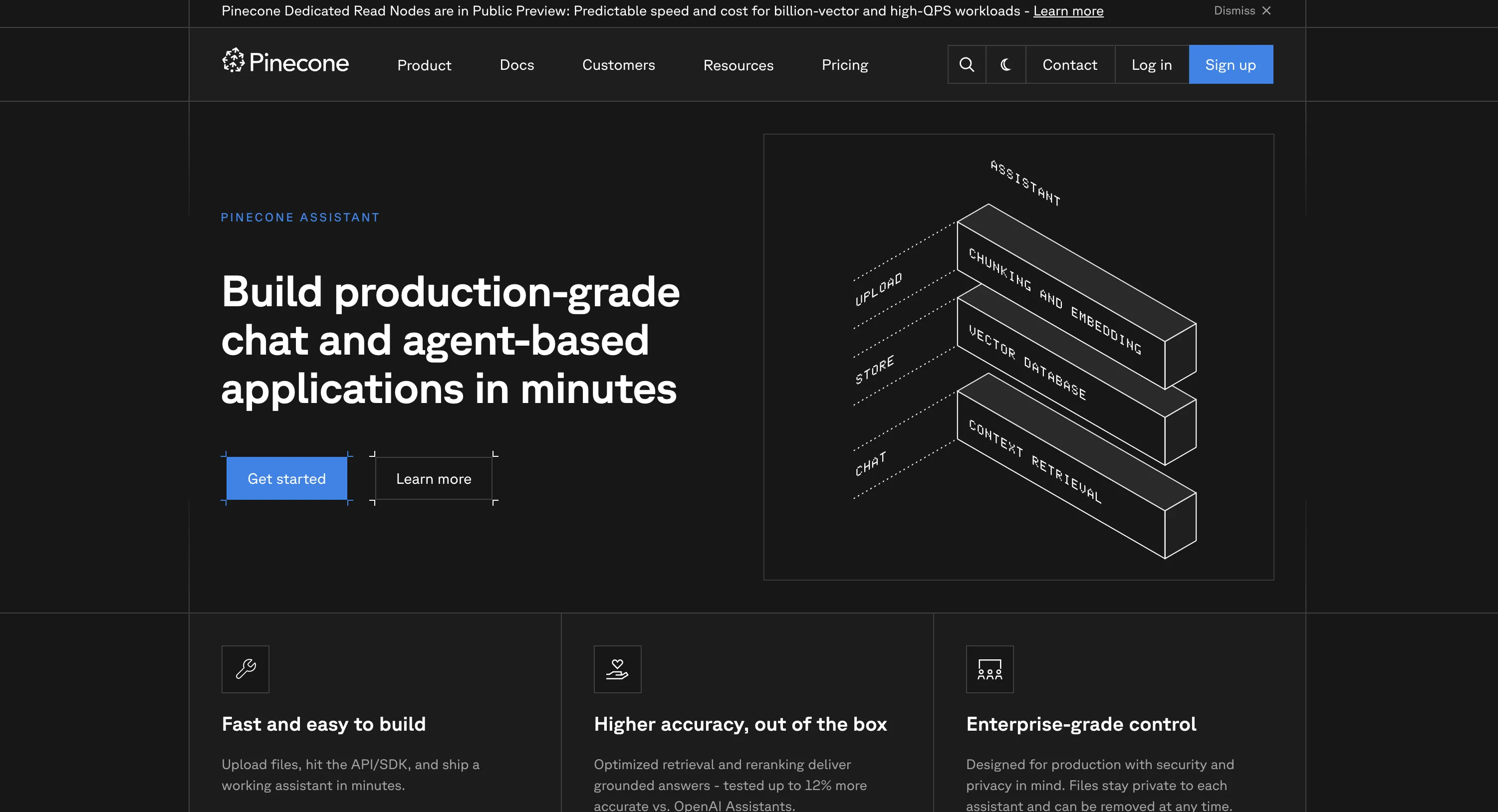
✅ File Format Support – PDF, JSON, Markdown, Word, plain text auto-chunked and embedded. [Pinecone Learn] ✅ Automatic Processing – Chunks, embeds, stores uploads in Pinecone index for fast search.✅ Metadata Filtering – Add tags to files for smarter retrieval results. [Metadata] ⚠️ No Native Connectors – No web crawler or Drive connector; push files via API/SDK.✅ Enterprise Scale – Billions of embeddings; preview tier supports 10K files or 10GB per assistant.
1,400+ file formats – PDF, DOCX, Excel, PowerPoint, Markdown, HTML + auto-extraction from ZIP/RAR/7Z archivesWebsite crawling – Sitemap indexing with configurable depth for help docs, FAQs, and public contentMultimedia transcription – AI Vision, OCR, YouTube/Vimeo/podcast speech-to-text built-inCloud integrations – Google Drive, SharePoint, OneDrive, Dropbox, Notion with auto-syncKnowledge platforms – Zendesk, Freshdesk, HubSpot, Confluence, Shopify connectorsMassive scale – 60M words (Standard) / 300M words (Premium) per bot with no performance degradation
Atomic UI Components – Drop-in components for search pages, support hubs, commerce sites with generative answersNative Platform Integrations – Salesforce, Sitecore with AI answers inside existing toolsREST APIs – Build custom chatbots, virtual assistants on Coveo's retrieval engine
⚠️ Backend Service Only – No built-in chat widget or turnkey Slack/Teams integration.Developer-Built Front-Ends – Teams craft custom UIs or integrate via code/Pipedream.REST API Integration – Embed anywhere by hitting endpoints; no one-click Zapier connector.✅ Full Flexibility – Drop into any environment with your own UI and logic.
Website embedding – Lightweight JS widget or iframe with customizable positioningCMS plugins – WordPress, WIX, Webflow, Framer, SquareSpace native support5,000+ app ecosystem – Zapier connects CRMs, marketing, e-commerce toolsMCP Server – Integrate with Claude Desktop, Cursor, ChatGPT, WindsurfOpenAI SDK compatible – Drop-in replacement for OpenAI API endpointsLiveChat + Slack – Native chat widgets with human handoff capabilities
Uses Relevance Generative Answering (RGA)—a two-step retrieval plus LLM flow that produces concise, source-cited answers.
Respects permissions, showing each user only the content they’re allowed to see.
Blends the direct answer with classic search results so people can dig deeper if they want.
Multi-Turn Q&A – GPT-4 or Claude; stateless conversation requires passing prior messages yourself.⚠️ No Business Extras – No lead capture, handoff, or chat logs; add in app layer.✅ Context-Grounded Answers – Returns cited responses tied to your documents reducing hallucinations.Core Focus – Rock-solid retrieval plus response; business features in your codebase.
✅ #1 accuracy – Median 5/5 in independent benchmarks, 10% lower hallucination than OpenAI✅ Source citations – Every response includes clickable links to original documents✅ 93% resolution rate – Handles queries autonomously, reducing human workload✅ 92 languages – Native multilingual support without per-language config✅ Lead capture – Built-in email collection, custom forms, real-time notifications✅ Human handoff – Escalation with full conversation context preserved
Atomic components are fully styleable with CSS, making it easy to match your brand’s look and feel.
You can tweak answer formatting and citation display through configs; deeper personality tweaks mean editing the prompt.
✅ 100% Your UI – No default interface; branding baked in by design, fully white-label.No Pinecone Badge – Zero branding to hide; complete control over look and feel.Domain Control – Gating and embed rules handled in code via API keys/auth.✅ Unlimited Freedom – Pinecone ships zero CSS; style however you want.
Full white-labeling included – Colors, logos, CSS, custom domains at no extra cost2-minute setup – No-code wizard with drag-and-drop interfacePersona customization – Control AI personality, tone, response style via pre-promptsVisual theme editor – Real-time preview of branding changesDomain allowlisting – Restrict embedding to approved sites only
Azure OpenAI GPT – Primary models via Azure OpenAI for high-quality generationBring Your Own LLM – Relevance-Augmented Passage Retrieval API supports custom modelsAuto-Tuning – Handles model tuning, prompt optimization; API override available
✅ GPT-4 & Claude 3.5 – Pick model per query; supports GPT-4o, GPT-4, Claude Sonnet. [Blog] ⚠️ Manual Model Selection – No auto-routing; explicitly choose GPT-4 or Claude each request.Limited Options – GPT-3.5 not in preview; more LLMs coming soon on roadmap.Standard Vector Search – No proprietary rerank layer; raw LLM handles final answer generation.
GPT-5.1 models – Latest thinking models (Optimal & Smart variants)GPT-4 series – GPT-4, GPT-4 Turbo, GPT-4o availableClaude 4.5 – Anthropic's Opus available for EnterpriseAuto model routing – Balances cost/performance automaticallyZero API key management – All models managed behind the scenes
Developer Experience ( A P I & S D Ks)
REST APIs & SDKs – Java, .NET, JavaScript for indexing, connectors, queryingUI Components – Atomic and Quantic components for fast front-end integrationEnterprise Documentation – Step-by-step guides for pipelines, index management
✅ Rich SDK Support – Python, Node.js SDKs plus clean REST API. [SDK Support] Comprehensive Endpoints – Create/delete assistants, upload/list files, run chat/retrieval queries.✅ OpenAI-Compatible API – Simplifies migration from OpenAI Assistants to Pinecone Assistant.Documentation – Reference architectures and copy-paste examples for typical RAG flows.
REST API – Full-featured for agents, projects, data ingestion, chat queriesPython SDK – Open-source customgpt-client with full API coveragePostman collections – Pre-built requests for rapid prototypingWebhooks – Real-time event notifications for conversations and leadsOpenAI compatible – Use existing OpenAI SDK code with minimal changes
Pairs keyword search with semantic vector search so the LLM gets the best possible context.
Reranking plus smart prompts keep hallucinations low and citations precise.
Built on a scalable architecture that handles heavy query loads and massive content sets.
✅ Fast Retrieval – Pinecone vector DB delivers speed; GPT-4/Claude ensures quality answers.✅ Benchmarked Superior – 12% more accurate vs OpenAI Assistants via optimized retrieval. [Benchmark] Citations Reduce Hallucinations – Context plus citations tie answers to real data sources.Evaluation API – Score accuracy against gold-standard datasets for continuous improvement.
Sub-second responses – Optimized RAG with vector search and multi-layer cachingBenchmark-proven – 13% higher accuracy, 34% faster than OpenAI Assistants APIAnti-hallucination tech – Responses grounded only in your provided contentOpenGraph citations – Rich visual cards with titles, descriptions, images99.9% uptime – Auto-scaling infrastructure handles traffic spikes
Customization & Flexibility ( Behavior & Knowledge)
Fine-tune which sources and metadata the engine uses via query pipelines and filters.
Integrates with SSO/LDAP so results are tailored to each user’s permissions.
Developers can tweak prompt templates or inject business rules to shape the output.
Custom System Prompts – Add persona control per call; persistent UI not in preview yet.✅ Real-Time Updates – Add, update, delete files anytime; changes reflect immediately in answers.Metadata Filtering – Narrow retrieval by tags/attributes at query time for smarter results.⚠️ Stateless Design – Long-term memory or multi-agent logic lives in your app code.
Live content updates – Add/remove content with automatic re-indexingSystem prompts – Shape agent behavior and voice through instructionsMulti-agent support – Different bots for different teamsSmart defaults – No ML expertise required for custom behavior
Enterprise Licensing – Pricing based on sources, query volume, features99.999% Uptime – Scales to millions of queries, regional data centersAnnual Contracts – Volume tiers with optional premium support
Usage-Based Model – Free Starter, then pay for storage/tokens/assistant fee. [Pricing] Sample Costs – ~$3/GB-month storage, $8/M input tokens, $15/M output tokens, $0.20/day per assistant.✅ Linear Scaling – Costs scale with usage; ideal for growing applications over time.Enterprise Tier – Higher concurrency, multi-region, volume discounts, custom SLAs.
Standard: $99/mo – 60M words, 10 botsPremium: $449/mo – 300M words, 100 botsAuto-scaling – Managed cloud scales with demandFlat rates – No per-query charges
ISO 27001/27018, SOC 2 – Plus HIPAA-compatible deployments availablePermission-Aware – Granular access controls, users see only authorized contentPrivate Cloud/On-Prem – Deployment options for strict data-residency requirements
✅ Data Isolation – Files encrypted and siloed; never used to train models. [Privacy] ✅ SOC 2 Type II – Compliant with strong encryption and optional dedicated VPC.Full Content Control – Delete or replace content anytime; control what assistant remembers.Enterprise Options – SSO, advanced roles, custom hosting for strict compliance requirements.
SOC 2 Type II + GDPR – Third-party audited complianceEncryption – 256-bit AES at rest, SSL/TLS in transitAccess controls – RBAC, 2FA, SSO, domain allowlistingData isolation – Never trains on your data
Observability & Monitoring
Analytics Dashboard – Tracks query volume, engagement, generative-answer performancePipeline Logs – Exportable for deeper analysis and troubleshootingA/B Testing – Query pipeline experiments to measure impact, fine-tune relevance
Dashboard Metrics – Shows token usage, storage, concurrency; no built-in convo analytics. [Token Usage] Evaluation API – Track accuracy over time against gold-standard benchmarks.⚠️ Manual Chat Logs – Dev teams handle chat-log storage if transcripts needed.External Integration – Easy to pipe metrics into Datadog, Splunk via API logs.
Real-time dashboard – Query volumes, token usage, response timesCustomer Intelligence – User behavior patterns, popular queries, knowledge gapsConversation analytics – Full transcripts, resolution rates, common questionsExport capabilities – API export to BI tools and data warehouses
Enterprise Support – Account managers, 24/7 help, extensive training programsPartner Network – Coveo Connect community with docs, forums, certified integrationsRegular Updates – Product releases and industry events for latest trends
✅ Lively Community – Forums, Slack/Discord, Stack Overflow tags with active developers.Extensive Documentation – Quickstarts, RAG best practices, and comprehensive API reference.Support Tiers – Email/priority support for paid; Enterprise adds custom SLAs and engineers.Framework Integration – Smooth integration with LangChain, LlamaIndex, open-source RAG frameworks.
Comprehensive docs – Tutorials, cookbooks, API referencesEmail + in-app support – Under 24hr response timePremium support – Dedicated account managers for Premium/EnterpriseOpen-source SDK – Python SDK, Postman, GitHub examples5,000+ Zapier apps – CRMs, e-commerce, marketing integrations
Additional Considerations
Coveo goes beyond Q&A to power search, recommendations, and discovery for large digital experiences.
Deep integration with enterprise systems and strong permissioning make it ideal for internal knowledge management.
Feature-rich but best suited for organizations with an established IT team to tune and maintain it.
⚠️ Developer Platform Only – Super flexible but no off-the-shelf UI or business extras.✅ Pinecone Vector DB – Built on blazing vector database for massive data/high concurrency.Evaluation Tools – Iterate quickly on retrieval and prompt strategies with built-in testing.Custom Business Logic – No-code tools, multi-agent flows, lead capture require custom development.
Time-to-value – 2-minute deployment vs weeks with DIYAlways current – Auto-updates to latest GPT modelsProven scale – 6,000+ organizations, millions of queriesMulti-LLM – OpenAI + Claude reduces vendor lock-in
No- Code Interface & Usability
Admin Console – Atomic components enable minimal-code starts⚠️ Developer Involvement – Full generative setup requires technical resources
Best For – Teams with existing IT resources, more complex than pure no-code
⚠️ Developer-Centric – No no-code editor or widget; console for quick uploads/tests only.Code Required – Must code front-end and call Pinecone API for branded chatbot.No Admin UI – No role-based admin for non-tech staff; build your own if needed.Perfect for Dev Teams – Not plug-and-play for non-coders; requires development resources.
2-minute deployment – Fastest time-to-value in the industryWizard interface – Step-by-step with visual previewsDrag-and-drop – Upload files, paste URLs, connect cloud storageIn-browser testing – Test before deploying to productionZero learning curve – Productive on day one
Market Position – Enterprise AI-powered search/discovery with RGA for large-scale knowledge managementTarget Customers – Large enterprises with complex content (SharePoint, Salesforce, ServiceNow, Confluence) needing permission-aware searchKey Competitors – Azure AI Search, Vectara.ai, Glean, Elastic Enterprise SearchCompetitive Advantages – 100+ connectors, hybrid search, permission-aware results, 99.999% uptime SLAPricing – Enterprise licensing higher than SaaS chatbots; best value for unified search across massive contentUse Case Fit – Knowledge hubs, support portals, commerce sites with generative answers
Market Position – Developer-focused RAG backend on top-ranked vector database (billions of embeddings).Target Customers – Dev teams building custom RAG apps requiring massive scale and concurrency.Key Competitors – OpenAI Assistants API, Weaviate, Milvus, CustomGPT, Vectara, DIY solutions.✅ Competitive Advantages – Proven infrastructure, auto chunking/embedding, OpenAI-compatible API, GPT-4/Claude choice, SOC 2.Best Value For – High-volume apps needing enterprise vector search without managing infrastructure.
Market position – Leading RAG platform balancing enterprise accuracy with no-code usability. Trusted by 6,000+ orgs including Adobe, MIT, Dropbox.Key differentiators – #1 benchmarked accuracy • 1,400+ formats • Full white-labeling included • Flat-rate pricingvs OpenAI – 10% lower hallucination, 13% higher accuracy, 34% fastervs Botsonic/Chatbase – More file formats, source citations, no hidden costsvs LangChain – Production-ready in 2 min vs weeks of development
Azure OpenAI GPT – Primary models via Azure OpenAI for high-quality generationModel Flexibility – Relevance-Augmented Passage Retrieval API supports custom LLMsAuto-Tuning – Handles model tuning, prompt optimization automatically; API override availableSearch Integration – LLM tightly integrated with keyword + semantic search pipeline
✅ GPT-4 Support – GPT-4o and GPT-4 from OpenAI for top-tier quality.✅ Claude 3.5 Sonnet – Anthropic's safety-focused model available for all queries.⚠️ Manual Model Selection – Explicitly choose model per request; no auto-routing based on complexity.Roadmap Expansion – More LLM providers coming; GPT-3.5 not in current preview.
OpenAI – GPT-5.1 (Optimal/Smart), GPT-4 seriesAnthropic – Claude 4.5 Opus/Sonnet (Enterprise)Auto-routing – Intelligent model selection for cost/performanceManaged – No API keys or fine-tuning required
RGA (Relevance Generative Answering) – Two-step retrieval + LLM producing source-cited answersHybrid Search – Keyword + semantic vector search for optimal LLM contextReranking & Smart Prompts – Keeps hallucinations low, citations precisePermission-Aware – SSO/LDAP integration shows only authorized content per userQuery Pipelines – Fine-tune sources, metadata, filters for retrieval control99.999% Uptime – Scalable architecture for heavy query loads, massive content sets
✅ Automatic Chunking – Document segmentation and vector generation automatic; no manual preprocessing.✅ Pinecone Vector DB – High-speed database supporting billions of embeddings at enterprise scale.✅ Metadata Filtering – Smart retrieval using tags/attributes for narrowing results at query time.✅ Citations Reduce Hallucinations – Responses include source citations tying answers to real documents.Evaluation API – Score accuracy against gold-standard datasets for continuous quality improvement.
GPT-4 + RAG – Outperforms OpenAI in independent benchmarksAnti-hallucination – Responses grounded in your content onlyAutomatic citations – Clickable source links in every responseSub-second latency – Optimized vector search and cachingScale to 300M words – No performance degradation at scale
Industries – Financial Services, Telecommunications, High-Tech, Retail, Healthcare, ManufacturingInternal Knowledge – Enterprise systems integration, permissioning for documentation, knowledge hubsCustomer Support – Support hubs with generative answers from knowledge bases, ticket historyCommerce Sites – Product search, recommendations, AI-powered discovery featuresContent Scale – Large distributed content across SharePoint, databases, file shares, Confluence, ServiceNowTeam Sizes – Large enterprises with IT teams, millions of queries
Financial & Legal – Compliance assistants, portfolio analysis, case law research, contract analysis at scale.Technical Support – Documentation search for resolving issues with accurate, cited technical answers.Enterprise Knowledge – Self-serve knowledge bases for teams searching corporate documentation internally.Shopping Assistants – Help customers navigate product catalogs with semantic search capabilities.⚠️ NOT SUITABLE FOR – Non-technical teams wanting turnkey chatbot with UI; developer-centric only.
Customer support – 24/7 AI handling common queries with citationsInternal knowledge – HR policies, onboarding, technical docsSales enablement – Product info, lead qualification, educationDocumentation – Help centers, FAQs with auto-crawlingE-commerce – Product recommendations, order assistance
ISO 27001/27018, SOC 2 – International security, privacy standards for enterprisesHIPAA-Compatible – Deployments available for healthcare compliance requirementsGranular Access Controls – Permission-aware search, SSO/LDAP integrationPrivate Cloud/On-Prem – Options for strict data-residency requirements99.999% Uptime SLA – Regional data centers for mission-critical infrastructure
✅ SOC 2 Type II – Enterprise-grade security validation from independent third-party audits.✅ HIPAA Certified – Available for healthcare applications processing PHI with appropriate agreements.Data Encryption – Files encrypted and siloed; never used to train global models.Enterprise Features – Optional dedicated VPC, SSO, advanced roles, custom hosting for compliance.
SOC 2 Type II + GDPR – Regular third-party audits, full EU compliance256-bit AES encryption – Data at rest; SSL/TLS in transitSSO + 2FA + RBAC – Enterprise access controls with role-based permissionsData isolation – Never trains on customer dataDomain allowlisting – Restrict chatbot to approved domains
Enterprise Licensing – $600 to $1,320 depending on sources, query volume, featuresPro Plan – Entry-level with core search, RGA for smaller enterprisesEnterprise Plan – Full-featured with advanced capabilities, higher volumes, premium supportAnnual Contracts – Volume tiers with optional premium support packages⚠️ Consumption-Based – Pricing model can make costs hard to predict
Best Value For – Unified search across massive content, millions of queries
Free Starter Tier – 1GB storage, 200K output tokens, 1.5M input tokens for evaluation/development.Standard Plan – $50/month minimum with pay-as-you-go beyond minimum usage credits included.Token & Storage Costs – ~$8/M input, ~$15/M output tokens, ~$3/GB-month storage, $0.20/day per assistant.✅ Linear Scaling – Costs scale with usage; Enterprise adds volume discounts and multi-region.
Standard: $99/mo – 10 chatbots, 60M words, 5K items/botPremium: $449/mo – 100 chatbots, 300M words, 20K items/botEnterprise: Custom – SSO, dedicated support, custom SLAs7-day free trial – Full Standard access, no chargesFlat-rate pricing – No per-query charges, no hidden costs
Enterprise Support – Account managers, 24/7 help, guaranteed response timesPartner Network – Certified integrations via Coveo Connect communityDocumentation – Step-by-step guides for pipelines, index management, connectorsTraining Programs – Admin console, Atomic components, developer integrationRegular Updates – Product releases, industry events for latest trends
✅ Comprehensive Docs – docs.pinecone.io with guides, API reference, and copy-paste RAG examples.Developer Community – Forums, Slack/Discord channels, and Stack Overflow tags for peer support.Python & Node SDKs – Feature-rich libraries with clean REST API fallback option.Enterprise Support – Email/priority support for paid tiers with custom SLAs for Enterprise.
Documentation hub – Docs, tutorials, API referencesSupport channels – Email, in-app chat, dedicated managers (Premium+)Open-source – Python SDK, Postman, GitHub examplesCommunity – User community + 5,000 Zapier integrations
Limitations & Considerations
⚠️ Developer Involvement – Full generative setup requires technical resources
⚠️ Cost Predictability – Consumption-based pricing hard to predict for enterprise scale
⚠️ IT Team Needed – Best for organizations with established technical teams
⚠️ Enterprise Focus – Optimized for enterprises vs. SMBs or startups
NOT Ideal For – Small businesses, plug-and-play chatbot needs, immediate no-code deployment
⚠️ Developer-Centric – No no-code editor or chat widget; requires coding for UI.⚠️ Stateless Architecture – Long-term memory, multi-agent flows, conversation state in app code.⚠️ Limited Models – GPT-4 and Claude 3.5 only; GPT-3.5 not in preview.File Restrictions – Scanned PDFs and OCR not supported; images in documents ignored.⚠️ NO Business Features – No lead capture, handoff, or chat logs; pure RAG backend.
Managed service – Less control over RAG pipeline vs build-your-ownModel selection – OpenAI + Anthropic only; no Cohere, AI21, open-sourceReal-time data – Requires re-indexing; not ideal for live inventory/pricesEnterprise features – Custom SSO only on Enterprise plan
Agentic AI Integration – Coveo for Agentforce, expanded API suite, Design Partner Program (2024-2025)Agent API Suite – Search API, Passage Retrieval API, Answer API for grounding agentsSalesforce Agentforce – Native integration for customer service, sales, marketing agentsAWS RAG-as-a-Service – MCP Server for Amazon Bedrock AgentCore, Agents, Quick Suite (Dec 2024)Four Tools – Passage Retrieval, Answer gen (Amazon Nova), Search, FetchSecurity-First – Inherits document/item-level permissions automatically for trusted answers
✅ Context API – Delivers structured context with relevancy scores for agentic systems requiring verification.✅ MCP Server Integration – Every Assistant is MCP server; connect as context tool since Nov 2024.Custom Instructions – Metadata filters restrict vector search; instructions tailor responses with directives.Retrieval-Only Mode – Use purely for context retrieval; agents gather info then process with logic.⚠️ Agent Limitations – Stateless design; orchestration logic, multi-agent coordination in application layer.
Custom AI Agents – Autonomous GPT-4/Claude agents for business tasksMulti-Agent Systems – Specialized agents for support, sales, knowledgeMemory & Context – Persistent conversation history across sessionsTool Integration – Webhooks + 5,000 Zapier apps for automationContinuous Learning – Auto re-indexing without manual retraining
R A G-as-a- Service Assessment
Platform Type – Enterprise search with RAG-as-a-Service, Relevance Generative Answering (RGA)RAG Launch – AWS RAG-as-a-Service announced December 1, 2024 as cloud-native offering40% Accuracy Improvement – RAG increases base model accuracy according to industry studiesHybrid Search – Keyword, vector, hybrid search with relevance tuning100+ Connectors – SharePoint, Salesforce, ServiceNow, Confluence, databases, SlackBest For – Enterprises with distributed content needing permission-aware search, knowledge hubs, generative answers
✅ TRUE RAG-AS-A-SERVICE – Managed backend API abstracting chunking, embedding, storage, retrieval, reranking, generation.API-First Service – Pure backend with Python/Node SDKs; developers build custom front-ends on top.✅ Pinecone Vector DB Foundation – Built on proven database supporting billions of embeddings at enterprise scale.OpenAI-Compatible – Simplifies migration from OpenAI Assistants to Pinecone Assistant seamlessly.⚠️ Key Difference – No no-code UI/widgets vs full-stack platforms (CustomGPT) with embeddable chat.
Platform type – TRUE RAG-AS-A-SERVICE with managed infrastructureAPI-first – REST API, Python SDK, OpenAI compatibility, MCP ServerNo-code option – 2-minute wizard deployment for non-developersHybrid positioning – Serves both dev teams (APIs) and business users (no-code)Enterprise ready – SOC 2 Type II, GDPR, WCAG 2.0, flat-rate pricing










Join the Discussion
Loading comments...