Data Ingestion & Knowledge Sources
✅ Point-and-click RAG builder – Mix SharePoint, Confluence, databases via visual pipeline [MongoDB Reference] ✅ Fine-grained control – Configure chunk sizes, embedding strategies, multiple sources simultaneously✅ Multi-source blending – Combine documents and live database queries in same pipeline
✅ PDF uploads & public website crawling – Zendesk help center content indexing supported✅ Proprietary interactive guide format – Primary content model with visual editor⚠️ No cloud storage integrations – Missing Google Drive, Dropbox, Notion, SharePoint, YouTubeContent limits: Basic (5 guides, 400 views/mo), Small Business (unlimited, 4K views/mo), Enterprise (custom)
1,400+ file formats – PDF, DOCX, Excel, PowerPoint, Markdown, HTML + auto-extraction from ZIP/RAR/7Z archivesWebsite crawling – Sitemap indexing with configurable depth for help docs, FAQs, and public contentMultimedia transcription – AI Vision, OCR, YouTube/Vimeo/podcast speech-to-text built-inCloud integrations – Google Drive, SharePoint, OneDrive, Dropbox, Notion with auto-syncKnowledge platforms – Zendesk, Freshdesk, HubSpot, Confluence, Shopify connectorsMassive scale – 60M words (Standard) / 300M words (Premium) per bot with no performance degradation
✅ API-first architecture – Surface agents via REST or GraphQL endpoints [MongoDB: API Approach] ⚠️ No prefab UI – Bring or build your own front-end chat widget✅ Universal integration – Drop into any environment that makes HTTP calls
✅ Deep help desk integrations – Zendesk, Salesforce Service Cloud, Freshdesk, ServiceNow✅ Zapier integration – Webhook triggers for form submissions and completions✅ Analytics integrations – Segment, Google Analytics⚠️ No messaging integrations – Missing Slack, WhatsApp, Telegram, Microsoft Teams
Website embedding – Lightweight JS widget or iframe with customizable positioningCMS plugins – WordPress, WIX, Webflow, Framer, SquareSpace native support5,000+ app ecosystem – Zapier connects CRMs, marketing, e-commerce toolsMCP Server – Integrate with Claude Desktop, Cursor, ChatGPT, WindsurfOpenAI SDK compatible – Drop-in replacement for OpenAI API endpointsLiveChat + Slack – Native chat widgets with human handoff capabilities
✅ Agentic architecture – Multi-step reasoning, tool use, dynamic decision-making [Agentic RAG] ✅ Intelligent routing – Agents decide knowledge base vs live DB vs API✅ Complex workflows – Fetch structured data, retrieve docs, blend answers automatically
✅ Interactive step-by-step guides – Visual flow builder with branching logic✅ Decision trees and checklists – Task management with progress tracking✅ Contact forms and lead capture – Integrated customer information collection✅ Multi-language support – Auto-translation on Enterprise plan
✅ #1 accuracy – Median 5/5 in independent benchmarks, 10% lower hallucination than OpenAI✅ Source citations – Every response includes clickable links to original documents✅ 93% resolution rate – Handles queries autonomously, reducing human workload✅ 92 languages – Native multilingual support without per-language config✅ Lead capture – Built-in email collection, custom forms, real-time notifications✅ Human handoff – Escalation with full conversation context preserved
✅ 100% front-end control – No built-in UI means complete look and feel ownership✅ Deep behavior tweaks – Customize prompt templates and scenario configs extensively✅ Multiple personas – Create unlimited agent personas with different rule sets
✅ Visual no-code editor – Intuitive interface for guides, decision trees, forms✅ CSS customization on all paid plans – White-labeling Enterprise only✅ Small learning curve – Users create guides in under 30 minutes⚠️ Cannot edit on mobile devices – Desktop-only guide creation
Full white-labeling included – Colors, logos, CSS, custom domains at no extra cost2-minute setup – No-code wizard with drag-and-drop interfacePersona customization – Control AI personality, tone, response style via pre-promptsVisual theme editor – Real-time preview of branding changesDomain allowlisting – Restrict embedding to approved sites only
✅ Model-agnostic – Plug in GPT-4, Claude, open-source models freely✅ Full stack control – Choose embedding model, vector DB, orchestration logic⚠️ More setup required – Power and flexibility trade-off vs turnkey solutions
⚠️ Undisclosed proprietary LLM – No model selection or transparency on provider✅ AI Profiles (20) & Custom Instructions (100) – Define tone, boundaries, behavior✅ Guided AI Answers – Predefined responses for sensitive scenarios bypass AI✅ Knowledge-grounded approach – Anchored responses reduce hallucinations vs generic chatbots
GPT-5.1 models – Latest thinking models (Optimal & Smart variants)GPT-4 series – GPT-4, GPT-4 Turbo, GPT-4o availableClaude 4.5 – Anthropic's Opus available for EnterpriseAuto model routing – Balances cost/performance automaticallyZero API key management – All models managed behind the scenes
Developer Experience ( A P I & S D Ks)
✅ No-code pipeline builder – Design pipelines visually, deploy to single API endpoint✅ Sandbox testing – Rapid iteration and tweaking before production launch⚠️ No official SDK – REST/GraphQL integration straightforward but no client libraries
✅ REST API – User provisioning, content management, widget control✅ Mobile SDKs (Enterprise only) – iOS, Android, React Native, Flutter⚠️ No Python/Node.js SDKs – No GraphQL, OpenAPI specs, or API sandbox
REST API – Full-featured for agents, projects, data ingestion, chat queriesPython SDK – Open-source customgpt-client with full API coveragePostman collections – Pre-built requests for rapid prototypingWebhooks – Real-time event notifications for conversations and leadsOpenAI compatible – Use existing OpenAI SDK code with minimal changes
✅ Hybrid retrieval – Mix semantic, lexical, or graph search for sharper context✅ Threshold tuning – Balance precision vs recall for your domain requirements✅ Enterprise scaling – Vector DBs and stores handle high-volume workloads efficiently
✅ 71% self-serve success rate – Company data with AI Answers feature✅ 70-76% ticket reduction – Documented in case studies✅ 99.9% uptime claimed – No published SLA or response time details⚠️ Flow reports update every 15 min – Not real-time analytics
Sub-second responses – Optimized RAG with vector search and multi-layer cachingBenchmark-proven – 13% higher accuracy, 34% faster than OpenAI Assistants APIAnti-hallucination tech – Responses grounded only in your provided contentOpenGraph citations – Rich visual cards with titles, descriptions, images99.9% uptime – Auto-scaling infrastructure handles traffic spikes
Customization & Flexibility ( Behavior & Knowledge)
✅ Multi-step reasoning – Scenario logic, tool calls, unified agent workflows✅ Data blending – Combine structured APIs/DBs with unstructured docs seamlessly✅ Full retrieval control – Customize chunking, metadata, and retrieval algorithms completely
✅ CSS and HTML customization – Change layout and look with custom code✅ Intuitive no-code tools – Easy customization without coding for basics✅ Personalized content – Use customer data for targeted experiences✅ Rich media support – Images, GIFs, videos, annotations
Live content updates – Add/remove content with automatic re-indexingSystem prompts – Shape agent behavior and voice through instructionsMulti-agent support – Different bots for different teamsSmart defaults – No ML expertise required for custom behavior
⚠️ Custom contracts only – No public tiers, typically usage-based enterprise pricing✅ Massive scalability – Leverage your own infrastructure for huge data and concurrency✅ Best for large orgs – Ideal for flexible architecture and pricing at scale
Basic (Free): 5 guides, 400 views/mo, 1 seat, single languageSmall Business ($249/mo, $199/mo annual): Unlimited guides, 4K views/mo, 5 seats, CSS customizationEnterprise (~$39K/year avg): Custom views, unlimited seats, AI Answers add-on, Mobile SDKs, SAML SSO⚠️ Overage pricing escalates – +15K views = $200/mo, auto-upgrade after 2 months
Standard: $99/mo – 60M words, 10 botsPremium: $449/mo – 300M words, 100 botsAuto-scaling – Managed cloud scales with demandFlat rates – No per-query charges
✅ Enterprise-grade security – Encryption, compliance, access controls included [MongoDB: Enterprise Security] ✅ Data sovereignty – Keep data in your environment with bring-your-own infrastructure✅ Single-tenant VPC – Supports strict isolation for regulatory compliance requirements
✅ SOC 2 Type 2, GDPR, HIPAA, ISO 27001 – PCI, CSA Star Level 1 compliant✅ Trust Center – trust.stonly.com with security documentation, subprocessor lists✅ SAML 2.0 SSO (Enterprise) – IP allowlisting, advanced RBAC, 2FA
SOC 2 Type II + GDPR – Third-party audited complianceEncryption – 256-bit AES at rest, SSL/TLS in transitAccess controls – RBAC, 2FA, SSO, domain allowlistingData isolation – Never trains on your data
Observability & Monitoring
✅ Pipeline-stage monitoring – Track chunking, embeddings, queries with detailed visibility [MongoDB: Lifecycle Tools] ✅ Step-by-step debugging – See which tools agent used and why decisions made✅ External logging integration – Hooks for logging systems and A/B testing capabilities
✅ Insights Dashboard – Views, visitors, bounce rates, drop-off analysis✅ NPS surveys (all plans) – CSAT and CES Enterprise only✅ Data export – Segment, Zapier, Google Analytics integration
Real-time dashboard – Query volumes, token usage, response timesCustomer Intelligence – User behavior patterns, popular queries, knowledge gapsConversation analytics – Full transcripts, resolution rates, common questionsExport capabilities – API export to BI tools and data warehouses
✅ Tailored onboarding – Enterprise-focused with solution engineering for large customers✅ MongoDB partnership – Tight integrations with Atlas Vector Search and enterprise support [Case Study] ⚠️ Limited public forums – Direct engineer-to-engineer support vs broad community resources
✅ 4.8/5 G2 rating (132 reviews) – Ease of use praised in 32 reviews✅ Email and chat support – Dedicated support on Enterprise plan✅ Pre-built templates – Quick onboarding, guides created in under 30 minutes
Comprehensive docs – Tutorials, cookbooks, API referencesEmail + in-app support – Under 24hr response timePremium support – Dedicated account managers for Premium/EnterpriseOpen-source SDK – Python SDK, Postman, GitHub examples5,000+ Zapier apps – CRMs, e-commerce, marketing integrations
Additional Considerations
✅ Graph-optimized retrieval – Specialized for interlinked docs with relationships [MongoDB Reference] ✅ AI orchestration layer – Call APIs or trigger actions as part of answers⚠️ Requires LLMOps expertise – Best for teams wanting deep customization, not prefab chatbots✅ Tailor-made agents – Focuses on custom AI agents vs out-of-box chat tool
⚠️ Limited UI customization – Cannot fully match specific brand requirements⚠️ No offline access – Requires internet connectivity for guide availability⚠️ Performance degradation with large guides – Scalability concerns with complexity⚠️ View-based pricing – Additional fees for exceeding 4K views/mo
Time-to-value – 2-minute deployment vs weeks with DIYAlways current – Auto-updates to latest GPT modelsProven scale – 6,000+ organizations, millions of queriesMulti-LLM – OpenAI + Claude reduces vendor lock-in
No- Code Interface & Usability
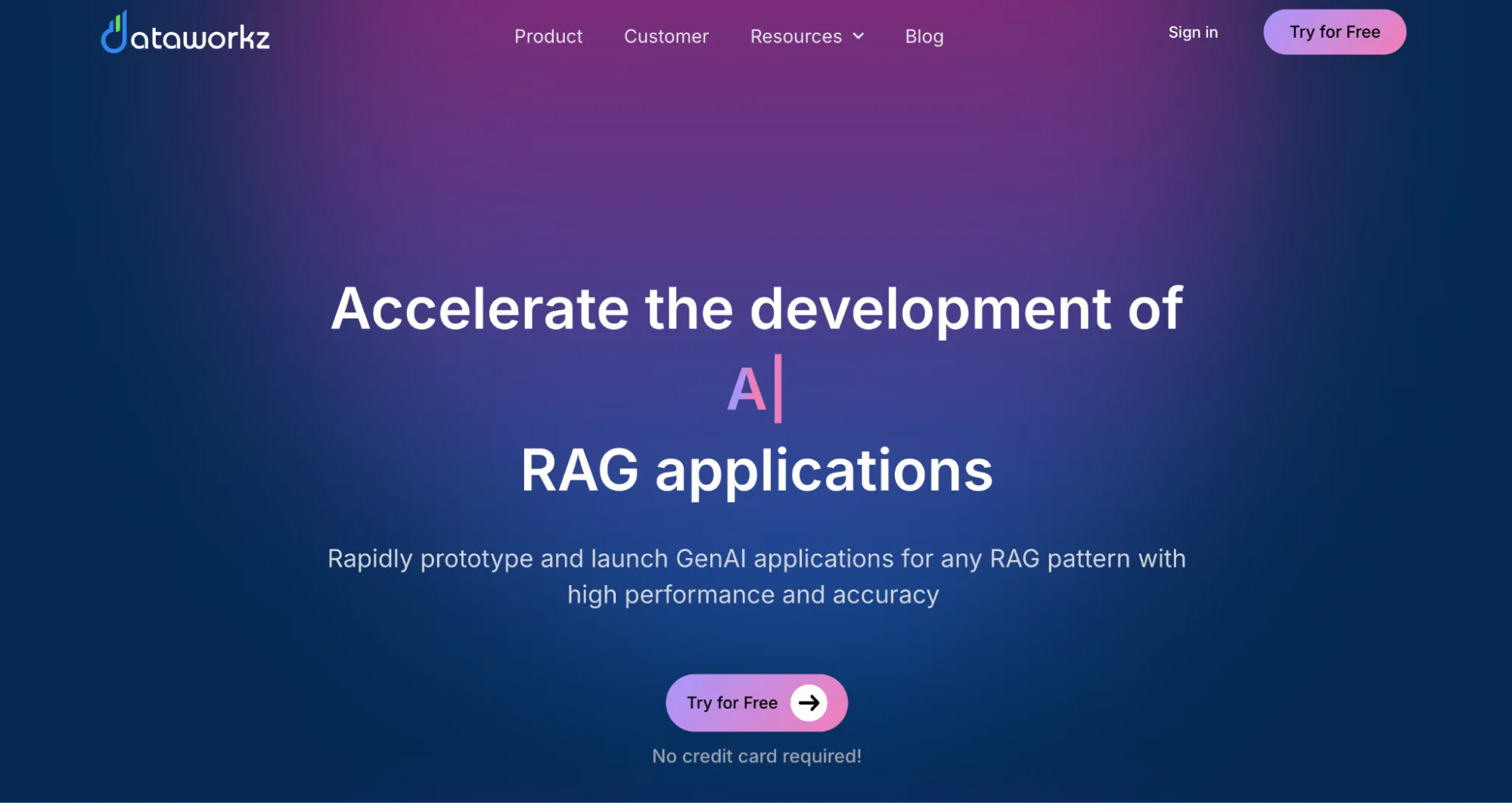
✅ Low-code builder – Set up pipelines, chunking, data sources without heavy coding⚠️ Technical knowledge needed – Understanding embeddings and prompts helps significantly⚠️ No end-user UI – You build front-end while Dataworkz handles back-end logic
✅ 4.8/5 ease of use rating – Visual drag-and-drop editor, no coding required✅ Small learning curve – Non-technical teams productive quickly✅ Pre-built templates – Common scenarios covered for faster creation
2-minute deployment – Fastest time-to-value in the industryWizard interface – Step-by-step with visual previewsDrag-and-drop – Upload files, paste URLs, connect cloud storageIn-browser testing – Test before deploying to productionZero learning curve – Productive on day one
Market position – Enterprise agentic RAG platform with point-and-click pipeline builderTarget customers – Large enterprises with LLMOps expertise building complex AI agentsKey competitors – Deepset Cloud, LangChain/LangSmith, Haystack, Vectara.ai, custom RAG solutionsCore advantages – Model-agnostic, agentic architecture, graph retrieval, no-code builder, MongoDB partnershipBest for – High-volume complex use cases with existing infrastructure and orchestration needs
✅ Unique interactive guide format – Structured support content vs free-form chat✅ 70-76% ticket reduction – 71% self-serve success rate documentedvs CustomGPT: Different categories (knowledge base vs RAG-as-a-Service)Target: Support teams using Zendesk/Salesforce, not RAG developers
Market position – Leading RAG platform balancing enterprise accuracy with no-code usability. Trusted by 6,000+ orgs including Adobe, MIT, Dropbox.Key differentiators – #1 benchmarked accuracy • 1,400+ formats • Full white-labeling included • Flat-rate pricingvs OpenAI – 10% lower hallucination, 13% higher accuracy, 34% fastervs Botsonic/Chatbase – More file formats, source citations, no hidden costsvs LangChain – Production-ready in 2 min vs weeks of development
✅ Model-agnostic – GPT-4, Claude, Llama, open-source models fully supported✅ Public APIs – AWS Bedrock and OpenAI API integration for managed access✅ Private hosting – Host open-source models in your VPC for sovereignty✅ Composable stack – Choose embedding, vector DB, chunking, LLM independently✅ No lock-in – Switch models without platform migration for cost or compliance
⚠️ Undisclosed Proprietary LLM – No model selection or transparency✅ AI Profiles (20) & Custom Instructions (100) – Define tone and boundaries✅ Guided AI Answers – Predefined responses for sensitive scenarios✅ Knowledge-grounded approach – Anchored responses reduce hallucinations
OpenAI – GPT-5.1 (Optimal/Smart), GPT-4 seriesAnthropic – Claude 4.5 Opus/Sonnet (Enterprise)Auto-routing – Intelligent model selection for cost/performanceManaged – No API keys or fine-tuning required
✅ Advanced pipeline builder – Point-and-click RAG configuration with fine-grained control RAG-as-a-Service ✅ Agentic architecture – Multi-step tasks, external tool calls, adaptive reasoning [Agentic RAG] ✅ Hybrid retrieval – Semantic, lexical, graph search for accuracy and context✅ Graph-optimized – Relationship-aware context for interlinked documents [Graph Capabilities] ✅ Dynamic tool selection – Agents choose knowledge base, DB, or API automatically
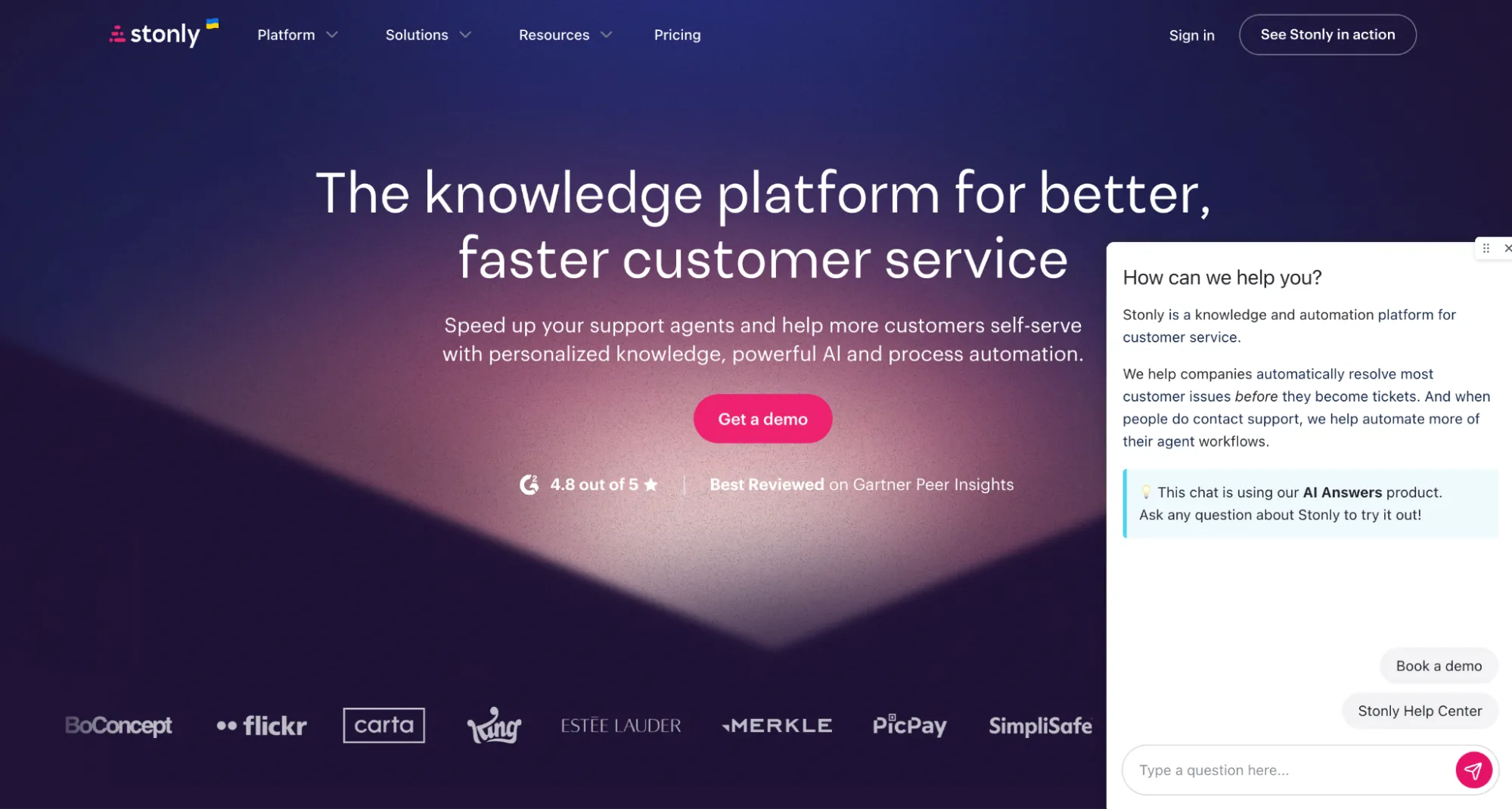
✅ AI Answers (Enterprise add-on) – Grounded in guides, websites, PDFs✅ 71% self-serve success rate – Confidence-based fallback to ML search⚠️ Limited data sources – No Google Drive, Dropbox, Notion, SharePoint, YouTube⚠️ Manual content updates – No automatic syncing from external sources
GPT-4 + RAG – Outperforms OpenAI in independent benchmarksAnti-hallucination – Responses grounded in your content onlyAutomatic citations – Clickable source links in every responseSub-second latency – Optimized vector search and cachingScale to 300M words – No performance degradation at scale
Retail – Product recommendations, inventory queries with structured/unstructured data blending [Retail Case Study] Banking – Regulatory compliance, risk assessment with enterprise security and auditabilityHealthcare – Clinical decision support, medical knowledge bases with HIPAA complianceEnterprise knowledge – Documentation, policy queries with multi-source integration (SharePoint, Confluence, databases)Customer support – Multi-step troubleshooting, automated responses with tool calling and APIsLegal – Contract analysis, regulatory research with audit trails and traceability
✅ Customer support ticket deflection – 70-76% reduction through interactive guides✅ Deep help desk integration – Zendesk, Salesforce, Freshdesk, ServiceNow workflows✅ Interactive onboarding – Step-by-step guides, decision trees, checklists✅ Multi-language support – Auto-translation for global teams (Enterprise)
Customer support – 24/7 AI handling common queries with citationsInternal knowledge – HR policies, onboarding, technical docsSales enablement – Product info, lead qualification, educationDocumentation – Help centers, FAQs with auto-crawlingE-commerce – Product recommendations, order assistance
✅ Enterprise-grade – Encryption, compliance, access controls for large organizations [Security Features] ✅ Audit trails – Every interaction, tool call, data access audited for transparency✅ Data sovereignty – Bring-your-own-infrastructure keeps data in your environment completely✅ Compliance ready – Architecture supports GDPR, HIPAA, SOC 2 through flexible deployment
✅ SOC 2 Type 2, GDPR, HIPAA, ISO 27001 – PCI, CSA Star Level 1✅ Trust Center – trust.stonly.com with documentation, subprocessor lists✅ SAML 2.0 SSO (Enterprise) – IP allowlisting, advanced RBAC, 2FA⚠️ Data residency not documented – May limit certain jurisdiction deployments
SOC 2 Type II + GDPR – Regular third-party audits, full EU compliance256-bit AES encryption – Data at rest; SSL/TLS in transitSSO + 2FA + RBAC – Enterprise access controls with role-based permissionsData isolation – Never trains on customer dataDomain allowlisting – Restrict chatbot to approved domains
⚠️ Custom contracts – Tailored pricing, no public tiers, requires sales engagement✅ Credit-based usage – 2M rows per credit for data movement, usage-based model✅ AWS Marketplace – Available for streamlined enterprise procurement [AWS Marketplace] ✅ BYOI savings – Use existing infrastructure (databases, vector stores) to reduce costs
Basic (Free): 5 guides, 400 views/mo, 1 seat, single languageSmall Business ($249/mo, $199/mo annual): Unlimited guides, 4K views/mo, 5 seats, CSS customizationEnterprise (~$39K/year avg): Custom views, unlimited seats, white-label, SAML SSO, Mobile SDKs⚠️ Overage pricing: +15K views = $200/mo, auto-upgrade after 2 consecutive months
Standard: $99/mo – 10 chatbots, 60M words, 5K items/botPremium: $449/mo – 100 chatbots, 300M words, 20K items/botEnterprise: Custom – SSO, dedicated support, custom SLAs7-day free trial – Full Standard access, no chargesFlat-rate pricing – No per-query charges, no hidden costs
✅ Enterprise onboarding – Tailored solution engineering for large organizations with complex needs✅ Direct engineering support – Engineer-to-engineer technical implementation and optimization assistance✅ Product documentation – Platform setup, pipeline config, agentic workflows covered [Product Docs] ✅ MongoDB partnership – Joint support for Atlas Vector Search and enterprise deployments
✅ 4.8/5 G2 rating (132 reviews) – Ease of use praised consistently✅ Email and chat support – Dedicated support on Enterprise plan✅ Pre-built templates & tutorials – Guides created in under 30 minutes
Documentation hub – Docs, tutorials, API referencesSupport channels – Email, in-app chat, dedicated managers (Premium+)Open-source – Python SDK, Postman, GitHub examplesCommunity – User community + 5,000 Zapier integrations
Limitations & Considerations
⚠️ No built-in UI – API-first platform requires you to build front-end interface⚠️ Technical expertise required – Best for LLMOps teams understanding embeddings, prompts, RAG architecture⚠️ Custom pricing only – No transparent public tiers, requires sales engagement for quotes⚠️ Enterprise focus – May be overkill for small teams or simple chatbot cases⚠️ Infrastructure requirements – BYOI model needs existing cloud infrastructure and data engineering capabilities
⚠️ NOT a RAG-as-a-Service platform – Knowledge base tool with embedded AI⚠️ AI Answers Enterprise-gated – ~$39K/year, not available on $249/mo tier⚠️ Limited data sources – PDF, web, Zendesk only; no cloud storage⚠️ No messaging integrations – Missing Slack, WhatsApp, Telegram, Microsoft TeamsNot ideal for: Pure RAG API, multi-tenant SaaS backends, model customization needs
Managed service – Less control over RAG pipeline vs build-your-ownModel selection – OpenAI + Anthropic only; no Cohere, AI21, open-sourceReal-time data – Requires re-indexing; not ideal for live inventory/pricesEnterprise features – Custom SSO only on Enterprise plan
✅ Agentic RAG – Multi-step reasoning, external tools, adaptive context-based operation [Agentic Capabilities] ✅ Agent memory – Conversational history, user preferences, business context via RAG pipelines✅ DAG task execution – Complex tasks decomposed into interdependent sub-tasks with parallelization [Multi-Step Reasoning] ✅ LLM Compiler – Identifies optimal sub-task sequence with parallel execution when possible✅ External API integration – Create CRM leads, support tickets, trigger actions dynamically [Agent Builder] ✅ Continuous learning – Agent frameworks support context switching and adaptation over time
✅ Knowledge-grounded responses – Verified structured knowledge prevents hallucinations✅ AI Agent Assist – Summarizes tickets, suggests paths, drafts responses✅ Process automation – Define workflows linked to back-office tools✅ 71% self-serve success rate – Personalized knowledge adapts to needs
Custom AI Agents – Autonomous GPT-4/Claude agents for business tasksMulti-Agent Systems – Specialized agents for support, sales, knowledgeMemory & Context – Persistent conversation history across sessionsTool Integration – Webhooks + 5,000 Zapier apps for automationContinuous Learning – Auto re-indexing without manual retraining
R A G-as-a- Service Assessment
Platform type – TRUE RAG-AS-A-SERVICE: Enterprise agentic orchestration layer for custom agentsCore architecture – Model-agnostic with full control over LLM, embeddings, vector DB, chunkingAgentic focus – Autonomous agents with multi-step reasoning, not simple Q&A chatbots [Agentic RAG] Developer experience – Point-and-click builder, sandbox testing, REST/GraphQL API, agent builder UITarget market – Large enterprises with data teams building sophisticated agents requiring deep customizationRAG differentiation – Graph retrieval, hybrid search, threshold tuning, agentic DAG execution
⚠️ NOT a RAG-as-a-Service platform – Knowledge base tool with embedded AI⚠️ Limited data sources – PDF, public web, Zendesk only✅ Strong hallucination controls – Grounded in structured contentBest for: Customer support ticket deflection, not flexible RAG backends
Platform type – TRUE RAG-AS-A-SERVICE with managed infrastructureAPI-first – REST API, Python SDK, OpenAI compatibility, MCP ServerNo-code option – 2-minute wizard deployment for non-developersHybrid positioning – Serves both dev teams (APIs) and business users (no-code)Enterprise ready – SOC 2 Type II, GDPR, WCAG 2.0, flat-rate pricing
Core Knowledge Base Features N/A
✅ Interactive step-by-step guides – Visual flow builder with branching logic✅ Decision trees, checklists, forms – Contact forms and lead capture✅ Content versioning – Side-by-side comparison, instant restore (Business+)✅ Multi-language support – Auto-translation on Enterprise plan
N/A
A I Answers Feature ( Enterprise Only) N/A
⚠️ Enterprise add-on only – Not included in Small Business plan✅ Generative AI grounded – Anchored in Stonly guides, websites, PDFs✅ Confidence-based fallback – Switches to ML-powered search when confidence low✅ 71% self-serve success rate – Hallucination reduction through knowledge-grounding
N/A










Join the Discussion
Loading comments...