In this comprehensive guide, we compare Glean and SciPhi across various parameters including features, pricing, performance, and customer support to help you make the best decision for your business needs.
Overview
When choosing between Glean and SciPhi, understanding their unique strengths and architectural differences is crucial for making an informed decision. Both platforms serve the RAG (Retrieval-Augmented Generation) space but cater to different use cases and organizational needs.
Quick Decision Guide
Choose Glean if: you value permissions-aware ai is genuinely differentiated - real-time enforcement across 100+ datasources addresses critical enterprise concern
Choose SciPhi if: you value state-of-the-art retrieval accuracy
About Glean
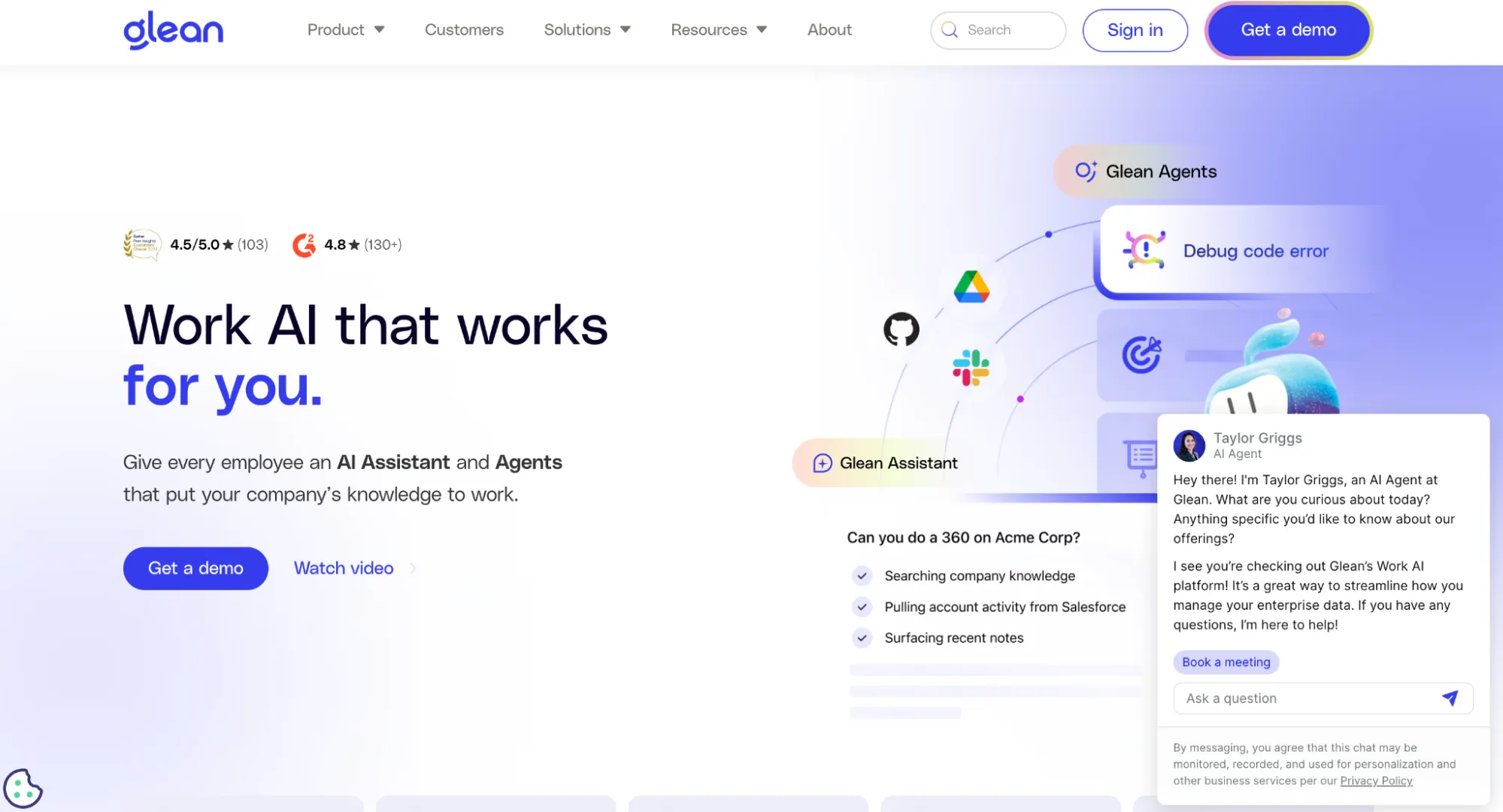
Glean is enterprise work ai with permissions-aware rag across 100+ apps. Glean is a premium enterprise RAG platform with permissions-aware AI as its core differentiator. Founded by ex-Google Search engineers, Glean achieved $100M ARR in three years and a $7.2B valuation (2025). It connects 100+ enterprise apps with real-time access controls, supports 15+ LLMs, and offers comprehensive APIs with 4-language SDKs. Trade-offs: enterprise-only sales (~$50/user/month, ~$60K minimum), no consumer messaging channels, and premium positioning over plug-and-play simplicity. Founded in 2019, headquartered in Palo Alto, CA, the platform has established itself as a reliable solution in the RAG space.
Overall Rating
96/100
Starting Price
$50/mo
About SciPhi
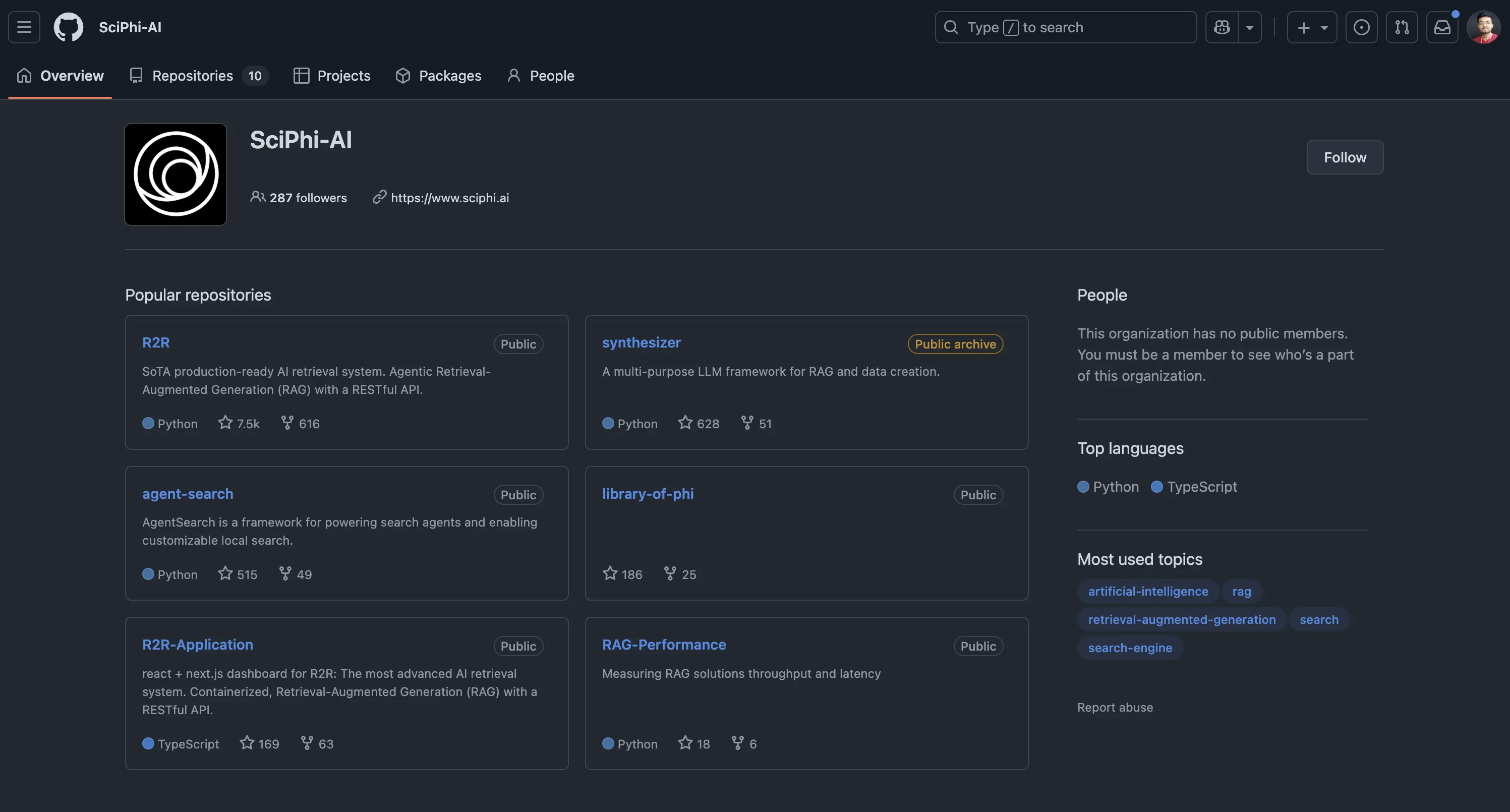
SciPhi is the most advanced ai retrieval system. R2R is a production-ready AI retrieval system supporting Retrieval-Augmented Generation with advanced features including multimodal ingestion, hybrid search, knowledge graphs, and a Deep Research API for multi-step reasoning across documents and the web. Founded in 2023, headquartered in San Francisco, CA, the platform has established itself as a reliable solution in the RAG space.
Overall Rating
89/100
Starting Price
Custom
Key Differences at a Glance
In terms of user ratings, Glean in overall satisfaction. From a cost perspective, SciPhi offers more competitive entry pricing. The platforms also differ in their primary focus: Enterprise RAG versus RAG Platform. These differences make each platform better suited for specific use cases and organizational requirements.
⚠️ What This Comparison Covers
We'll analyze features, pricing, performance benchmarks, security compliance, integration capabilities, and real-world use cases to help you determine which platform best fits your organization's needs. All data is independently verified from official documentation and third-party review platforms.
Detailed Feature Comparison
Glean
SciPhi
CustomGPTRECOMMENDED
Data Ingestion & Knowledge Sources
100+ native connectors covering major enterprise categories
Cloud Storage: Google Drive, SharePoint, OneDrive, Dropbox, Box
Communication: Slack, Microsoft Teams, Gmail, Outlook, Zoom
Indexing API: 10 requests/second for bulk operations, ProcessAll limited to once per 3 hours
Handles 40 + formats—from PDFs and spreadsheets to audio—at massive scale
Reference.
Async ingest auto-scales, crunching millions of tokens per second—perfect for giant corpora
Benchmark details.
Ingest via code or API, so you can tap proprietary databases or custom pipelines with ease.
Lets you ingest more than 1,400 file formats—PDF, DOCX, TXT, Markdown, HTML, and many more—via simple drag-and-drop or API.
Crawls entire sites through sitemaps and URLs, automatically indexing public help-desk articles, FAQs, and docs.
Turns multimedia into text on the fly: YouTube videos, podcasts, and other media are auto-transcribed with built-in OCR and speech-to-text.
View Transcription Guide
Connects to Google Drive, SharePoint, Notion, Confluence, HubSpot, and more through API connectors or Zapier.
See Zapier Connectors
Supports both manual uploads and auto-sync retraining, so your knowledge base always stays up to date.
L L M Model Options
Model Hub supports 15+ LLMs across multiple hosting providers
OpenAI: GPT-3.5, GPT-4
Azure OpenAI: GPT models
Google Vertex AI: Gemini 1.5 Pro
Amazon Bedrock: Claude 3 Sonnet
Per-step model selection: Different LLMs for each workflow step
Temperature controls: Factual, balanced, or creative output settings
Model tiers: Basic, Standard, Premium (premium consumes FlexCredits on Enterprise Flex)
Two access options: Glean Universal Key (managed) or Customer Key (BYOK)
Zero data retention: Customer data never used for model training
Automatic model updates: Deprecated models replaced with latest versions
Automatic routing: Optimizes using best-in-class models per query type
LLM-agnostic—GPT-4, Claude, Llama 2, you choose.
Pick, fine-tune, or swap models anytime to balance cost and performance
Model options.
Taps into top models—OpenAI’s GPT-4, GPT-3.5 Turbo, and even Anthropic’s Claude for enterprise needs.
Automatically balances cost and performance by picking the right model for each request.
Model Selection Details
Uses proprietary prompt engineering and retrieval tweaks to return high-quality, citation-backed answers.
Handles all model management behind the scenes—no extra API keys or fine-tuning steps for you.
Performance & Accuracy
74% human-agreement rate on AI Evaluator benchmarks
25% precision increases reported in customer case studies
20% response time decreases documented
141% ROI over 3 years (Forrester Total Economic Impact study)
$15.6M NPV for composite organizations
110 hours saved per employee annually
AI Evaluator metrics: Context relevance, recall, answer relevance, completeness, groundedness
Embeddings control: Via Indexing API and custom datasources
Performance benchmarks: Strong (Forrester TEI, customer case studies)
Permissions & governance: Best-in-class (real-time enforcement, Active Data Governance)
Best for: Large enterprises requiring permissions-aware RAG with compliance needs
Not ideal for: SMBs with budget constraints, teams needing consumer messaging channels
Platform Type: HYBRID RAG-AS-A-SERVICE - combines open-source R2R framework with SciPhi Cloud managed service for enterprise deployments
Core Mission: Bridge gap between experimental RAG models and production-ready systems with straightforward path to deploy, adapt, and maintain RAG pipelines
Developer Target Market: Built by and for OSS community to help startups and enterprises quickly build with RAG - emphasizes developer flexibility and control
Deployment Flexibility: Free tier + $25/month Dev tier, Enterprise plans with custom pricing and self-hosting options - unique among RAG platforms for offering both managed and on-premise
RAG Technology Leadership: HybridRAG (knowledge graph boosting for 150% accuracy improvement), async auto-scaling to millions of tokens/second, 40+ format support including audio at massive scale, sub-second latency
Open-Source Advantage: Complete transparency with R2R core on GitHub, enables customization and portability, avoids vendor lock-in while offering managed cloud option
Enterprise Features: Multimodal ingestion, agentic RAG with reasoning agents, document-level security, comprehensive observability, customer-managed encryption for self-hosted deployments
API-First Architecture: REST API + Python client (R2RClient) with extensive documentation, sample code, GitHub repos for deep integration control
LIMITATION vs No-Code Platforms: NO native chat widgets, Slack/WhatsApp integrations, visual agent builders, or pre-built analytics dashboards - developer-first approach requires technical resources
Comparison Validity: Architectural comparison to CustomGPT.ai is VALID but highlights different priorities - SciPhi developer infrastructure with self-hosting vs CustomGPT likely more accessible no-code deployment
Use Case Fit: Enterprises processing massive document volumes requiring async auto-scaling, development teams needing advanced RAG (HybridRAG, knowledge graphs) for accuracy improvements, organizations wanting open-source foundation with self-hosting for complete control
NOT Ideal For: Non-technical teams requiring no-code chatbot builders, businesses needing immediate deployment without developer involvement, organizations seeking turnkey UI widgets and integrations
Core Architecture: Serverless RAG infrastructure with automatic embedding generation, vector search optimization, and LLM orchestration fully managed behind API endpoints
API-First Design: Comprehensive REST API with well-documented endpoints for creating agents, managing projects, ingesting data (1,400+ formats), and querying chat
API Documentation
Developer Experience: Open-source Python SDK (customgpt-client), Postman collections, OpenAI API endpoint compatibility, and extensive cookbooks for rapid integration
No-Code Alternative: Wizard-style web dashboard enables non-developers to upload content, brand widgets, and deploy chatbots without touching code
Hybrid Target Market: Serves both developer teams wanting robust APIs AND business users seeking no-code RAG deployment - unique positioning vs pure API platforms (Cohere) or pure no-code tools (Jotform)
RAG Technology Leadership: Industry-leading answer accuracy (median 5/5 benchmarked), 1,400+ file format support with auto-transcription, proprietary anti-hallucination mechanisms, and citation-backed responses
Benchmark Details
Deployment Flexibility: Cloud-hosted SaaS with auto-scaling, API integrations, embedded chat widgets, ChatGPT Plugin support, and hosted MCP Server for Claude/Cursor/ChatGPT
Enterprise Readiness: SOC 2 Type II + GDPR compliance, full white-labeling, domain allowlisting, RBAC with 2FA/SSO, and flat-rate pricing without per-query charges
Use Case Fit: Ideal for organizations needing both rapid no-code deployment AND robust API capabilities, teams handling diverse content types (1,400+ formats, multimedia transcription), and businesses requiring production-ready RAG without building ML infrastructure from scratch
Competitive Positioning: Bridges the gap between developer-first platforms (Cohere, Deepset) requiring heavy coding and no-code chatbot builders (Jotform, Kommunicate) lacking API depth - offers best of both worlds
Competitive Positioning
vs CustomGPT: Enterprise-premium vs developer-friendly; permissions-aware AI vs flexible customization
vs Zendesk: Enterprise search + RAG vs customer service platform
Unique strength: Real-time permissions-aware AI across 100+ datasources (no competitor matches this)
Target audience: Large enterprises (1K-100K users) with complex permission hierarchies
Pricing barrier: ~$50/user/month with ~$60K minimum excludes SMBs
Enterprise focus: Security, governance, compliance over plug-and-play simplicity
Market position: Developer-first RAG infrastructure (R2R framework) combining open-source flexibility with managed cloud service, specializing in enterprise-scale performance and advanced RAG techniques
Target customers: Development teams building high-performance RAG applications, enterprises requiring massive-scale ingestion (millions of tokens/second), and organizations wanting HybridRAG with knowledge graph capabilities for 150% accuracy improvements
Key competitors: LangChain/LangSmith, Deepset/Haystack, Pinecone Assistant, and custom RAG implementations
Competitive advantages: Async ingest auto-scaling to millions of tokens/second, 40+ format support including audio at massive scale, HybridRAG with knowledge-graph boosting (up to 150% better accuracy), sub-second latency even at enterprise scale, LLM-agnostic with easy model swapping (GPT-4, Claude, Llama 2), open-source R2R core for transparency and portability, and self-hosting options for complete control
Pricing advantage: Free tier plus $25/month Dev tier for experiments; enterprise plans with custom pricing and self-hosting; open-source foundation enables cost savings for teams with infrastructure expertise; best value for high-volume applications requiring enterprise-scale performance
Use case fit: Perfect for enterprises processing massive document volumes requiring async auto-scaling ingestion, development teams needing advanced RAG techniques (HybridRAG, knowledge graphs) for accuracy improvements, and organizations wanting open-source foundation with option to self-host for complete control and cost optimization
Market position: Leading all-in-one RAG platform balancing enterprise-grade accuracy with developer-friendly APIs and no-code usability for rapid deployment
Target customers: Mid-market to enterprise organizations needing production-ready AI assistants, development teams wanting robust APIs without building RAG infrastructure, and businesses requiring 1,400+ file format support with auto-transcription (YouTube, podcasts)
Key competitors: OpenAI Assistants API, Botsonic, Chatbase.co, Azure AI, and custom RAG implementations using LangChain
Competitive advantages: Industry-leading answer accuracy (median 5/5 benchmarked), 1,400+ file format support with auto-transcription, SOC 2 Type II + GDPR compliance, full white-labeling included, OpenAI API endpoint compatibility, hosted MCP Server support (Claude, Cursor, ChatGPT), generous data limits (60M words Standard, 300M Premium), and flat monthly pricing without per-query charges
Pricing advantage: Transparent flat-rate pricing at $99/month (Standard) and $449/month (Premium) with generous included limits; no hidden costs for API access, branding removal, or basic features; best value for teams needing both no-code dashboard and developer APIs in one platform
Use case fit: Ideal for businesses needing both rapid no-code deployment and robust API capabilities, organizations handling diverse content types (1,400+ formats, multimedia transcription), teams requiring white-label chatbots with source citations for customer-facing or internal knowledge projects, and companies wanting all-in-one RAG without managing ML infrastructure
A I Models
Model Hub supports 15+ LLMs across multiple hosting providers with per-step model selection
OpenAI: GPT-3.5, GPT-4 via OpenAI or Azure OpenAI endpoints
Google Vertex AI: Gemini 1.5 Pro with multimodal capabilities
Amazon Bedrock: Claude 3 Sonnet for high-accuracy enterprise use cases
Temperature controls: Factual, balanced, or creative output settings per workflow
Model tiers: Basic, Standard, Premium (premium consumes FlexCredits on Enterprise Flex plan)
Two access options: Glean Universal Key (managed) or Customer Key (BYOK) for data sovereignty
Zero data retention: Customer data never used for model training with automatic model updates
Automatic routing: Optimizes using best-in-class models per query type for accuracy and cost
LLM-Agnostic Architecture: Supports GPT-4, GPT-3.5-turbo, Claude (Anthropic), Llama 2, and other open-source models
Model Flexibility: Easy model swapping to balance cost and performance without vendor lock-in
Custom Model Support: Configure any LLM via API, including fine-tuned or proprietary models
Embedding Models: Supports multiple embedding providers for semantic search and vector generation
Model Configuration: Full control over temperature, max tokens, and other generation parameters
Primary models: GPT-4, GPT-3.5 Turbo from OpenAI, and Anthropic's Claude for enterprise needs
Automatic model selection: Balances cost and performance by automatically selecting the appropriate model for each request
Model Selection Details
Proprietary optimizations: Custom prompt engineering and retrieval enhancements for high-quality, citation-backed answers
Managed infrastructure: All model management handled behind the scenes - no API keys or fine-tuning required from users
Anti-hallucination technology: Advanced mechanisms ensure chatbot only answers based on provided content, improving trust and factual accuracy
R A G Capabilities
Hybrid search: Combines semantic (vector-based) and lexical (keyword) approaches for maximum accuracy
Knowledge Graph Framework: Proprietary anchors and signals across enterprise data with rich, scalable crawler
LLM Control Layer: Optimizes and controls LLM outputs with permission-safe document retrieval and ranking
Real-time permissions enforcement: Users only see authorized content with identity crawling and connector-level permission mirroring
Context-aware query rewriting: LLM determines optimal query set with enterprise-specific rewrites
Hallucination prevention: RAG grounding, permission-aware retrieval, citation/source attribution for every answer
74% human-agreement rate on AI Evaluator benchmarks with 25% precision increases in customer case studies
141% ROI over 3 years: $15.6M NPV for composite organizations, 110 hours saved per employee annually (Forrester)
Permissions-aware AI (unique): Real-time access control enforcement across all 100+ datasources - no competitor matches this capability
HybridRAG Technology: Combines vector search with knowledge graphs for up to 150% accuracy improvement over traditional RAG
Hybrid Search: Dense vector retrieval + keyword search with reciprocal rank fusion for optimal precision
Knowledge Graph Extraction: Automatic entity and relationship mapping enriches context across documents
Agentic RAG: Reasoning agent integrated with retrieval for autonomous research across documents and web
Multimodal Ingestion: Process 40+ formats including PDFs, spreadsheets, audio files at massive scale
Async Auto-Scaling: Millions of tokens per second ingestion throughput for enterprise document volumes
Sub-Second Latency: Fast retrieval even at enterprise scale with optimized vector operations
Core architecture: GPT-4 combined with Retrieval-Augmented Generation (RAG) technology, outperforming OpenAI in RAG benchmarks
RAG Performance
Anti-hallucination technology: Advanced mechanisms reduce hallucinations and ensure responses are grounded in provided content
Benchmark Details
Automatic citations: Each response includes clickable citations pointing to original source documents for transparency and verification
Optimized pipeline: Efficient vector search, smart chunking, and caching for sub-second reply times
Scalability: Maintains speed and accuracy for massive knowledge bases with tens of millions of words
Context-aware conversations: Multi-turn conversations with persistent history and comprehensive conversation management
Source verification: Always cites sources so users can verify facts on the spot
Use Cases
Enterprise knowledge retrieval: Unified search across 100+ datasources (Google Drive, SharePoint, Confluence, Salesforce, Zendesk, GitHub, Slack) for 10K-100K user organizations
Permissions-aware search: Complex permission hierarchies requiring real-time enforcement - healthcare, finance, legal industries with sensitive data access controls
AI agents and automation: 30+ prebuilt agents for sales, engineering, IT, HR use cases with workflow automation capabilities
Developer-friendly RAG: Official SDKs (Python, Java, Go, TypeScript), LangChain integration, MCP Server for Claude Desktop/Cursor/VS Code
Active Data Governance: Continuous scanning with 100+ predefined infotypes (PII, PCI, M&A) and customizable policies with auto-hide
Cloud-Prem deployment: Customer-hosted in AWS or GCP for regulated industries requiring full data residency control
NOT suitable for: SMBs with <100 users or <$60K budgets, simple document Q&A without permission requirements, consumer messaging channels (WhatsApp, Telegram)
Enterprise Knowledge Management: Process and search across millions of documents with knowledge graph relationships
Customer Support Automation: Build RAG-powered support bots with accurate, grounded responses
Research & Analysis: Agentic RAG capabilities for autonomous research across document collections and web
Compliance & Legal: Search and analyze large document repositories with precise citation tracking
Internal Documentation: Developer-focused RAG for code documentation, API references, and technical knowledge bases
Custom AI Applications: API-first architecture enables integration into any custom application or workflow
Customer support automation: AI assistants handling common queries, reducing support ticket volume, providing 24/7 instant responses with source citations
Internal knowledge management: Employee self-service for HR policies, technical documentation, onboarding materials, company procedures across 1,400+ file formats
Sales enablement: Product information chatbots, lead qualification, customer education with white-labeled widgets on websites and apps
Documentation assistance: Technical docs, help centers, FAQs with automatic website crawling and sitemap indexing
Educational platforms: Course materials, research assistance, student support with multimedia content (YouTube transcriptions, podcasts)
Healthcare information: Patient education, medical knowledge bases (SOC 2 Type II compliant for sensitive data)
FlexCredits (Enterprise Flex): For premium LLM usage with consumption-based billing
Support tiers: Standard (24x5, included) or Premium (24x7 critical, additional fee)
Dedicated CSMs: Assigned to enterprise accounts with regular business reviews and hands-on onboarding
Pricing barrier: Excludes SMBs and startups - targets Fortune 500 and mid-market enterprises with 1K-100K users
Free Tier: Generous free tier requiring no credit card for experimentation and development
Developer Plan: $25/month for individual developers and small projects
Enterprise Plans: Custom pricing based on scale, features, and support requirements
Self-Hosting: Open-source R2R available for free self-hosting (infrastructure costs only)
Managed Cloud: SciPhi handles infrastructure, deployment, scaling, updates, and maintenance
No Per-Request Fees: Flat subscription pricing without per-query or per-document charges
Cost Optimization: Self-hosting option enables cost savings for teams with infrastructure expertise
Standard Plan: $99/month or $89/month annual - 10 custom chatbots, 5,000 items per chatbot, 60 million words per bot, basic helpdesk support, standard security
View Pricing
Premium Plan: $499/month or $449/month annual - 100 custom chatbots, 20,000 items per chatbot, 300 million words per bot, advanced support, enhanced security, additional customization
Enterprise Plan: Custom pricing - Comprehensive AI solutions, highest security and compliance, dedicated account managers, custom SSO, token authentication, priority support with faster SLAs
Enterprise Solutions
7-Day Free Trial: Full access to Standard features without charges - available to all users
Annual billing discount: Save 10% by paying upfront annually ($89/mo Standard, $449/mo Premium)
Flat monthly rates: No per-query charges, no hidden costs for API access or white-labeling (included in all plans)
Managed infrastructure: Auto-scaling cloud infrastructure included - no additional hosting or scaling fees
Support & Documentation
Standard support: 24x5 (Mon-Fri) via portal, email, Slack Connect channels
Premium support: 24x7 for critical issues with additional fee
Dedicated CSMs: Enterprise accounts with hands-on onboarding and regular business reviews
Excellent documentation: developers.glean.com with OpenAPI specs, CodeSandbox demos, comprehensive API references
Official SDKs: Python (pip install glean), Java (Maven), Go, TypeScript with async support and framework integrations
Web SDK: @gleanwork/web-sdk for embeddable components (chat, search, autocomplete, recommendations)
GitHub repositories: github.com/gleanwork with SDK repositories and sample projects
NO FedRAMP certification: Not suitable for US federal government deployments
Limited consumer channels: No native WhatsApp, Telegram integrations - designed for internal enterprise use only
Complex implementation: Initial indexing takes "few days" depending on data volume, requires enterprise IT coordination
Cross-language queries in early access: English query finding Spanish documents still in testing phase
Best for: Large enterprises (1K-100K users) with complex permission hierarchies, $60K+ budgets, and need for permissions-aware AI across 100+ datasources
NOT suitable for: SMBs, startups, simple document Q&A without permission requirements, organizations prioritizing transparent pricing
Developer-Focused: No no-code UI—requires technical expertise to build and wire custom front ends
Infrastructure Requirements: Self-hosting requires GPU infrastructure and DevOps expertise
Integration Effort: API-first design means building your own chat UI and user experience
Learning Curve: Advanced features like knowledge graphs and agentic RAG require understanding of RAG concepts
No Pre-Built Widgets: Unlike plug-and-play chatbot platforms, requires custom implementation
Community Support Limits: Open-source support relies on community unless on enterprise plan
Managed vs Self-Hosted Trade-offs: Cloud convenience vs self-hosting control requires careful evaluation
Managed service approach: Less control over underlying RAG pipeline configuration compared to build-your-own solutions like LangChain
Vendor lock-in: Proprietary platform - migration to alternative RAG solutions requires rebuilding knowledge bases
Model selection: Limited to OpenAI (GPT-4, GPT-3.5) and Anthropic (Claude) - no support for other LLM providers (Cohere, AI21, open-source models)
Pricing at scale: Flat-rate pricing may become expensive for very high-volume use cases (millions of queries/month) compared to pay-per-use models
Customization limits: While highly configurable, some advanced RAG techniques (custom reranking, hybrid search strategies) may not be exposed
Language support: Supports 90+ languages but performance may vary for less common languages or specialized domains
Real-time data: Knowledge bases require re-indexing for updates - not ideal for real-time data requirements (stock prices, live inventory)
Enterprise features: Some advanced features (custom SSO, token authentication) only available on Enterprise plan with custom pricing
Core Agent Features
Autonomous AI agents: Agents use AI to understand tasks and take action on behalf of users from answering questions and retrieving information to executing work autonomously
Natural language agent builder: Build agents by describing desired output in simple natural language - Glean understands goal and designs complex multi-step workflows
Agentic reasoning engine: LLM-agnostic engine enables agents to go beyond retrieval and generation - powers sophisticated automation and decision-making by understanding outcomes, building multi-step plans, and using action library
100+ native actions: Supports 100+ new native actions across Slack, Microsoft Teams, Salesforce, Jira, GitHub, Google Workspace and other applications
MCP host support: Gives agents dramatically larger surface area to operate across enterprise applications
Human-in-the-loop design: Agents can autonomously do work end-to-end with human review checkpoints - process customer support tickets, conduct research, prepare responses for employee review before execution
Vibe coding: Upgraded builder makes agent creation as simple as chatting - anyone (not just developers) can create and refine agents without understanding or interacting with code
Grounded in enterprise data: Autonomous agents grounded in most relevant authoritative information for confident work automation
Automatic agent triggering: Orchestrates agents automatically based on schedules or events and surfaces agent recommendations across enterprise
Visual and conversational workflow design: Turn ideas into structured workflows using simple natural language prompts or visual builder
Agentic RAG: Reasoning agent integrated with retrieval for autonomous research across documents and web with multi-step problem solving
Conversational Interface: Complex information retrieval maintaining context across multiple interactions via conversation_id for stateful dialogues
Multi-Turn Context Management: Agent remembers previous interactions and builds upon conversation history for follow-up questions
Deep Research API: Multi-step reasoning system fetching data from knowledgebase and/or internet for rich, context-aware answers to complex queries
Tool Orchestration: Dynamic tool invocation with intelligent routing based on query characteristics and context requirements
Citation Transparency: Detailed responses with citations to source material for fact-checking and verification
LIMITATION - No Pre-Built Chat UI: API-first platform requiring developers to build custom conversational interfaces - not a turnkey chatbot solution
LIMITATION - No Lead Capture/Analytics: Focuses on knowledge retrieval infrastructure - lead generation, dashboards, and human handoff must be implemented at application layer
Custom AI Agents: Build autonomous agents powered by GPT-4 and Claude that can perform tasks independently and make real-time decisions based on business knowledge
Decision-Support Capabilities: AI agents analyze proprietary data to provide insights, recommendations, and actionable responses specific to your business domain
Multi-Agent Systems: Deploy multiple specialized AI agents that can collaborate and optimize workflows in areas like customer support, sales, and internal knowledge management
Memory & Context Management: Agents maintain conversation history and persistent context for coherent multi-turn interactions
View Agent Documentation
Tool Integration: Agents can trigger actions, integrate with external APIs via webhooks, and connect to 5,000+ apps through Zapier for automated workflows
Hyper-Accurate Responses: Leverages advanced RAG technology and retrieval mechanisms to deliver context-aware, citation-backed responses grounded in your knowledge base
Continuous Learning: Agents improve over time through automatic re-indexing of knowledge sources and integration of new data without manual retraining
Additional Considerations
Cannot create content directly: Glean focuses purely on search and retrieval - not suitable for organizations needing content creation within platform
Platform designed for large organizations: Feature set and pricing optimized for large enterprises - smaller teams may find it overkill and less cost-effective
AI production challenges: 68% of organizations report moving only 30% or fewer AI experiments into full production highlighting persistent scaling difficulties beyond proof-of-concept
Integration complexity: Requires strategic overhaul of processes to ensure seamless technology incorporation into existing workflows
Change management: Overcoming resistance to change demands strong leadership and commitment to fostering innovation and adaptability environment
Data reliability monitoring: Potential for inaccuracies in AI outputs necessitates rigorous monitoring frameworks to ensure data reliability and trustworthiness
Cybersecurity concerns: As AI deployment expands, cybersecurity threats become more pronounced requiring enhanced protective measures for sensitive information
Bias in AI models: Models can inadvertently learn and replicate biases in training data leading to unfair or discriminatory outcomes particularly in hiring, customer service, legal decisions
Training investment required: Enterprises must invest in training workforce to effectively use AI tools - upskilling employees, hiring AI talent, or partnering with consultants
Security risks and shadow IT: Many organizations hesitate due to uncertainties from security risks and shadow IT - ad hoc generative AI adoption comes with heavy risks and costs
Advanced extras like GraphRAG and agentic flows push beyond basic Q&A
Great fit for enterprises needing deeply customized, fully integrated AI solutions.
Slashes engineering overhead with an all-in-one RAG platform—no in-house ML team required.
Gets you to value quickly: launch a functional AI assistant in minutes.
Stays current with ongoing GPT and retrieval improvements, so you’re always on the latest tech.
Balances top-tier accuracy with ease of use, perfect for customer-facing or internal knowledge projects.
Core Chatbot Features
Glean Chat interface: Primary interface for interacting with Glean Assistant offering familiar chat-like experience enabling natural conversations with company knowledge base
Multi-turn conversations: Supports conversational AI with natural language and context awareness maintaining context across conversation turns
Streaming responses: Real-time response streaming for better user experience with automatic source citations for transparency
Chatbot context understanding: Understands thread and sequence of conversations tracking references like "their" and "they" across multiple exchanges
Enterprise knowledge integration: Works across all company apps and knowledge sources including Microsoft 365, Google Workspace, Salesforce, Jira, GitHub and nearly 100 more applications
Personalization and security: Delivers answers highly customized to each user based on deep understanding of company content, employees, and activity while adhering to real-time enterprise data permissions and governance rules
Citation and transparency: Provides full linking to source information across documents, conversations and applications for transparency and trust
Simple chatbot API: Powerful tool for integrating conversational AI into products creating custom conversational interfaces leveraging Glean's AI capabilities
Use case flexibility: Build chatbots answering customer questions using help documentation, FAQs, knowledge bases or create internal tools helping employees find company policies, procedures, documentation
Core RAG engine serves retrieval-grounded answers; hook it to your UI for multi-turn chat.
Multi-lingual if the LLM you pick supports it.
Lead-capture or human handoff flows are yours to build through the API.
Reduces hallucinations by grounding replies in your data and adding source citations for transparency.
Benchmark Details
Handles multi-turn, context-aware chats with persistent history and solid conversation management.
Speaks 90+ languages, making global rollouts straightforward.
Includes extras like lead capture (email collection) and smooth handoff to a human when needed.
After analyzing features, pricing, performance, and user feedback, both Glean and SciPhi are capable platforms that serve different market segments and use cases effectively.
When to Choose Glean
You value permissions-aware ai is genuinely differentiated - real-time enforcement across 100+ datasources addresses critical enterprise concern
Model flexibility without vendor lock-in - 15+ LLMs with per-step selection and bring-your-own-key option
Best For: Permissions-aware AI is genuinely differentiated - real-time enforcement across 100+ datasources addresses critical enterprise concern
When to Choose SciPhi
You value state-of-the-art retrieval accuracy
Open-source with strong community
Production-ready with proven scalability
Best For: State-of-the-art retrieval accuracy
Migration & Switching Considerations
Switching between Glean and SciPhi requires careful planning. Consider data export capabilities, API compatibility, and integration complexity. Both platforms offer migration support, but expect 2-4 weeks for complete transition including testing and team training.
Pricing Comparison Summary
Glean starts at $50/month, while SciPhi begins at custom pricing. Total cost of ownership should factor in implementation time, training requirements, API usage fees, and ongoing support. Enterprise deployments typically see annual costs ranging from $10,000 to $500,000+ depending on scale and requirements.
Our Recommendation Process
Start with a free trial - Both platforms offer trial periods to test with your actual data
Define success metrics - Response accuracy, latency, user satisfaction, cost per query
Test with real use cases - Don't rely on generic demos; use your production data
Evaluate total cost - Factor in implementation time, training, and ongoing maintenance
Check vendor stability - Review roadmap transparency, update frequency, and support quality
For most organizations, the decision between Glean and SciPhi comes down to specific requirements rather than overall superiority. Evaluate both platforms with your actual data during trial periods, focusing on accuracy, latency, ease of integration, and total cost of ownership.
📚 Next Steps
Ready to make your decision? We recommend starting with a hands-on evaluation of both platforms using your specific use case and data.
• Review: Check the detailed feature comparison table above
• Test: Sign up for free trials and test with real queries
• Calculate: Estimate your monthly costs based on expected usage
• Decide: Choose the platform that best aligns with your requirements
Last updated: December 4, 2025 | This comparison is regularly reviewed and updated to reflect the latest platform capabilities, pricing, and user feedback.
The most accurate RAG-as-a-Service API. Deliver production-ready reliable RAG applications faster. Benchmarked #1 in accuracy and hallucinations for fully managed RAG-as-a-Service API.
DevRel at CustomGPT.ai. Passionate about AI and its applications. Here to help you navigate the world of AI tools and make informed decisions for your business.
People Also Compare
Explore more AI tool comparisons to find the perfect solution for your needs

Join the Discussion
Loading comments...